Astronomers at the University of Sydney have found a slimmer type of red giant star for the first time. These stars have undergone dramatic weight loss, possibly due to the presence a greedy neighbour. Published in Nature Astronomy, the discovery is an important step forward to understanding the life of stars in the Milky Way – our closest stellar neighbours.
There are millions of ‘red giant’ stars found in our galaxy. These cool and luminous objects are what our Sun will become in four billion years. For some time, astronomers have predicted the existence of slimmer red giants. After finding a smattering of them, the University of Sydney team can finally confirm their existence.
“It’s like finding Waldo,” said lead author, PhD candidate Mr Yaguang Li from the University of Sydney. “We were extremely lucky to find about 40 slimmer red giants, hidden in a sea of normal ones. The slimmer red giants are either smaller in size or less massive than normal red giants.”
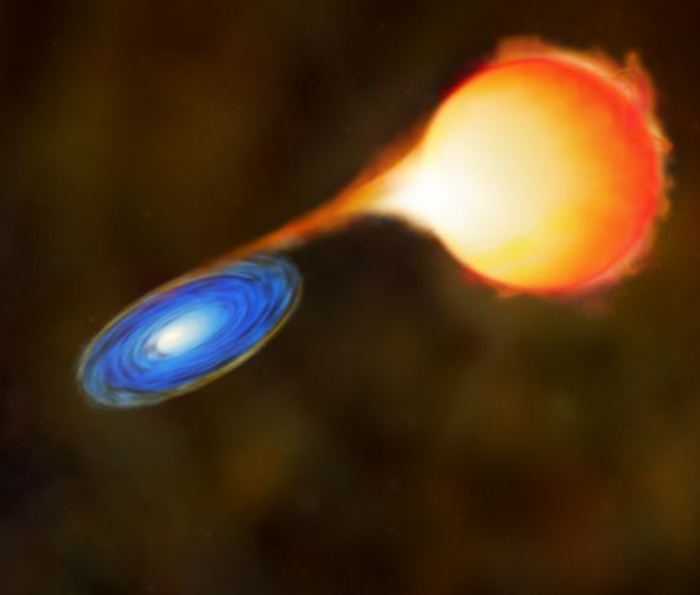
How and why did they slim down? Most stars in the sky are in binary systems – two stars that are gravitationally bound to each other. When the stars in close binaries expand, as stars do as they age, some material can reach the gravitational sphere of their companion and be sucked away. “In the case of relatively tiny red giants, we think a companion could possibly be present,” Mr Li said.
An intragalactic treasure hunt
The team analysed archival data from NASA’s Kepler space telescope. From 2009 to 2013, the telescope continuously recorded brightness variations on tens of thousands of red giants. Using this incredibly accurate and large dataset, the team conducted a thorough census of this stellar population, providing the groundwork for spotting any outliers.
Two types of unusual stars were revealed: very low-mass red giants, and underluminous (dimmer) red giants.
The very low-mass stars weigh only 0.5 to 0.7 solar mass – around half the weight of our Sun. If the very low-mass stars had not suddenly lost weight, their masses would indicate they were older than the age of the Universe – an impossibility.
“So, when we first obtained the masses of these stars, we thought there was something wrong with the measurement,” Mr Li said. “But it turns out there wasn’t.”
The underluminous stars, on the other hand, have normal masses, ranging from 0.8 to 2.0 solar mass. “However, they are much less ‘giant’ than we expect,” said study co-author, Dr Simon Murphy from the University of Southern Queensland. “They’ve slimmed down somewhat and because they’re smaller, they’re also fainter, hence ‘underluminous’ compared to normal red giants.”
Only seven such underluminous stars were found, and the authors suspect many more are hiding in the sample. “The problem is that most of them are very good at blending in. It was a real treasure hunt to find them,” Dr Murphy said.
These unusual data points could not be explained by simple expectations from stellar evolution. This led the researchers to conclude that another mechanism must be at work, forcing these stars to undergo dramatic weight loss: theft of mass by nearby stars.
Stellar population census
The researchers relied on asteroseismology – the study of stellar vibrations – to determine the properties of the red giants.
Traditional methods to study a star are limited to their surface properties, for example, surface temperature and luminosity. By contrast, asteroseismology, which uses sound waves, probes beneath this. “The waves penetrate the stellar interior, giving us rich information on another dimension,” Mr Li said.
The researchers could precisely determine stars’ evolutionary stages, masses, and sizes with this method. And when they looked at the distributions of these properties, something unusual was immediately noticed: some stars have tiny masses or sizes.
“It is highly unusual for a PhD student to make such an important discovery”, said Professor Tim Bedding, Mr Li’s academic supervisor. “By sifting carefully through data from NASA’s Kepler space telescope, Yaguang spotted something that everyone else had missed.”
IMAGE CREDIT: NASA/CXC/M.Weiss.


Leave a Reply