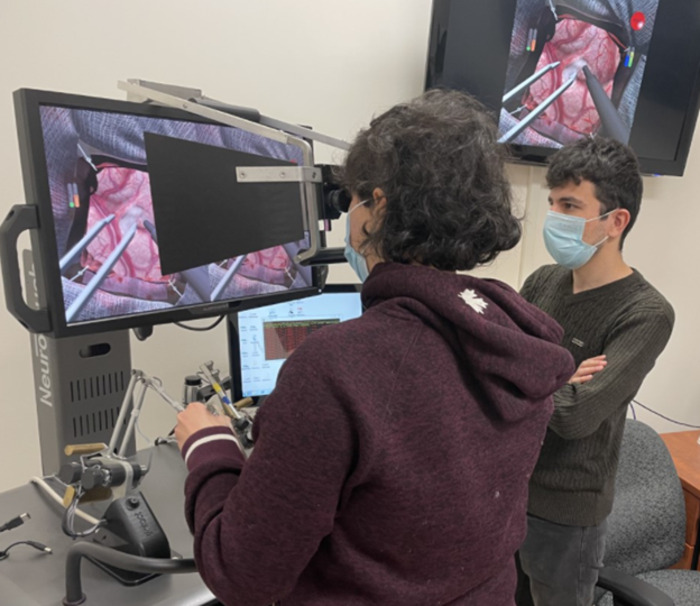
The COVID-19 pandemic has presented both challenges and opportunities for medical training. Remote learning technology has become increasingly important in several fields. A new study finds that in a remote environment, an artificial intelligence (AI) tutoring system can outperform expert human instructors.

The Neurosurgical Simulation and Artificial Intelligence Learning Centre at The Neuro (Montreal Neurological Institute-Hospital) recruited seventy medical students to perform virtual brain tumour removals on a neurosurgical simulator. Students were randomly assigned to receive instruction and feedback by either an AI tutor or a remote expert instructor, with a third control group receiving no instruction.
An AI-powered tutor called the Virtual Operative Assistant (VOA) used a machine learning algorithm to teach safe and efficient surgical technique and provided personalized feedback, while a deep learning Intelligent Continuous Expertise Monitoring System (ICEMS) and a panel of experts assessed student performance.
In the other group, remote instructors watched a live feed of the surgical simulations and provided feedback based on the student’s performance.
The researchers found that students who received VOA instruction and feedback learned surgical skills 2.6 times faster and achieved 36 per cent better performance compared to those who received instruction and feedback from remote instructors. And while researchers expected students instructed by VOA to experience greater stress and negative emotion, they found no significant difference between the two groups.
Surgical skill plays an important role in patient outcomes both during and after brain surgery. VOA may be an effective way to increase neurosurgeon performance, improving patient safety while reducing the burden on human instructors.
“Artificially intelligent tutors like the VOA may become a valuable tool in the training of the next generation of neurosurgeons,” says Dr. Rolando Del Maestro, the study’s senior author. “The VOA significantly improved expertise while fostering an excellent learning environment. Ongoing studies are assessing how in-person instructors and AI-powered intelligent tutors can most effectively be used together to improve the mastery of neurosurgical skills.”
“Intelligent tutoring systems can use a variety of simulation platforms to provide almost unlimited chances for repetitive practice without the constraints imposed by the availability of supervision,” says Ali Fazlollahi, the study’s first author. “With continued research, increased development, and dissemination of intelligent tutoring systems, we can be better prepared for ever-evolving future challenges.”
This study, published in the Journal of the American Medical Association (JAMA Network Open) on Feb. 22, 2022, was funded by the Franco Di Giovanni Foundation, the Royal College of Physicians and Surgeons of Canada, and the Brain Tumour Foundation of Canada Tumour Research Grant along with The Neuro. Cognitive assessment was led by Dr. Jason Harley at McGill University’s Department of Surgery.
IMAGE CREDIT: The Neuro


Leave a Reply