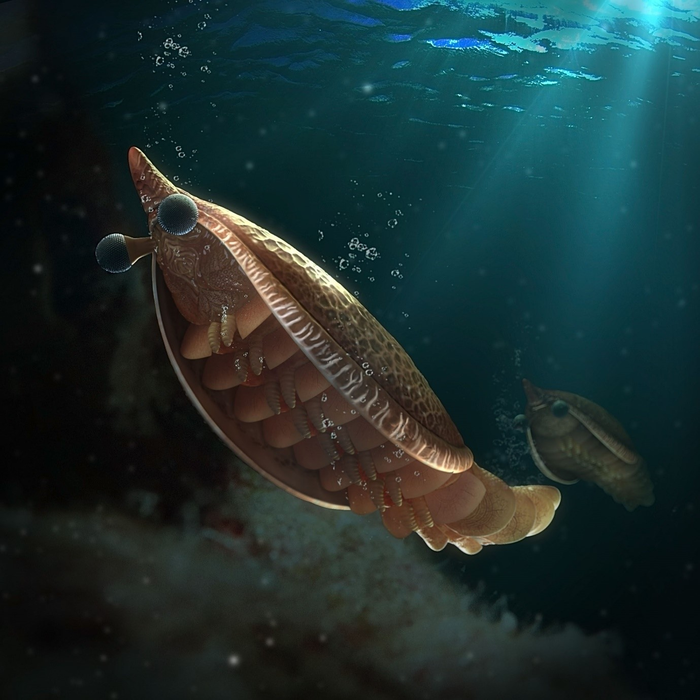
University of Manchester research fellow David Legg, in collaboration with a team of international scientists from China, Switzerland, and Sweden, has today announced a new fossil that reveals the origin of gills in arthropods.

Arthropods, the group of animals that includes creepy crawlies like spiders and woodlice, are the largest phylum in the animal kingdom and are found everywhere from the deepest ocean trench to the top of Mount Everest.
Research published today shows the newest addition to the group is a 520-million-year-old (about 10 times as old as the dinosaurs) organism called Erratus sperare. Erratus sperare was discovered in the Chengjiang Fossil Site, a UNESCO World Heritage Site located in Yunnan, China. The Chengjiang Fossil Site preserves an ancient underwater ecosystem which included the relatives of some well-known arthropod fossils like trilobites and anomalocarids.
Modern water dwelling arthropods have biramous limbs, legs that have two parts – one for breathing and one for walking – but how such specialised limbs evolved was a mystery. Some of the earliest fossil arthropods, like Anomalocaris, had swimming flaps that may have doubled as gills, but until now researchers didn’t know how arthropods made the jump from these specialised flaps to the biramous limbs of modern arthropods.
Erratus sperare provides the missing link between arthropods that used such specialised flaps and arthropods with biramous limbs. It has both legs and flaps.
Dr David Legg, one of the authors of this study, said: “Fish aren’t the only organisms that have gills! Arthropods have gills too… they just have them on their legs. When it came to arthropods, however, we just weren’t sure where these gills came from.
“Thanks to this new fossil, Erratus sperare, we now have a much clearer idea. These gills also probably went on to evolve into the wings of insects and the lungs of terrestrial arthropods like spiders so were a very important innovation.”
IMAGE CREDIT: The University of Manchester




Leave a Reply