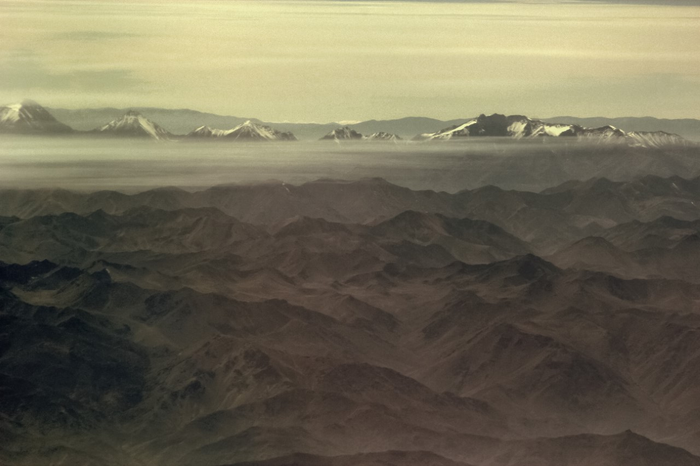
When winds loft fine desert dust high into the atmosphere, iodine in that dust can trigger chemical reactions that destroy some air pollution, but also let greenhouse gases stick around longer. The finding, published today in the journal Science Advances, may force researchers to re-evaluate how particles from land can impact the chemistry of the atmosphere.

“Iodine, the same chemical added as a nutrient to table salt, is eating up ozone in dusty air high in the atmosphere,” said Rainer Volkamer, a CIRES Fellow and professor of chemistry at CU Boulder. Volkamer led the team that made precision atmospheric measurements by aircraft over the eastern Pacific Ocean several years ago. The new finding, he said, has implications for not only air quality, but climate, too—iodine chemistry can make greenhouse gases stick around longer and should give us pause to re-think geoengineering schemes involving dust.
“Our understanding of the iodine cycle is incomplete,” Volkamer said. “There are land-based sources and chemistry we didn’t know about, which we must now consider.”
Atmospheric researchers have long been interested in the observation that dusty layers of air are often very low in the air pollutant ozone, which, when concentrated, can damage people’s lungs and even crops. It seemed that some kind of dust-surface chemistry was eating up ozone, but no one had been able to show that happening in laboratory experiments. Others have speculated about this, but there’s been a lot of doubt, said Volkamer. By contrast, lab experiments have long shown that a gaseous form of iodine can gobble up ozone—but there were only hints of a connection between dust and iodine.
There were other tantalizing hints about the process in a dataset from 2012, from a series of aircraft flights offshore Chile and Costa Rica. Dust seen blowing offshore from South America had striking levels of gaseous iodine. Volkamer handed the data to then-CU Boulder graduate student Theodore Koenig, lead author on this study. Koenig describes those data as one in a set of blurry photographs shared by atmospheric chemists around the world. In one image, for example, “iodine seemed to correlate with dust … but not absolutely clearly,” he said. Everywhere, dust seemed to destroy ozone, but why? “Iodine and ozone clearly connect, but there weren’t any ‘photos’ of both with dust,” said Koenig, who is now an air pollution researcher at Peking University in China.
The data from TORERO (the “Tropical Ocean Troposphere Exchange of Reactive Halogens and Oxygenated Hydrocarbons,” a field campaign funded by the National Science Foundation) captured those three characters together, finally, in one image he said, and it was clear that where desert dust contained significant levels of iodine—like dust from the Atacama and Sechura deserts in Chile and Peru—the iodine was quickly transformed into a gaseous form and ozone dropped to very low levels. But how did that dust-based iodine transform? “The mechanism still remains elusive,” Volkamer said. “That’s future work.”
So the picture is another blurry one, Koenig said, but still, the science is sharper than it was. “I have more questions at the end of the project than at the start,” he said. “But they’re better, more specific questions.”
They’re also very important, for anyone interested in the future of the atmosphere, Volkamer said. Iodine’s reactions in the atmosphere are known to play a role in reducing levels of OH, for example, which can increase the lifetime of methane and other greenhouse gases. Perhaps more importantly, various geoengineering ideas involve injecting dust particles high into Earth’s atmosphere, to reflect incoming solar radiation. There, in the stratosphere, ozone is not a pollutant; rather, it forms a critical “ozone layer” that helps shield the planet from incoming radiation.
If iodine from dust was chemically transformed into an ozone-depleting form in the stratosphere, Volkamer said, “well, that’d not be good, as it could delay the recovery of the ozone layer. Let’s avoid adding anthropogenic iodine into the stratosphere!”
IMAGE CREDIT: Sam Hall



Leave a Reply