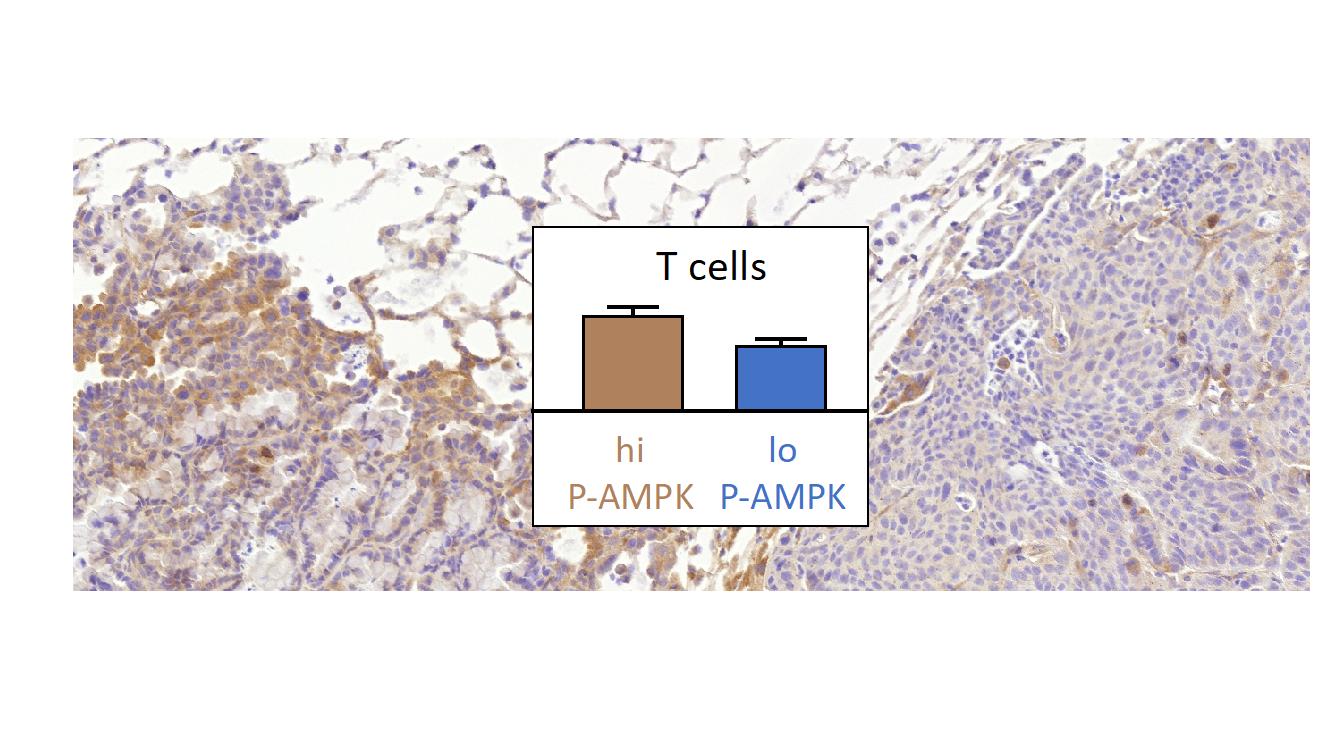
Thenewly discovered biomarker may help to distinguish which patients are more likely to benefit from treatment that helps the immune system fight cancer. If validated in further studies, the finding could enable better personalized care for lung cancer patients.

In order for cancer cells to develop into a severe tumor, they need to be able to escape attack by the patient’s own immune system. This is why immunotherapeutic treatment that helps the immune system to find and fight cancer has emerged as such an important regimen for cancer patients.
It has, however, turned out to be difficult to predict which patients benefit from these therapies. A step toward better targeting of immunotherapies was taken by investigators from the iCAN Digital Precision Cancer Medicine Flagship at the University of Helsinki and HUS Helsinki University Hospital.
In a study published in Clinical Cancer Research, the iCAN researchers identified a new biomarker, inactiveAMPK (lo-P-AMPK). It may be used to see how well the body responds to immunotherapeutic treatment for lung cancer.
Shedding light on how cancer tumors escape immunotherapies
Only very few specific gene mutations in cancer cells have been linked with immune evasion, the ability to avoid the host’s immune response. A notable exception is the tumor suppressor LKB1. Lung cancers with mutations in LKB1 respond to immunotherapies significantly worse than those without mutations.There has therefore been significant interest in understanding how LKB1 mutations impact immunotherapy.
In the recently published study, iCAN researchers found that following mutations in the tumor suppressor LKB1, the AMP-dependent protein kinase (AMPK) and antigen presentation machinery act as mediators of the tumor’s ability to stay below the immune system’s radar.
New biomarker validated in lung cancer model system
The study also suggested a new biomarker to predict immune evasion. Inactive AMPK, detected by low levels of phosphorylated AMPK (lo-P-AMPK), was noted to correlate with low amounts of T-cells in lung cancer.
”We observed a clear correlation between lo-P-AMPKand suppressed anti-tumor immunityin lung cancer patients –even in the absence of LKB1 mutations,”comments M.Sc.Pekka Päivinen,a doctoral student involved in the study.
The correlations identified in human material were validated in a lung cancer model system, where deletion of AMPK led to immune evasion and dysfunctional antigen presentation.
”Developing this lung cancer model enabled us to provide a direct genetic approach to demonstrate the link between LKB1, AMPK, and antigen presentation. The international collaboration with the Viollet and Verschuren labs was critical in achieving these results,”notes DrYan Yan, the corresponding author of the study.
If ongoing studies in iCAN validate lo-P-AMPK as a biomarker for lung cancer immunotherapy, this new tool will provide direct benefits to patients by identifying which patients are more likely to benefit from immunotherapies.
IMAGE CREDIT: Pekka Päivinen




Leave a Reply