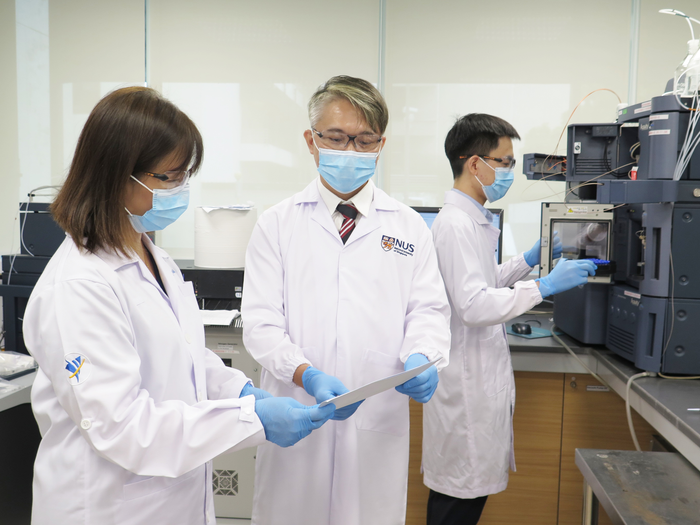
Singapore, 30 August 2021 – A team of researchers from the National University of Singapore (NUS) has come up with a new solution to boost the surveillance of designer drug abuse. Led by Professor Eric Chan from the NUS Department of Pharmacy, the team has identified three new urinary biomarkers that could be used to detect consumption of ADB-BUTINACA, an emerging synthetic cannabinoid which is a type of new psychoactive substance (NPS). The innovative approach used to identify the biomarkers can be applied to other existing and new synthetic cannabinoids.
NPS are drugs designed to mimic the effects of illegal substances such as cannabis, cocaine, heroin, ‘Ice’, Ecstacy and LSD. The intention of the clandestine laboratories to introduce synthetic cannabinoids with different chemical structures is to try to circumvent legislative bans.
Over the past two years, users of NPS made up the third largest proportion of drug abusers in Singapore, while synthetic cannabinoids have dominated Singapore’s NPS market for the past four years. As most synthetic cannabinoids are extensively metabolised in the body after consumption, they become virtually undetectable in urine samples.
Commenting on the significance of the team’s research, Prof Chan said, “Prior to our study, the metabolism and urinary biomarkers of ADB-BUTINACA were unclear. Our discovery and unique methodology offer assistance to the forensic fraternity who is constantly being challenged by the emergence of novel synthetic cannabinoids, and can also bring benefits to the international public communities to tackle the increasing abuse of this synthetic cannabinoid. This will bring us closer to the goal of having a drug-free world.”
The study, which was carried out in collaboration with the Analytical Toxicology Laboratory of Singapore’s Health Sciences Authority, was first published in the journal Clinical Chemistry on 13 August 2021.
New biomarkers for accurate detection of synthetic drug abuse
ADB-BUTINACA is a new synthetic cannabinoid that was first identified in Europe in 2019, and it entered Singapore’s drug scene last year. Although three existing metabolites of ADB-BUTINACA are available as reference standards for routine forensic monitoring, they have been found to be absent or detected at lower concentrations in some urine samples of abusers. This created an impetus to identify other potential metabolites for use as urinary biomarkers for the cannabinoid’s consumption.
Instead of using the conventional and more time-consuming method of chemically synthesising metabolites of ADB-BUTINACA, Prof Chan and his team introduced an innovative method to identify the cannabinoid’s unique metabolites using the concepts of drug metabolism and pharmacokinetics.
The team synthesised key metabolites of ADB-BUTINACA using human liver enzymes in the laboratory for investigating their disposition and identifying novel biomarker metabolites in urine. From their studies, a total of 15 metabolites of ADB-BUTINACA and their respective pathways of biotransformation in the body were identified for the first time using this method.
Of the 15 new metabolites, the researchers proposed four as urinary metabolite biomarkers due to their metabolic stability, including one metabolite where its reference standard is currently available. A panel comprising either one or a combination of these four newly-established urinary biomarkers was developed for diagnosing the consumption of ADB-BUTINACA.
Moving forward, the team plans to extend their current strategy to better understand the disposition of novel metabolites of synthetic cannabinoids by kidneys and their eventual occurrence in urine.
IMAGE CREDIT: National University of Singapore


Leave a Reply