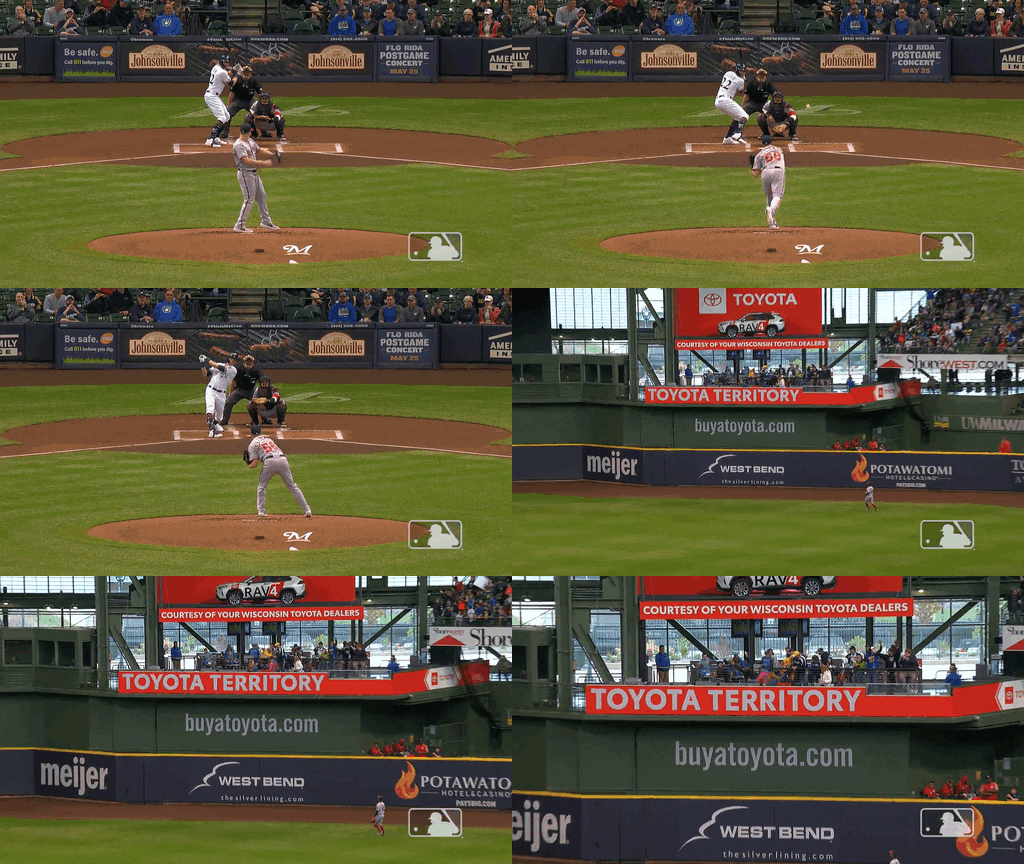
For two years prior to the Great Pandemic year, the baseball gods smiled down on Milwaukee Brewers’ Christian Yelich and Los Angeles Dodgers’ Cody Bellinger. They were young and healthy and played the game with that sandlot type of enthusiasm we like to think all baseball players carry with them. Major League Baseball celebrated them during All-Star games, putting them forward as representatives of the sport’s exciting and youthful future, something that ran contrary to its bleaker, middle-aged reality.
Then just like that, everything changed. Baseball’s dynamic duo showed that they were human. They got injured.
For Yelich, his injury woes began when he fractured his kneecap while batting, thanks to a foul ball. The mishap occurred at the worst possible time, during the final stretch of the season as he battled Cody Bellinger for the National League Most Valuable Player award which he won the season before. Ultimately, Yelich lost out to Bellinger.
Then the COVID-19 pandemic hit, throwing the entire sports world off-balance. Athletes found their entire schedules compressed and their routines in tatters. Some were able to adjust while others could not.
In 2020, Yelich struggled from day one going 1-for-27 with 12 strikeouts. It only got a little better from there, finishing the shortened season with a .205/.356/.430 slash line.
Ever since he fractured his knee, injuries have hampered Yelich. He has struggled with a persistent back injury that has kept him in and out of the Brewers’ lineup. Yelich played one game in a five-week stretch from mid-April to mid-May due to a lower back strain. Most recently, he was placed on the COVID-19 injured list after testing positive for the disease. While it’s unclear how he will be affected long term, in the near term, being out of the lineup does nothing to help build a rhythm.
Earlier this season, he spoke to mlb.com’s Adam McCalvy about his struggles:
“Yelich said a lot of the things you hear from a player in slump a lot deeper than the one his numbers suggest he’s in. Yelich said he is ‘slowing it down’ and ‘trying to figure things out’ and ‘trying to get back to basics.’ He said he’s never struggled like this, ‘but that’s baseball, and it’s a hard game.’”
So what’s happened?
For starters, Yelich has been seeing fewer pitching in the strike zone. Opposing pitchers have been content to nibble around the edges. However, when he does see pitches to hit, Yelich isn’t hitting them as cleanly as he did in previous seasons. This can be seen in his barrel rates.
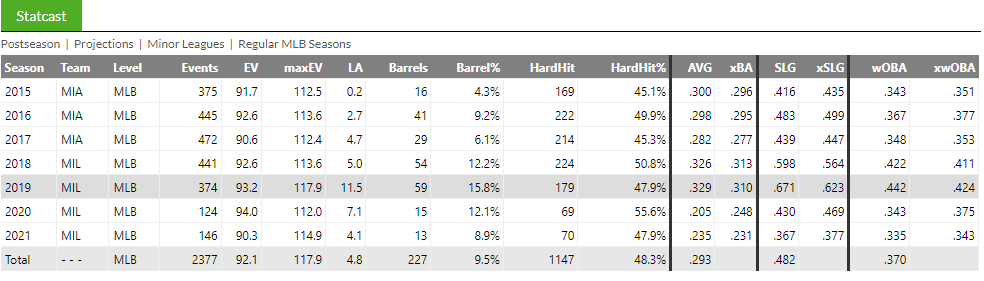
Comparing Yelich’s Statcast numbers between 2019 and 2020, we see a steep drop in Barrels from 59 to 15. This is partly due to the abbreviated season but the trend is even seen in his Barrel%. The percentage of solid contact falls from 15.8% to 12.1%. That said, his Barrel% in 2020 is very similar to that of 2018, the year he won the NL MVP and hit .326. In fact, in terms of percentage, Yelich was hitting the ball harder in 2018 (50.8% HardHit) and 2020 (55.6% HardHit) compared with 2019. Interestingly, in 2019, Yelich’s average launch angle (117.9 degrees) was greater than every other season and it showed with his 44 home runs. In the end, looking at barrels alone doesn’t provide any definitive answers.
One set of numbers that show dramatic changes between Yelich’s most productive years and his current struggles is his K% and BB%. Both numbers essentially spiked as his wOBA dropped precipitously.
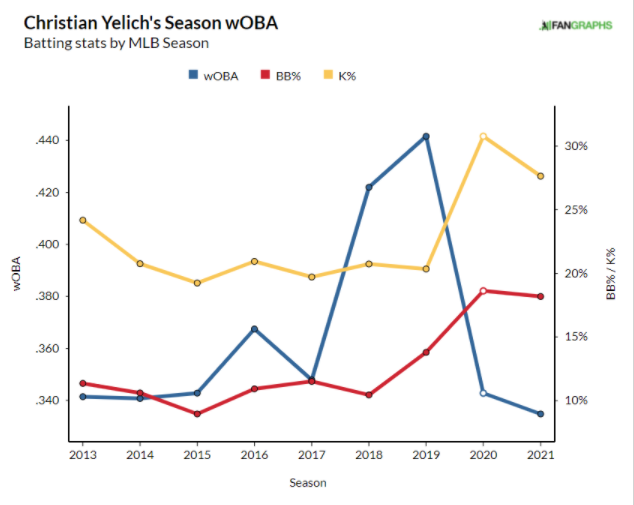
Making matters worse, his strikeout percentage was much higher and the slope between 2019 and 2020 far steeper. His increased base on balls suggests he may be swinging less and taking more pitches. While this isn’t necessarily a bad thing if it means getting on base, it’s not great if it’s also translating to more strikeouts.
Driving that point home is Yelich’s Swinging Strikeout percentage (SwStr%) vs Called Strikeout percentage (CStr%). Between 2019 and 2020, his SwStr% dropped from 11.5% to 10.9%. However, his CStr% popped from 13.6% to 19.7%. He’s not only striking out swinging but also getting punched out with greater frequency.
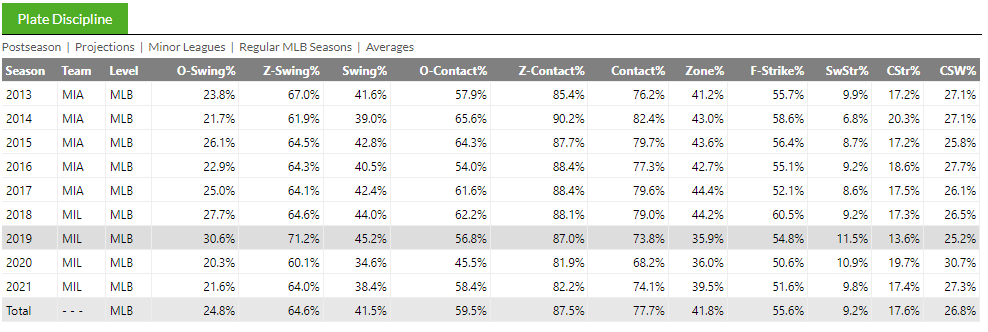
In conclusion, comparing Christian Yelich’s strikeout and walks numbers seems to indicate that he’s become a bit gun-shy during his extended slump.
WORDS: Marc Landas.




Leave a Reply