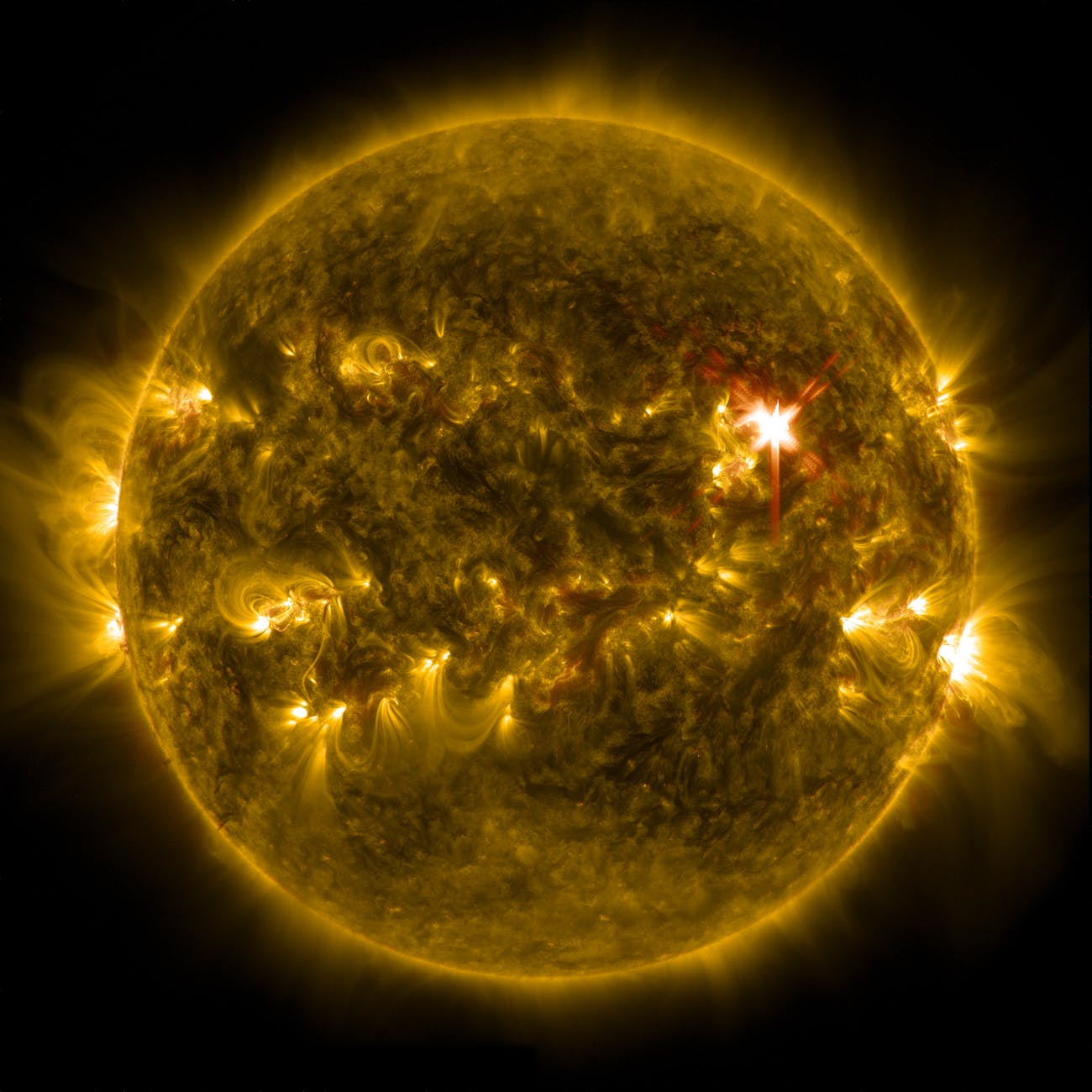
New research shows that sunspots and other active regions can change the overall solar emissions. The sunspots cause some emissions to dim and others to brighten; the timing of the changes also varies between different types of emissions. This knowledge will help astronomers characterize the conditions of stars, which has important implications for finding exoplanets around those stars.
An international research team led by Shin Toriumi at the Japan Aerospace Exploration Agency added up the different types of emissions observed by a fleet of satellites including “Hinode” and the “Solar Dynamics Observatory” to see what the Sun would look like if observed from far away as a single dot of light like other stars.
The team investigated how features like sunspots change the overall picture. They found that when a sunspot is near the middle of the side of the Sun facing us, it causes the total amount of visible light to dim. In contrast, when the sunspots are near the edge of the Sun the total visible light brightens because at that viewing angle bright structures known as faculae surrounding the sunspots are more visible than the dark centers.
In addition, X-rays which are produced in the corona above the solar surface grow brighter when a sunspot is visible. The coronal loops extending above the sunspots are magnetically heated, so this brightening appears before the sunspot itself rotates into view and persists even after the sunspot has rotated out of view.
Because the changes in the overall solar emissions and their timings carry information about the location and structure of features on the surface of the Sun, astronomers hope to be able to deduce the surface features of other stars such as starspots and magnetic fields. This will help astronomers to better recognize dimming caused by the shadow of an exoplanet. With better knowledge about the effects of starspots, we can estimate the parameters, such as the radii and orbits, of exoplanets more accurately.
As in-depth investigations into the Sun proceed, a better understanding of the detailed mechanisms of atmospheric heating and flare eruptions will be gained. Toriumi comments, “To this end, the next-generation solar-observing satellite Solar-C(EUVST), being developed by Japan in close collaboration with US and European partners, aims to observe the Sun in emissions that probe the chromosphere, transition region, and corona as a single system.”




Leave a Reply