Economists have a well-worn playbook for spotting a technology on the verge of reshaping the world: watch its cost curve. Solar panels, computer chips, and 19th-century steamship freight all became transformative once their price per unit fell fast enough, for long enough. According to a new Cambridge-led study, spaceflight now belongs on that list — and it’s falling faster than any of them.
The research, published in the journal PNAS Nexus, forecasts that the cost of sending a kilogram of cargo into low Earth orbit will fall more than 58 percent by the end of the decade, dropping from an average of $3,868 last year to roughly $1,569 by 2030. By 2040, the study projects, that figure could fall to as little as $273 per kilogram — a decline of about 93 percent from today.
To build the forecast, researchers assembled what they describe as the largest global dataset of rocket launches ever compiled: more than 4,400 launches spanning 1960 to 2025, covering sixteen geographical entities and more than 330 distinct rocket configurations. Analyzing that dataset through the lens of a classic economic tool called an experience curve — which measures how costs fall as cumulative production doubles — the team found that costs have historically dropped by 21.2 percent with every doubling of total payload launched into orbit.

That rate of improvement outpaces the textbook case for transformative technology. Steamship freight during the Industrial Revolution, which reshaped global trade in commodities like wheat and cotton, saw costs fall by roughly 15.5 percent for every doubling of cargo volume. Spaceflight, the researchers argue, is now improving faster than the technology historians point to as the definitive example of a transport revolution.
“Space is no longer a science-fiction fantasy or a purely scientific pursuit, it is becoming a marketplace,” said Dr. Alessio Terzi of Cambridge’s Bennett School of Public Policy, who led the study. “As launch costs fall and commercial activity expands, we are entering an era where spacefaring is like any other economy, driven by incentives, trade and investment, and economists should be paying more attention.”
The trajectory has not been a smooth, continuous decline. According to the study’s estimates, the overall cost of reaching orbit fell about 96 percent between 1960 and 2025 — but almost all of that improvement clusters into two distinct eras separated by a long stall. The Space Race drove costs from more than $87,000 per kilogram in 1960 down to around $20,000 per kilogram by the early 1970s, before progress froze in place following the end of the Apollo program and the retirement of the Saturn V rocket. Costs stayed largely flat through the 1980s.
Everything changed after 1989. Comparing the pre- and post-Cold War eras directly, Terzi and co-author Dr. Francesco Nicoli of the Politecnico Institute of Turin found that costs fell more than two and a half times faster once the Berlin Wall came down and commercial and private-sector involvement flooded into the sector — a decline of roughly 44 percent with each doubling of payload after 1989, compared with 17 percent before it. “State-led competition during the Cold War did not foster cost efficiency on the same scale as the ensuing era of international space cooperation and private sector involvement,” Nicoli said.
That shift has produced a launch market now dominated by a single company. SpaceX currently accounts for roughly 80 percent of the total payload sent into orbit globally each year — a concentration the researchers compare, in a related working paper co-authored by Terzi, to the East India Company’s grip on maritime trade in the 1820s. It’s a comparison meant as a warning as much as an observation: the same authors caution that profit-maximizing monopolies, combined with rising geopolitical tension, could just as easily slow the cost curve down as accelerate it, particularly if nations increasingly prioritize developing sovereign launch capacity over open commercial competition.
The scale of recent growth is striking on its own terms. The amount of payload launched into orbit has grown by 31 percent annually since 2020, compared with average annual growth of just 4 percent between 2000 and 2019, driven largely by the satellite technology boom. Roughly 4,900 tonnes reached orbit in 2025 alone, and the space economy was valued at more than $600 billion in 2024 — comparable to the entire GDP of Sweden. Terzi and Nicoli forecast that global launch capacity will nearly double by 2030, to 9,100 tonnes a year, a target they say SpaceX alone could hit with roughly eighty flights of its fully reusable Starship rocket. By 2040, they project annual capacity could reach 32,000 tonnes.
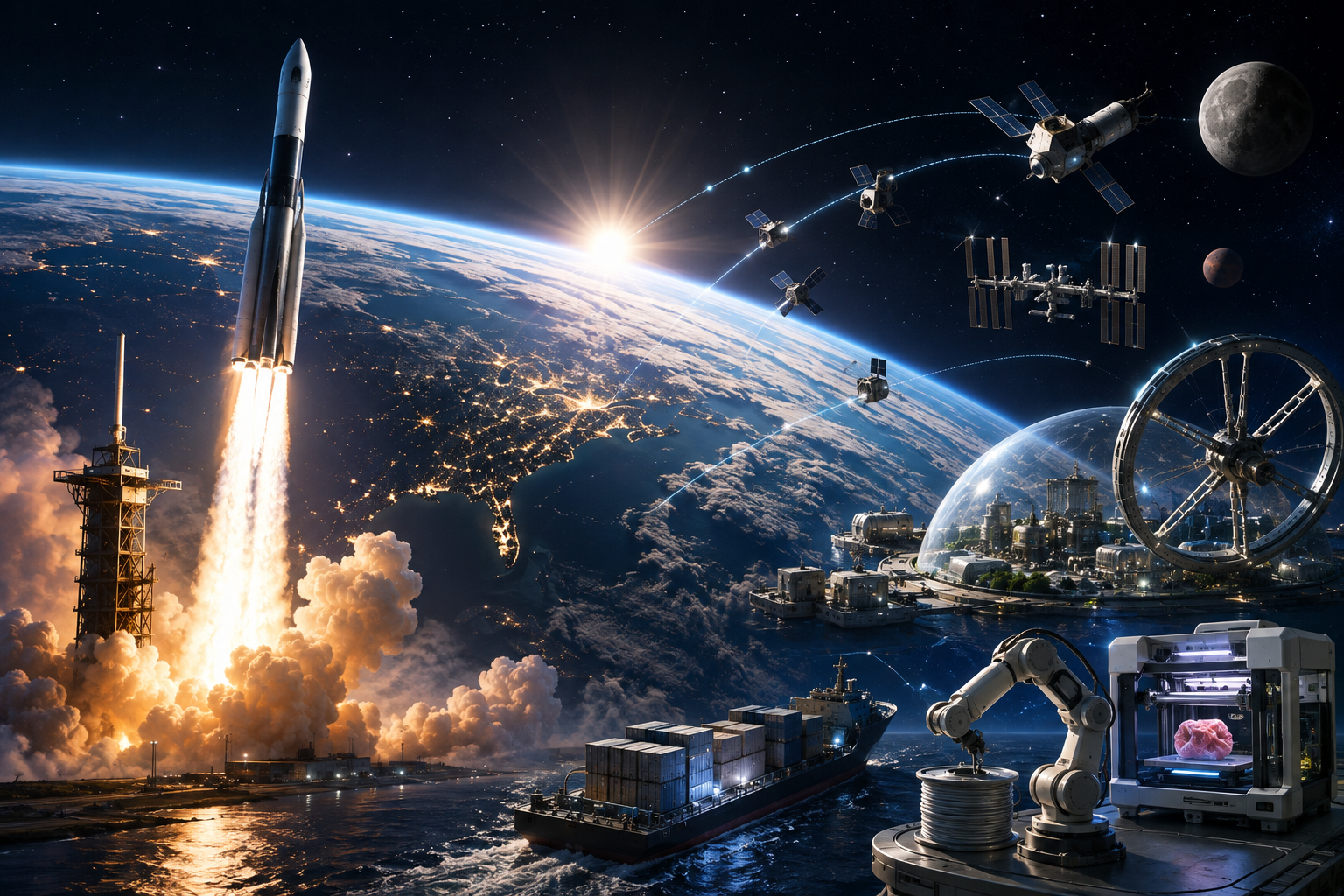
What happens once that capacity exists is where the study turns speculative, and where its economic argument becomes a vision of a genuinely different kind of economy. The researchers point to zero-gravity research, orbital tourism, and factories exporting fiber-optic cable and 3D-bioprinted organs back to Earth as plausible early industries. Because escaping Earth’s gravity well demands the bulk of a mission’s energy, but travel once in orbit is comparatively cheap — Terzi notes that gravitational pull in orbit is roughly a fiftieth of that at sea level, with little difference in energy needs between destinations as varied as the Moon and Mars — falling launch costs could open commercial activity well beyond low Earth orbit.
“Rapidly falling launch costs could open the way to space colonisation and commercial activity far beyond low Earth orbit,” Terzi said. “Ever cheaper launch costs could open up possibilities around solar power production in orbit, asteroid mining, and a self-sustaining economy producing fuel, food and infrastructure in orbit or on the Moon. Major polluting industries currently devastating the biosphere could even be offshored to sit outside the Earth’s atmosphere.”
Endnotes
Alessio Terzi and Francesco Nicoli, “From Sputnik to Starship: Estimating the experience curve of space launch technology,” PNAS Nexus (2026), https://doi.org/10.1093/pnasnexus/pgag217
University of Cambridge, “Space cargo costs could fall more than 90% by 2040, transforming the marketplace of space,” EurekAlert!, July 14, 2026, https://www.eurekalert.org/news-releases/1135913




Leave a Reply