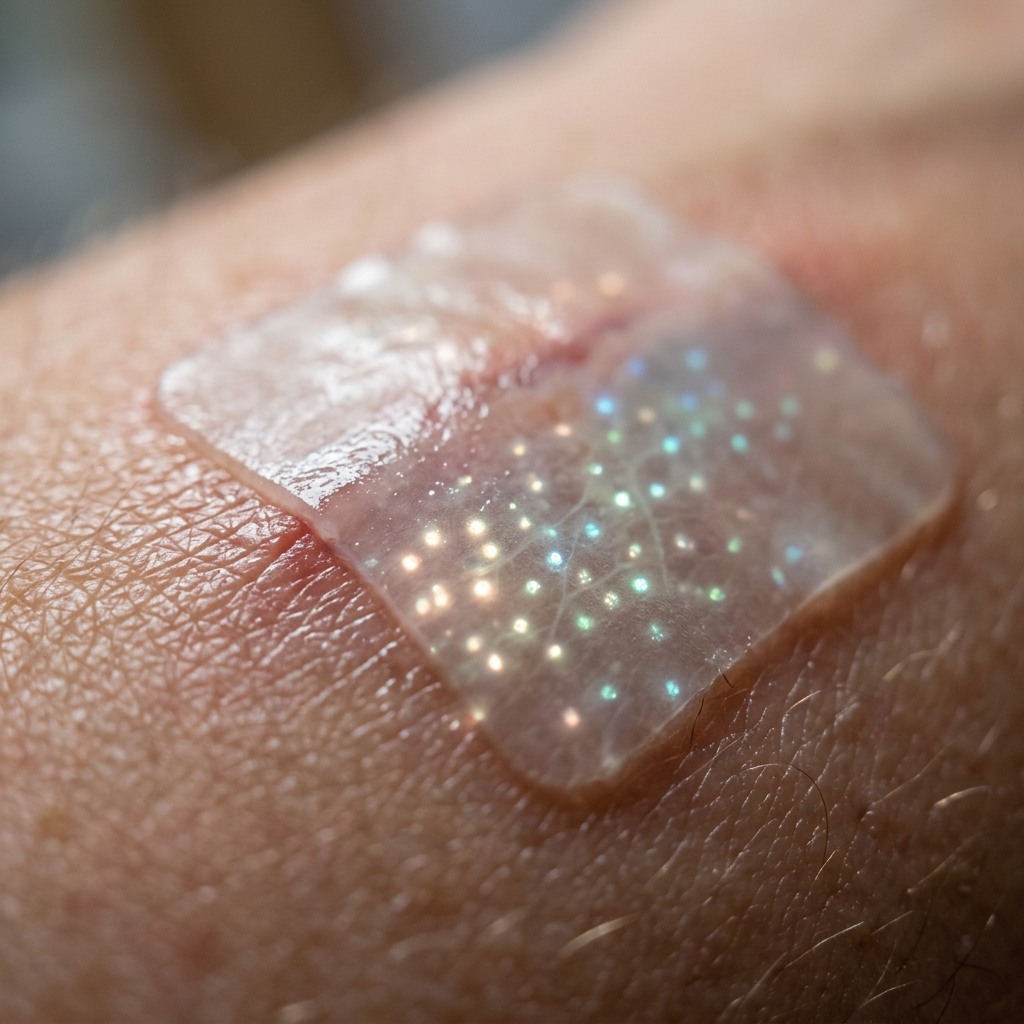
Most efforts to speed up wound healing follow the same basic logic: identify the biological signals that drive tissue repair, then find a way to deliver more of them. That approach has an obvious appeal, but a persistent flaw — growth factors, the proteins that instruct cells to move, multiply, and rebuild tissue, tend to break down quickly once applied, often disappearing from a wound before they’ve had a chance to do much good. A new bioinspired material developed at Imperial College London takes a different approach entirely: rather than flooding a wound with manufactured drugs, it captures the body’s own healing proteins and holds them in reserve, releasing them only when a repair cell physically tugs on the material itself.
The research, published in Nature Materials, marks the first demonstration that this mechanism can function in living, repairing tissue rather than a simplified laboratory cell culture. The team tested the dressing across three increasingly realistic settings: rat bone injuries, mouse skin wounds, and living human skin tissue maintained in the lab. In each case, the material accelerated healing — and versions of the dressing that couldn’t be triggered by cellular pulling failed to produce the same effect, evidence that the force-activated mechanism itself, not just the presence of the material, is doing the work.
“What excites me most is that this works in living human skin,” said Dr. Magdalene Ho of Imperial’s Department of Bioengineering and the study’s lead author. “We can see repair cells migrating into the wound dressing and confirm the material is engaging with human biology. That result makes me optimistic that this approach has a future in the clinic.”
The underlying idea builds on research Imperial scientists first published in 2019, which showed the basic concept could work in a controlled cell-culture environment — a setting far simpler than an actual wound, with none of the complexity of blood, immune activity, or damaged tissue architecture. Moving that mechanism into rat bone, mouse skin, and living human skin represents what the researchers describe as a major step toward eventual clinical use.
The material works by selecting specific healing proteins already present in a wound or in blood and keeping them chemically inactive — essentially holding them in a dormant, primed state. When a repair cell moves into the dressing and exerts physical force on it, the mechanical tug releases the bound protein directly to that cell, at the exact place and moment repair is underway. It’s a markedly different strategy than current treatments, which typically deliver large doses of growth-factor drugs via sprays or creams, only for those proteins to degrade or diffuse away before they can act. Other wound-care materials skip the biological signaling altogether, offering only structural support without provide the cues that guide the tissue’s own machinery.
Dr. Ben Almquist, associate professor in bioengineering, co-director of the Imperial Network of Excellence in Wound Healing and Regeneration, and the study’s senior author, framed the approach as a fundamental shift in how healing materials are designed. “What particularly stands out with this research is that the patient’s own body becomes the pharmacy,” Almquist said. “We are not delivering a manufactured drug and hoping it survives long enough to work. We are capturing what the body is already making and giving it back to the cells that need it, by encoding intelligence directly into the material, activated by the one signal guaranteed to be present right where healing is happening: the physical force of a cell pulling on its surroundings.”
Because the mechanism responds to cellular force rather than chemical concentration, it appears able to work at remarkably low doses — hundreds to thousands of times lower than conventional growth-factor delivery methods, and more than 2,000 times lower than an existing clinical growth-factor product, according to the researchers.
Mr. Shehan Hettiaratchy, professor of practice in plastic and reconstructive surgery at Imperial and an independent expert who was not involved in the research, described the work as addressing a long-recognized weakness in how difficult wounds are treated. “This is a major breakthrough in wound healing,” he said. “We have known for a long time that the body is the best healer of wounds unless that system is disrupted. What this technology does is harness that system to get it back on track to heal wounds that the body is struggling to deal with. This may have a huge impact on chronic wounds and also help ensure that acute wounds, such as from trauma or accidents, are optimised to heal from the start.”
The scale of the problem the research aims to address is considerable. Diabetic foot ulcers affect an estimated 18.6 million people worldwide each year, with roughly a fifth of those cases eventually leading to partial or full amputation of the foot. Burn injuries cause about 180,000 deaths annually, disproportionately in low- and middle-income countries, and are a leading cause of prolonged hospitalization and disability. Road traffic injuries, meanwhile, kill roughly 1.19 million people a year and leave tens of millions more with complex, hard-to-heal wounds. Chronic, non-healing wounds like diabetic ulcers and pressure sores can persist for months or years, straining both patients and health systems.
Because the dressing works by harvesting proteins the body already produces rather than requiring cold-chain manufactured drugs, the researchers see particular promise for settings where advanced wound therapies are hardest to access — emergency medicine, humanitarian crises, frontline military care, and low-resource health systems generally. The technology is now being developed commercially through an Imperial spinout, Traxion Biotech, led by Ho and Almquist, with Hettiaratchy serving as a medical adviser as the company works to bring the material toward clinical use.
Endnotes
1. Ho, M., Almquist, B., et al. “Force-responsive biomaterials drive tissue repair by harnessing endogenous growth factors.” Nature Materials (2026). DOI: 10.1038/s41563-026-02682-8
2. Imperial College London press release, July 27, 2026, via EurekAlert!: https://www.eurekalert.org/news-releases/1137465

COPY II (2-3 PARAGRAPHS)
IMAGE CREDIT: NASA.


Leave a Reply