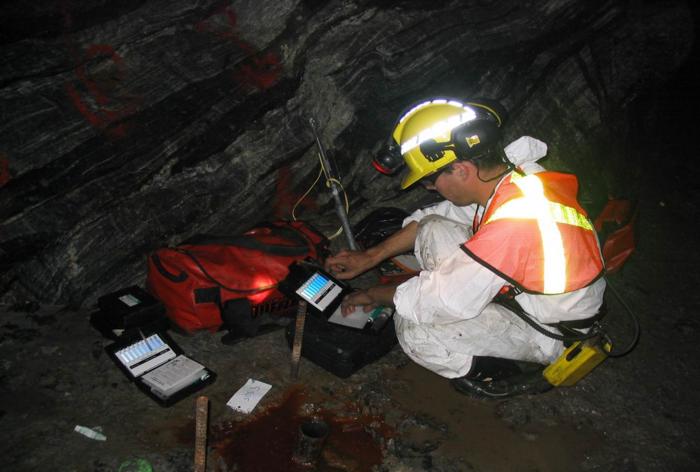
Within the Canadian Shield, hydrogen gas is steadily building up naturally among some of the oldest rocks on Earth. Now, for the first time, geochemists at the University of Toronto and the University of Ottawa have measured its presence, mapped its concentration and tracked its long-term accumulation, shedding new light on this source of natural, or white, hydrogen.
The findings make it possible to assess the economic viability of this emerging energy source and point to a new approach to hydrogen exploration — one that could accelerate greenhouse gas reductions and expand hydrogen’s role in the clean energy
transition.
A study published in the Proceedings of the National Academy of Sciences reports measurements of hydrogen directly observed discharging from the vast billion-year-old rocks of the Canadian Shield. Using data from an operating mine near Timmins, Ontario, the researchers show that boreholes at the site release an average of 0.008 tonnes of hydrogen per year – approximately 8 kilograms, which is the weight of an average-sized car battery – and can continue to do so for 10 years or more.

Extrapolating to the site’s nearly 15,000 boreholes results in a total discharge of more than 140 tonnes of hydrogen per year. Such discharges could provide 4.7 million kilowatts of energy per year from a single location – enough to support the annual energy needs of over 400 households.
“The data from this study suggests there are critical untapped opportunities to access a domestic source of cost-effective energy produced from the rocks beneath our feet,” says University Professor Barbara Sherwood Lollar in the Department of Earth Sciences in the Faculty of Arts & Science at University of Toronto, the lead author of the study. “What’s more, this provides a ‘made in Canada’ resource that might be able to support local and regional industry hubs and reduce their dependence on importing hydrocarbon-based fuels”.
The existing global hydrogen economy is a $135-billion industry. Major uses are in methanol and steel production, though the single largest use of hydrogen is fertilizer production, making it a fundamental component in agriculture and critically tied to global food security. Currently, hydrogen used in these ways is produced by energy-intensive industrial processes that typically convert hydrocarbons found in fossil fuels such as petroleum, natural gas and coal, while releasing carbon monoxide and CO2 in the process. Even hydrogen generated from renewable energy sources – often described as green hydrogen – is energy intensive, costly to produce and requires long distance transport and storage.
To date, white hydrogen as a source for energy and manufacturing has largely flown under the radar, investigated almost exclusively by microbiologists seeking to understand the subsurface biosphere and to inform astrobiology and space exploration. The potential contribution of natural hydrogen in Earth’s crust to the current global economy has until now been largely speculative, based on models and theoretically available amounts, rather than on measured data. The U of T-led study is the first to document large volumes of hydrogen, and most importantly, discharges that are sustained for years.
“Natural hydrogen is produced over time through underground chemical reactions between rocks and the groundwaters in those rocks,” says Sherwood Lollar. “Canada is blessed that vast amounts of its territories, especially on the Canadian Shield, contain the right rocks and minerals to create this natural hydrogen.”
The researchers say Canada has the potential to provide an alternative to industrially produced hydrogen, using natural hydrogen to provide cheaper and cleaner sources of the resource and without the need for hydrocarbons. Such innovative hydrogen resource development can then be extended worldwide to other nations where hydrogen-producing rocks also commonly exist. They further note that natural hydrogen is found in the greatest volumes in the same geologic settings that have historically been the focus of Canada’s mining industry – locations that include Northern Ontario and Quebec, as well as Nunavut and the Northwest Territories.
“The common link is the rock,” says study co-author Oliver Warr, an assistant professor in the Department of Earth and Environmental Sciences at University of Ottawa. “Natural hydrogen is produced in the same rocks where Canada’s nickel, copper and diamond deposits are found, and that are currently under exploration for critical minerals such as lithium, helium, chromium and cobalt. The co-location of mining resources and hydrogen production and use mitigates the need for long transportation routes to market, for hydrogen storage and major hydrogen infrastructure development.”
The authors suggest this untapped resource could reduce costs and carbon footprints for mines within Canada and provide a source of local clean energy for northern communities. Such a resource development model could not only offset carbon emissions for mining industries, but also potentially contribute to a meaningful reduction in the high costs of transporting fuel to communities in northern locations.
“There is a global race to increase hydrogen availability in order to decarbonize and reduce the costs of the existing hydrogen economy,” says Sherwood Lollar. “We now have a better understanding of the economic viability of this resource that can be mapped to hydrogen deposits around the world that are both already known and yet to be discovered.”
IMAGE CREDIT: Barbara Sherwood Lollar.




Leave a Reply