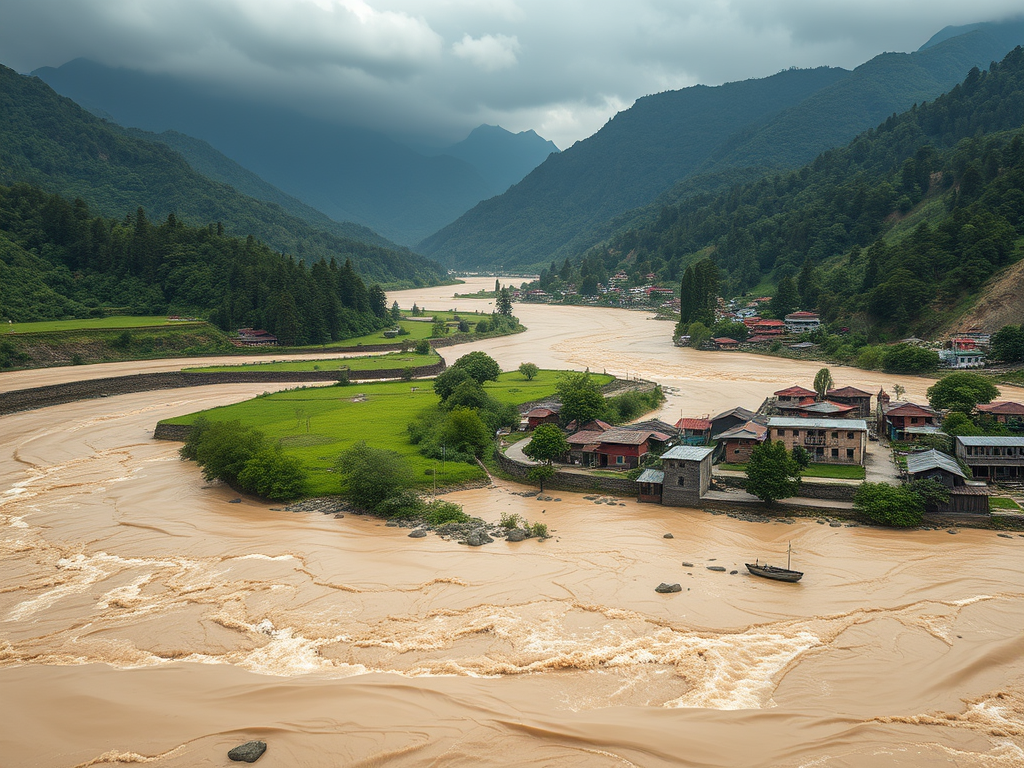
Rising greenhouse gas emissions could see the size of extreme floods in the Central Himalayas increase by between as much as 73% and 84% by the end of this century.
Geographers at Durham University, UK, simulated the risk of increased flooding on the Karnali River, which spans Nepal and China and has the potential to impact communities in Nepal and India.
They found that extreme floods – those with a 1% chance of happening within a year – could increase in size by 22% and 26% between 2020 and 2059, compared to flooding seen in the region between 1975 and 2014.

This increase is expected to be within 37% and 43% between 2060 and 2099 with medium greenhouse gas emissions. High greenhouse gas emissions could see the size of extreme floods increase by between 73% and 84% in the same period.
The findings, published in the journal Scientific Reports, highlight the scale of the increase in flooding that communities in the Central Himalayas could experience.
The researchers say their study could inform local flood hazard management in the region.
The floodplains of the Central Himalayan foreland are among the most flood-affected areas of the world.
In September 2024, floods caused 236 deaths and displaced 8,400 people, along with damage worth 1% of Nepal’s gross domestic product (GDP). By 2050, flood damages are projected to account for 2.2% of Nepal’s annual GDP.
Flooding in the Himalayan foreland in Nepal also has consequences for food insecurity and the outbreak of epidemics, which would likely be exacerbated by higher greenhouse gas emissions.
Dr Ivo Pink, in the Department of Geography/Institute of Hazard, Risk and Resilience, Durham University, said: “The densely populated Central Himalayan foreland is prone to flooding, and our findings show that the intensity of extreme floods is only going to get worse across the coming century as greenhouse gas emissions increase.
“Floods with a 1% chance of happening within a year could occur once every five to 10 years at the end of the century.
“This shows the urgent need to cut global greenhouse gas emissions as soon as possible, because flood hazards will continue to increase for decades after the emission peak.”
The Durham researchers coupled climate projections from different research centres worldwide with hydrological simulations and statistical analysis.
Increased rainfall would be the largest source of floodwater, rather than snow or glacier melt.
The study shows that large sets of climate models are needed to predict changes in extreme floods because they occur infrequently, the researchers add.
Professor Sim Reaney, in the Department of Geography, Durham University, said: “It is often stated that ‘all forecasts are uncertain, especially those about the future’. Our study addresses this problem of the uncertainties in potential future flood hazards in Nepal by combining uncertainties from both climate and river flow simulations.
“We can then see the range of possibilities for the future and make effective decisions to reduce flood hazards and improve the livelihoods of people living on the Central Himalayan foreland.”


Leave a Reply