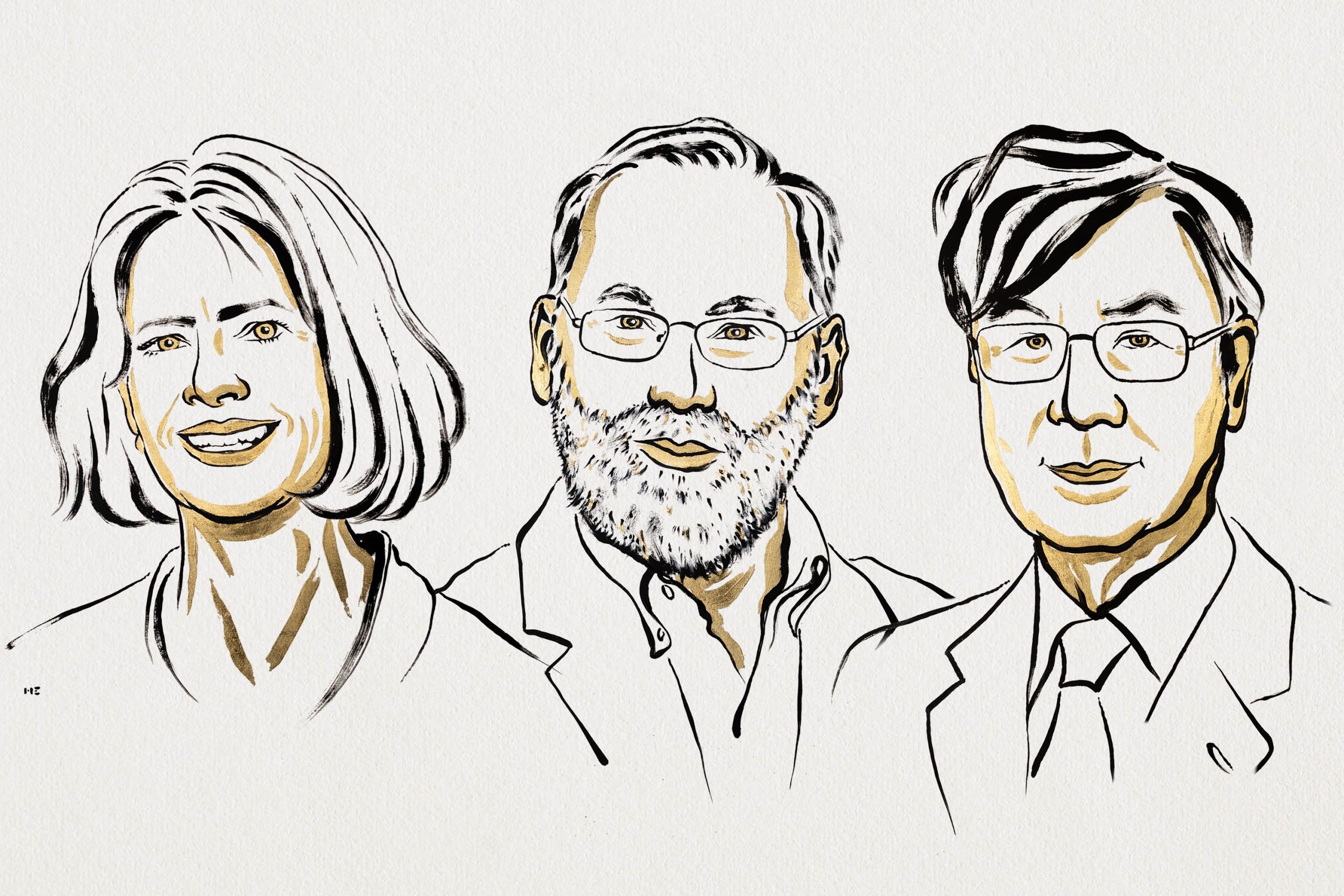
Immune tolerance pioneers honored for unlocking body’s self-control
Mary E. Brunkow, Fred Ramsdell, and Shimon Sakaguchi received the medicine prize for discoveries explaining how the immune system prevents self-destruction through peripheral tolerance. The committee traced a path from Sakaguchi’s 1995 identification of regulatory T cells (T-regs), to Brunkow and Ramsdell’s 2001 finding that mutations in the Foxp3 gene disrupt this control, and finally to work showing Foxp3 governs T-reg development. The research opened a field focused on harnessing T-regs to treat autoimmune disease and cancer and clarified why most people don’t develop severe autoimmunity. The trio—based in Seattle, San Francisco, and Osaka—will share 11 million Swedish kronor, with the ceremony on December 10. Their work demonstrates how overlapping immune checks and balances avert damaging overreactions. (AP)
When will autonomous AI make Nobel-worthy science?
A news feature explores whether artificial intelligence could soon be credited with a prize-level discovery. Rapid advances show models analyzing data, proposing hypotheses, and even designing experiments, prompting some researchers to forecast “AI scientists” capable of competing with top human minds within decades. Others argue autonomy remains speculative and undesirable without rigorous oversight. The piece weighs how credit, accountability, and authorship would work if AI leads breakthroughs, and whether existing prize rules could recognize nonhuman contributors. It also surveys milestones in materials discovery and mathematics that hint at emerging capabilities, while stressing unresolved ethical and governance questions. Overall, it frames the debate around feasibility, desirability, and the changing nature of discovery as AI systems become integral to research. (Nature)
Mira Murati’s Stealth AI Lab Launches Its First Product
Former OpenAI CTO Mira Murati’s new startup, Thinking Machines Lab, debuted “Tinker,” a developer platform that automates fine-tuning for top models while keeping users’ data and training choices private. The launch positions fine-tuning—especially reinforcement learning–based post-training—as the next competitive wedge beyond simple API access. Early users highlight simpler distributed training, guardrails for misuse, and support for families like Llama and Qwen. The company’s pitch: give teams the knobs Big Tech uses internally without forcing them to hand over sensitive corpora. It’s also a signal of how fast the tooling around frontier models is professionalizing, potentially accelerating bespoke AI across industries while raising policy questions about capability access. (WIRED)
Meta Will Use Your AI Chats to Power Targeted Recommendations
Meta plans to notify users on October 7 that conversations with its AI will inform content and ad recommendations starting December 16. Opt-out isn’t offered; instead, Meta frames the change as personalization spanning Facebook, Instagram, and WhatsApp. Privacy advocates worry the move blurs boundaries between “assistant” interactions and behavioral tracking, especially when chats may contain sensitive context. Regulators in the EU and elsewhere could scrutinize consent and data-processing bases. For creators and advertisers, richer intent signals may boost engagement and conversion—if user backlash doesn’t force rollbacks. The shift highlights a growing trend: companies mining assistant interactions as first-party data to offset tighter tracking elsewhere. (Ars Technica)
AI-Designed Toxins Are Slipping Past Safety Screens, Study Finds
A Science investigation reports that modest, AI-assisted edits to known toxin sequences can evade gene-synthesis safety checks used by companies to block dangerous orders. Researchers show how today’s filters—often governed by voluntary standards—struggle when sequences are altered yet remain functionally hazardous. The piece urges harmonized, auditable pipelines; third-party oversight; and mechanisms for sharing threat intelligence without leaking “how-to” details. As generative biology tools mature, experts argue that screening must become adaptive and standardized, paired with layered controls at labs and vendors. The bottom line: technical and policy guardrails haven’t kept pace with AI-accelerated design, and patchwork defenses may leave exploitable gaps unless the ecosystem modernizes. (Science)
“Silicon Samples” Can Skew Social Science, Researchers Warn
Scientists testing AI-generated “participants” found these synthetic subjects can distort experimental outcomes, particularly for social science studies. Because models mirror training data and researcher prompts, results may look precise yet systematically biased, creating false confidence in replicability. The authors recommend strict labeling, validation against real human cohorts, and using synthetic data only for limited, pre-registered purposes (e.g., power estimation). The warning arrives as lab budgets shrink and AI tools tempt researchers with cheap, scalable samples. The message: silicon participants can be useful—if treated as simulations with known failure modes, not stand-ins for people. Peer reviewers and journals may need new disclosure and auditing norms as usage grows. (Science)
AI Generates Working Phage Genomes That Kill E. coli in the Lab
Two models, Evo 1 and Evo 2, designed hundreds of bacteriophage genomes from scratch; 16 proved viable in experiments, and some outpaced a classic E. coli phage at suppressing bacterial growth. Researchers avoided human-infecting pathogens and used a well-studied template to limit risk, but the work underscores generative biology’s dual-use edge: powerful for rapid therapeutics, troubling for biosecurity. Regulators and vendors are racing to upgrade sequence-screening tools as design gets easier. The study marks a milestone: AI isn’t just tweaking biology—it’s composing viable viral genomes with useful properties, accelerating the iterate-and-test loop in wet labs. (Science News)
Patching the Filters: New Safeguards Target AI-Designed Proteins
Following demonstrations that AI can help craft harmful protein variants that bypass vendor checks, researchers rolled out software patches that better flag risky orders. Early tests show improved sensitivity to adversarial edits without overwhelming labs with false positives. Still, experts caution that no single gate will suffice; layered safety (screening + human review + secure fulfillment) is essential as models lower the barrier to sequence manipulation. The episode highlights a cat-and-mouse dynamic familiar from cybersecurity: as design tools advance, defenses must iterate quickly, share threat intel, and undergo independent audits. Expect funders and journals to push for standardized reporting on screening practices. (Science News)
AI Helps Tame Fusion Plasmas by “Seeing” What Sensors Miss
Princeton-led researchers unveiled an AI control aid that infers hidden plasma states from indirect diagnostics, predicting instabilities early enough to adjust actuators and improve confinement. By fusing disparate signals, the system reconstructs latent dynamics—akin to recreating missing audio from video—reducing disruptions that plague tokamaks. If generalizable beyond the testbeds, the approach could complement physics-based controllers, boosting uptime and efficiency for future reactors. It’s another sign that high-stakes scientific infrastructure is embracing AI not just for analysis but for real-time operations, where reliability, interpretability, and safety certification will be as important as performance gains. (SciTechDaily)
AI Spots Hidden Cellular Disease Markers Before Symptoms
A McGill-led team introduced DOLPHIN, an interpretable AI that mines single-cell datasets to uncover subtle molecular patterns linked to disease, potentially enabling earlier diagnosis and better treatment selection. Validated across multiple cohorts, the method surfaces weak, high-dimensional signals clinicians typically miss, offering hypotheses for follow-up testing rather than definitive calls. The researchers stress that prospective trials, clinical guardrails, and transparency will be critical before deployment, but the work exemplifies AI’s growing role as a microscope for biology—highlighting risk flags across tissues long before traditional symptoms emerge. If integrated with routine profiling, such tools could help triage patients for preventative care. (SciTechDaily)
Study Finds AI-Written Content Quietly Rising in Public Communications
An analysis in Patterns suggests that roughly 17% of sampled corporate and governmental text—ranging from job ads to press releases—now shows AI authorship markers, with usage accelerating since 2022. Researchers warn that undisclosed AI writing can obscure accountability, launder claims through automated fluency, and amplify subtle biases. They call for clearer disclosures and internal policies that specify when AI can draft, summarize, or translate public-facing material. For newsrooms, regulators, and consumers, the findings raise verification stakes: slick text no longer guarantees human oversight. The authors also note benefits—speed, accessibility, and multilingual reach—if organizations pair AI with editorial review and transparent labeling. (phys.org)
Global antibiotic and diagnostic pipeline shows alarming gaps
Two new World Health Organization analyses warn that development of treatments and tests for drug-resistant infections is faltering. The antibacterial clinical pipeline fell from 97 candidates in 2023 to 90 in 2025, with only 15 considered innovative and just 5 targeting at least one “critical priority” pathogen. Approvals since the last review are scarce; withdrawals outpace additions. Pediatric indications, oral options for outpatient use, and agents with meaningful novelty remain limited. The preclinical pipeline is larger but dominated by small companies facing steep economic hurdles. A companion report flags diagnostic shortfalls in low-resource settings, where platforms for rapid identification and susceptibility testing are often inaccessible. WHO urges significant investment in innovative antibiotics and simpler, cheaper diagnostics to slow antimicrobial resistance. (CIDRAP)
After Climate.gov’s Shutdown, Educators Race to Replace Data
After NOAA’s Climate.gov went dark in June, teachers like Illinois biology instructor Jeffrey Grant scrambled to save graphs and datasets used to teach climate analysis. The site’s shutdown—after the Trump administration dismissed ten science communication staff—now redirects to a pared-down NOAA page framed as “centralization.” It reflects broader efforts to restrict climate research and education, remove datasets, and retreat from emissions commitments; Trump even called climate change “the greatest con job.” Educators warn standards that weave climate change into classes will suffer if data grow harder to find. Defunding idled CLEAN, a NOAA-funded repository of 800 lessons, leaving materials online but unmaintained. Nonprofits like SubjectToClimate are scrambling to replace vanished data. Former staff are crowdfunding climate.us to restore, update, and safeguard content from political interference. (Science)
Pro sports venues push greener playbooks, from solar to zero-waste
A report spotlights sustainability programs at major football venues, led by efforts in Philadelphia, Atlanta, and Santa Clara. One stadium’s solar array now provides about 40% of annual energy, with renewable energy credits covering the rest. Another became the first professional sports facility to achieve a top waste-diversion certification, with roughly 98% of concession materials compostable and a rainwater cistern supporting irrigation. Teams pair infrastructure (solar panels, rooftop gardens, recycling/composting) with fan-facing nudges—recognizing recyclers on the big screen, promoting transit, and modeling behaviors that can carry home. League initiatives also fund local ecological projects around marquee events. Experts note tailgating waste remains a challenge, but argue visible, incremental steps can shift norms at scale. (AP)



Leave a Reply