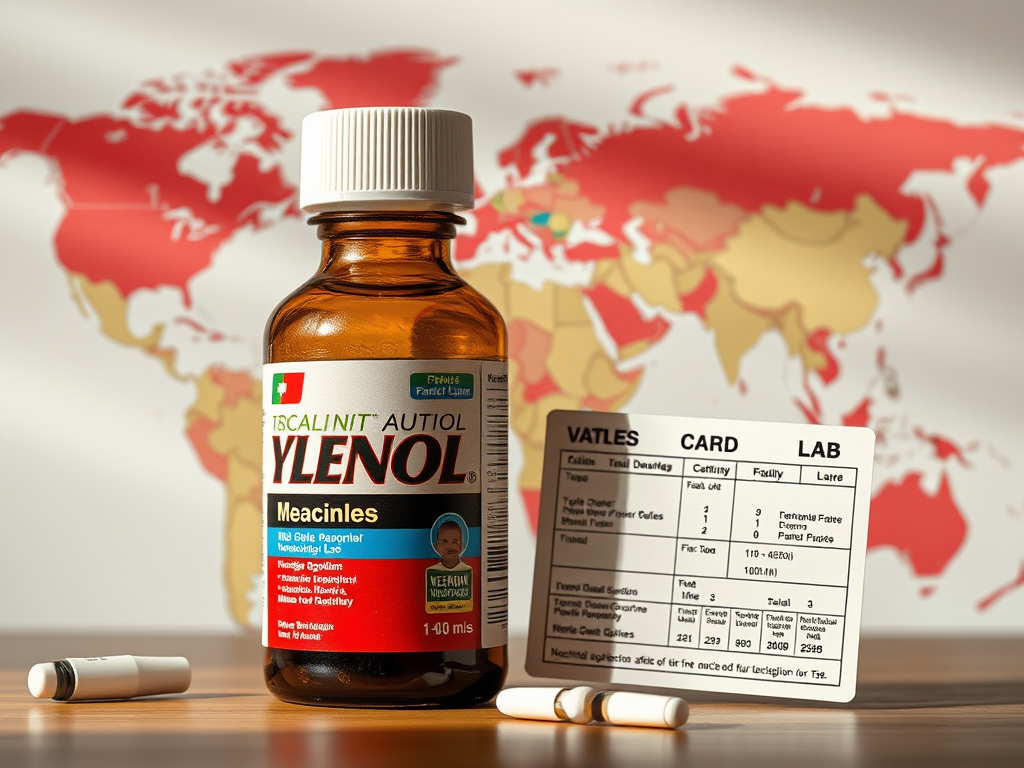
Tylenol–Autism Claims Resurface Amid Political Announcement
A high-profile announcement revived unproven claims that acetaminophen (Tylenol) use in pregnancy and routine childhood vaccines contribute to autism, despite decades of research finding no causal link. The remarks urged pregnant people to avoid Tylenol and suggested spacing vaccines, positions clinicians warned could harm patients by discouraging treatment of fever and undermining immunization schedules. Experts cited conflicting observational studies on prenatal acetaminophen and autism and emphasized confounding by maternal illness. Professional groups reiterated current guidance that acetaminophen remains appropriate when used as directed in pregnancy. The event also previewed a government push to investigate autism’s causes and floated agency actions, including notifying clinicians of a “possible association,” while drawing sharp criticism from scientists who called the claims irresponsible and unsupported. (AP News)
Scientists Explain Why Tylenol–Autism Link Lacks Solid Evidence
Following public admonitions to “Don’t take Tylenol,” researchers reviewed the evidence on acetaminophen use in pregnancy and autism and concluded that robust data do not support a causal link. Two large, high-quality studies—including sibling-comparison designs in Sweden (~2.5 million births) and Japan (>200,000 children)—found no association after adjusting for confounding. Observational findings suggesting risk are likely biased by unmeasured factors such as maternal illness, fever, or recall error. Regulators announced a new warning label noting a “possible association,” and officials discussed exploring leucovorin for a folate-transport deficiency subgroup, but experts cautioned that focusing on acetaminophen distracts from more plausible contributors and risks misinforming patients. The consensus message: treat fever appropriately and avoid drawing causal conclusions from weak associations. (Nature)
Measles Explodes Across the Americas, Imperiling Elimination Gains
New regional data show 11,313 measles cases and 23 deaths reported this year across ten countries in the Americas—a 31-fold increase over the same point last year (358 cases). Health officials attribute the surge to pandemic-era immunization gaps, undervaccinated communities, and cross-border spread. The pattern raises concerns that multiple nations could lose elimination status unless two-dose MMR coverage rebounds above 95%. Authorities urge catch-up campaigns, stronger surveillance, and targeted outreach ahead of travel seasons. The update also underscores the risk of imported cases igniting outbreaks where local immunity is thin. Public health guidance emphasizes rapid case identification, post-exposure prophylaxis, and school-entry enforcement as key tools to block transmission while rebuilding routine vaccination systems strained in recent years. (cidrap.umn.edu)
Asteroid Impact Confirmed for North Sea’s Silverpit Crater
Scientists have confirmed that the Silverpit Crater, located 700 meters below the North Sea seabed, was formed by an asteroid or comet impact 43–46 million years ago. Led by Dr. Uisdean Nicholson, the team used seismic imaging and microscopic rock analysis, published in Nature Communications (2025, DOI: 10.1038/s41467-025-63985-z). They found “shocked” quartz and feldspar, proving extreme impact pressures, and estimated a 160-meter asteroid triggered a 100-meter tsunami. This 3 km-wide crater, with a 20 km fault zone, is a rare, well-preserved hypervelocity impact site, offering insights into planetary impacts and future collision risks, joining confirmed craters like Chicxulub. (phys.org)
Superheavy Gravitinos Proposed as Dark Matter Candidates
Researchers from the University of Warsaw and Max Planck Institute propose superheavy charged gravitinos as dark matter candidates, linking to N=8 supergravity. Published in Physical Review Research, their study suggests the JUNO detector, set to begin measurements in 2025, could detect these particles due to unique signals. Simulations account for backgrounds like radioactive decay, revealing distinct gravitino signatures. Detection would provide evidence for physics near the Planck scale, advancing unified theory research. However, their rarity poses detection challenges, with future detectors like DUNE offering hope. This could reshape our understanding of dark matter and gravity. (phys.org)
Engineered Salmonella Targets Colorectal Tumors in Mice
Scientists at NUS Medicine and Central South University engineered Salmonella typhimurium to self-destruct inside colorectal tumors, releasing the protein LIGHT to activate the LIGHT-HVEM immune pathway. This boosted ILC3s, matured tertiary lymphoid structures, and enhanced CD8+ T cell activity, reducing tumor growth in mice. Tested in genetic and chemical cancer models, the therapy relies on LIGHT-HVEM signaling. Human responses and bacterial therapy risks remain concerns. If translatable, this “living medicine” could complement existing treatments, with human trials planned. The study appeared in Science Translational Medicine. (New Atlas)
AI-Driven SCIGEN Accelerates Quantum Material Discovery
MIT’s SCIGEN technique steers AI diffusion models to design materials with exotic quantum properties, like superconductivity, by enforcing geometric constraints. Published in Nature Materials, it generated 10 million candidate materials with Archimedean lattices. After screening, two compounds, TiPdBi and TiPbSb, were synthesized, showing predicted magnetic traits. Supported by the U.S. Department of Energy, SCIGEN could advance quantum computing materials, though experimental validation remains crucial. (Eureka Alert)
Ultrasmall Nanoparticles Enable Advanced Medical Imaging
Researchers at Martin Luther University developed light-sensitive single-chain nanoparticles (SCNPs) with polypyrrole for medical imaging. These nanoparticles absorb near-infrared light, converting it to heat, enabling photoacoustic imaging for 3D body models. They could aid cancer research by visualizing tumors and potentially deliver drugs or destroy cancer cells via hyperthermia. Published in Communications Chemistry, the study was funded by the German Research Foundation. (Eureka Alert)
Teen Scientists Study E. coli in Space
St. Francis High School teens launched an experiment via the Knight Skies Program to compare E. coli protein synthesis on Earth and the ISS. Using Mixstix, they studied GFP production, finding mRNA levels in space nearly tripled. Launched via SpaceX CRS-31, the experiment could impact space-based biomedical manufacturing, like insulin production. Results are being prepared for publication. (The Scientist)
Enceladus’ Organic Compounds May Form Above Ground
A study suggests organic compounds in Enceladus’ geysers may form via high-energy radiation, not solely from its ocean. Presented at the Europlanet Science Congress and published in Planetary and Space Science, the research recreated Enceladus’ conditions, producing acetylene and matching Cassini-detected compounds. This cautions against assuming plume chemicals indicate life, though habitability remains possible. (Science News)
NASA’s 2025 Astronaut Class Prioritizes Lunar Missions
NASA’s Group 24 astronaut class, announced September 22, includes 10 members, with six women, selected from 8,000 applicants. Training for ISS, commercial stations, and Artemis moon missions, the class aims for a 2027 lunar landing. Beating China to the moon is a priority, despite Starship delays. The class may also support Mars missions. (Space News)
New Thruster Tackles Space Debris Crisis
Tohoku University’s bidirectional plasma thruster, enhanced by fusion reactor magnetic fields, boosts deceleration force for space debris removal. Published in Scientific Reports, the thruster generated 25 millinewtons at 5 kilowatts, nearing the force to de-orbit a one-tonne satellite. This non-contact method avoids entanglement risks, advancing safe debris management in low-Earth orbit. (Popular Mechanics)



Leave a Reply