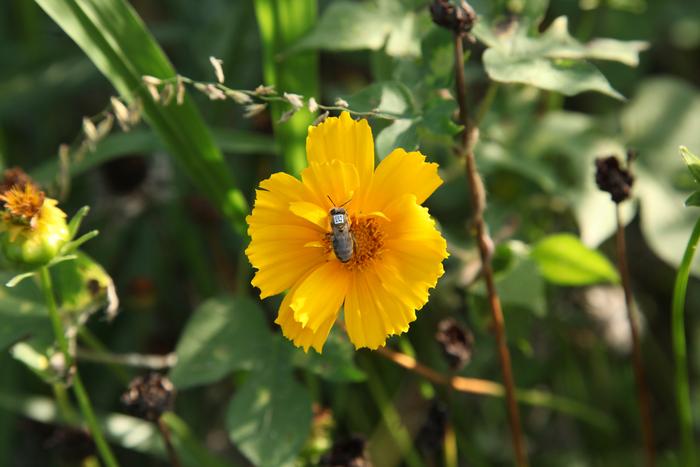
Several genetic variants associated with social behavior in honey bees are located within genes that have previously been linked to social behavior in humans, Ian Traniello at the University of Illinois at Urbana-Champaign, USA, and colleagues report on September 16th in the open-access journal PLOS Biology. The results hint at ancient roots to social behavior that have been conserved across species.
In social species, there is individual variation in sociability — some individuals are highly social and well-connected within their society, whereas others prefer less social interaction. This variation can be driven by many factors, including mood, social status, previous experience, and genetics. However, the genetic and molecular mechanisms that influence sociability are poorly understood.
Researchers used a combination of genome sequencing, brain gene expression analysis, and behavioral observations to investigate the genetic mechanisms underpinning variation in social behavior in western honey bees (Apis mellifera). They collected adult honeybees from three colonies and attached tiny barcodes to their bodies, enabling automated tracking of their social behaviors within glass-walled observation hives. Whole-genome sequencing of 357 bees revealed 18 genetic variants associated with the tendency to share nutritious liquid with nestmates — a social behavior known as ‘trophallaxis’. Several of those variants were located within two genes, neuroligin-2 and nmdar2, which share a similar sequence to genes that have previously been linked to autism in humans. Transcriptome sequencing also revealed over 900 genes that were more highly expressed in the brain the more frequently a bee interacted with her nestmates.
The results highlight similarities in the genetic mechanisms underpinning social behavior in humans and bees — species that diverged over 600 million years ago. Sociability is a complex characteristic, controlled by many genes, but these shared genomic features suggest there are ancient molecular building blocks of social life that have been conserved through millions of years of evolution, even if humans and bees evolved social life independently, the authors say.
The authors add, “It is a central feature of all societies that group members often engage with one another, but vary in their tendency to do so. Combining automated monitoring of social interactions, DNA sequencing, and brain transcriptomics in honey bee colonies, we identified evolutionarily conserved molecular roots of sociability shared across phylogenetically distinct species, including humans.”
Sign up for the Daily Dose Newsletter and get every morning’s best science news from around the web delivered straight to your inbox? It’s easy like Sunday morning.
Ian Traniello adds, “Social insects are ideal for whole-colony behavioral tracking, and the technology is such that we can monitor what each bee is doing throughout the majority of her life.
In this study, we sought to push things a step forward, thinking, ‘We can follow all of these animals, we know who they’re socially engaging via food-sharing interactions, we know how they move and where they spend their time. The honey bee molecular toolkit is vast and growing, and we can also explore the structure of the genome or gene expression patterns within the brain as they relate to variation in social interactivity.’ We asked: ‘How can we bring these technologies together, to ask general questions about the molecular underpinnings of social organization and test the hypothesis that some of these features might be conserved across species?’ And that’s exactly what we did.”
IMAGE CREDIT: Dr. Zachary Huang (CC-BY 4.0, https://creativecommons.org/licenses/by/4.0/).
Leave a Reply