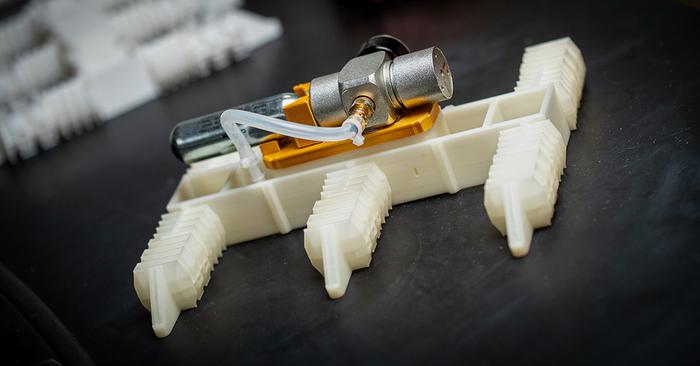
Imagine a robot that can walk, without electronics, and only with the addition of a cartridge of compressed gas, right off the 3D-printer. It can also be printed in one go, from one material.
That is exactly what roboticists have achieved in robots developed by the Bioinspired Robotics Laboratory at the University of California San Diego. They describe their work in an advanced online publication in the journal Advanced Intelligent Systems.
To achieve this feat, researchers aimed to use the simplest technology available: a desktop 3D-printer and an off-the-shelf printing material. This design approach is not only robust, it is also cheap—each robot costs about $20 to manufacture.
“This is a completely different way of looking at building machines,” said Michael Tolley, a professor in the UC San Diego Department of Mechanical and Aerospace Engineering and the paper’s senior author.
These robots could be used in settings where electronics cannot function. For example, the robots could be used for scientific reconnaissance in areas with strong radiation, or for disaster response or space exploration.
The researchers tested the robots in the lab and showed that as long as they were connected to a source of air or gas under constant pressure, they could keep functioning non-stop for three days. The team also showed that the robots could walk outdoors, untethered, using a compressed gas cartridge as a power source, and traverse different surfaces, including turf and sand. The robot can even walk underwater.
Sign up for the Daily Dose Newsletter and get every morning’s best science news from around the web delivered straight to your inbox? It’s easy like Sunday morning.
The goal was not only to design robots that could walk right off the printer, with the addition of an air power source but also to do so with flexible, soft materials. “These robots are not manufactured with any of the traditional, rigid components researchers typically use,” Tolley said. Instead, they are made of simple 3D-printing filament.
The biggest challenge was creating a design that would include artificial muscles and a control system, all printed out of the same soft material, in a single print. The team, led by postdoctoral scholar Yichen Zhai in Tolley’s research group at the UC San Diego Jacobs School of Engineering, adapted a 3D printing technique that they used previously to build an electronics-free gripper. Their efforts led to the fabrication of a six-legged robot. “We have taken a giant leap forward with a robot that walks entirely on its own,” Zhai said.
To drive the robots to move, the team created a pneumatic oscillating circuit to control the repeated motions of soft actuators, similar to the mechanism that drove a locomotive’s steam engine. The circuit coordinates the movement of the six legs by delivering air pressure at the right time alternating between two sets of three legs. The robots’ legs are capable of moving in four degrees of freedom—up and down, forward and back, which in turn allows the robot to walk in a straight line.
Next steps include finding ways to store the compressed gas inside the robots and using recyclable or biodegradable materials. The researchers are also exploring ways to add manipulators, such as grippers, to the robots.
Tolley’s lab partnered with the BASF corporation through their California Research Alliance (CARA) to test various soft materials that could be used on standard 3D printers. Some of the high-end materials they tested are not commercially available, but researchers also successfully printed the robots with off-the-shelf, standard materials.
IMAGE CREDIT: David Baillot/University of California San Diego




Leave a Reply