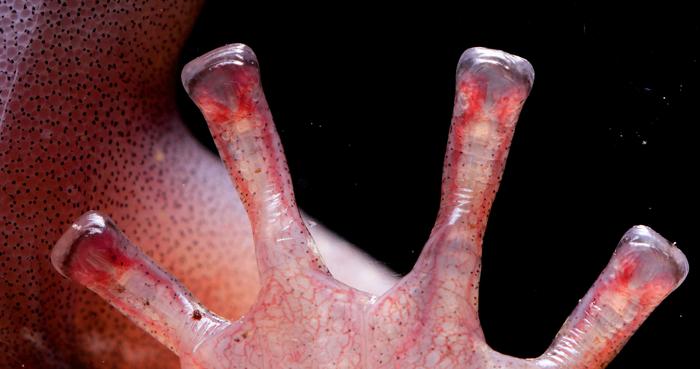
Wandering salamanders are known for gliding high through the canopies of coastal redwood forests, but how the small amphibians stick their landing and take-off with ease remains something of a mystery.
A new study in the Journal of Morphology reveals the answer may have a lot to do with a surprising mechanism: blood-powered toes. The Washington State University-led research team discovered that wandering salamanders (Aneides vagrans) can rapidly fill, trap, and drain the blood in their toe tips to optimize attachment, detachment and general locomotion through their arboreal environment.
The research not only uncovers a previously unknown physiological mechanism in salamanders but also has implications for bioinspired designed. Insights into salamander toe mechanics could ultimately inform the development of adhesives, prosthetics, and even robotic appendages.
“Gecko-inspired adhesives already allow surfaces to be reused without losing stickiness,” said Christian Brown, lead author of the study and an integrative physiology and neuroscience postdoctoral researcher at WSU. “Understanding salamander toes could lead to similar breakthroughs in attachment technologies.”
Discovery sparked by a documentary shoot
Salamanders of the Aneides genus have long puzzled scientists with their square-shaped toe tips and bright red blood “lakes” that can be seen just beneath their translucent skin. Historically, these features were thought to aid oxygenation, but no evidence supported that claim.
Sign up for the Daily Dose Newsletter and get every morning’s best science news from around the web delivered straight to your inbox? It’s easy like Sunday morning.
Brown’s interest in the topic traces back to an unexpected observation during the filming of the documentary, “The Americas,” which airs on Feb. 23 on NBC and Peacock. While assisting on set as the resident salamander expert, Brown had the opportunity to observe through the production team’s high-powered camera lenses how the amphibians move around.
He noticed something strange. Blood was rushing into the small creatures’ translucent toe tips moments before they took a step. Brown and camera assistant William Goldenberg repeatedly observed the phenomenon. “We looked at each other like, ‘Did you see that?’” Brown said.
Though the producers moved on, Brown’s curiosity didn’t. After the shoot, he reached out to Goldenberg and asked if he was interested in using his film equipment to investigate what they had observed in a scientific and repeatable way.
Through high-resolution video trials and corroborating analysis in WSU’s Franceschi Microscopy & Imaging Center, Brown, Goldenberg and colleagues at WSU and Gonzaga University uncovered that wandering salamanders can finely control and regulate blood flow to each side of their toe tips.
This allows them to adjust pressure asymmetrically, improving grip on irregular surfaces like tree bark. Surprisingly, the blood rushing in before “toe off” appears to help salamanders detach rather than attach. By slightly inflating the toe tip, the salamanders reduce the surface area in contact with the surface they are on, minimizing the energy required to let go. This dexterity is crucial for navigating the uneven and slippery surfaces of the redwood canopy—and for sticking safe landings when parachuting between branches.
“If you’re climbing a redwood and have 18 toes gripping bark, being able to detach efficiently without damaging your toe tips makes a huge difference,” Brown said.
The implications of the research could extend beyond Aneides vagrans. Similar vascularized structures are found in other salamander species, including aquatic ones, suggesting a universal mechanism for toe stiffness regulation that may serve different purposes depending on the salamander’s environment. Moving forward, Brown and colleagues plan to expand the research to look at how the mechanism works in other salamander species and habitats.
“This could redefine our understanding of how salamanders move across diverse habitats,” Brown said.
IMAGE CREDIT: William P. Goldenberg




Leave a Reply