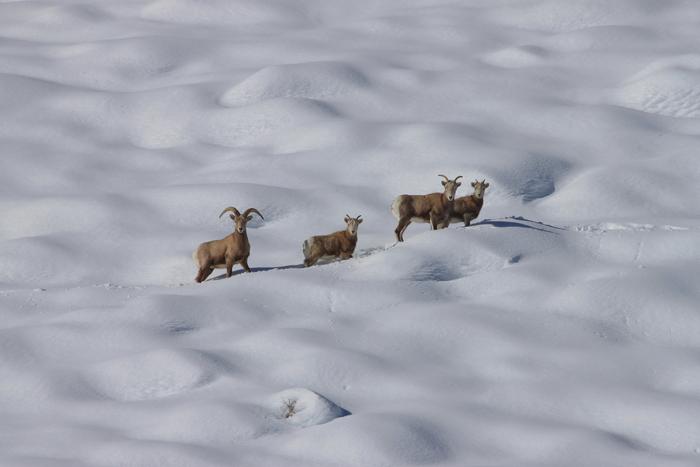
Snow cover in the Sierra Nevada is expected to shrink overall as the climate warms, but avalanche frequency could remain the same or even increase at high elevations. That’s bad news for bighorn sheep that live there, according to new research to be presented at AGU’s 2024 Annual Meeting.
In John Muir’s 1894 book “The Mountains of California,” he praised the “perfect strength and beauty” of the wild Sierra Nevada bighorn sheep, “leaping unscathed from crag to crag.” Those bighorn sheep are now an endangered species. After surmounting its first threats — diseases from and overgrazing by domestic sheep settlers introduced to the Sierra Nevada — the species made a slow comeback, crawling from 100 individuals in 1995 to 600 in 2015. But much of that conservation work is being undone by a new threat: avalanches. Together with mountain lion predation, the Sierra bighorn sheep population has halved since 2023.
Ned Bair, a researcher at the University of California, Santa Barbara, and colleagues ran simulations for the current (1990-2020) and future (2050-2080) climate to find out how avalanches might continue to affect bighorn sheep. They found that while snow cover may decrease in the Sierra Nevada as the climate warms, avalanches that kill bighorn sheep might not.
“There’s certainly going to be less snow in the future, and it’s going to impact the sheep, which are very fragile as is,” Bair said. “In dry winters, they don’t have enough forage. And in the big winters, they die of starvation and avalanches.”
Bair will present his work on Tuesday, 10 December 2024 at AGU’s Annual Meeting in Washington, D.C., where more than 26,000 scientists gather to discuss the latest Earth and space science research.
A perilous environment for bighorn sheep
While bighorn sheep exist in other western mountain ranges, the Sierra Nevada subgroup is genetically distinct — the remaining 350 sheep are all that remain of the species. The few remaining herds of the sheep live at rocky, high elevations, and forage on grasses, herbs and shrubs.
“They like to live in very challenging environments, hence the avalanche problem,” Bair said.
Sign up for the Daily Dose Newsletter and get every morning’s best science news from around the web delivered straight to your inbox? It’s easy like Sunday morning.
Snow is an essential water source for bighorn sheep, but it can also be dangerous. The 2022-2023 winter in California set precipitation records and dumped approximately 18 meters (60 feet) of snow onto the Sierra Nevada. That winter, avalanches killed at least 73 bighorn sheep, with 12 deaths from just one avalanche, according to the California Department of Fish and Wildlife.
The researchers projected how much snow would fall throughout the Sierra Nevada under future climate change, using precipitation data from past dry years (2013 and 2018) and a wet year (2019) to run their simulations.
While snow cover will generally decrease in the Sierra Nevada in the future, that decrease will mostly be at lower elevations, where snowfall may become rain. The high elevations where bighorn sheep live will have fewer changes to snow cover. Those high elevations may even see an increase in snow accumulation as climate change increases the number and strength of California’s atmospheric rivers, which were responsible for the Sierra Nevada’s deep snowpack in 2023. More snow could mean more avalanches at high elevations, leading to more bighorn sheep deaths.
It is not yet clear how the California Department of Fish and Wildlife’s Bighorn Sheep Recovery Program, founded after 2023’s devastating winter, will adapt to increased avalanches. The wild sheep could also see increased threats from recovering wolf and mountain lion populations.
“It’s a hard population to sustain,” Bair said. “I think there are some real challenges with being assured of at least my children being able to see a bighorn sheep in the wild when they’re my age.”
IMAGE CREDIT: California Department of Fish and Wildlife/Steve Yaeger
.




Leave a Reply