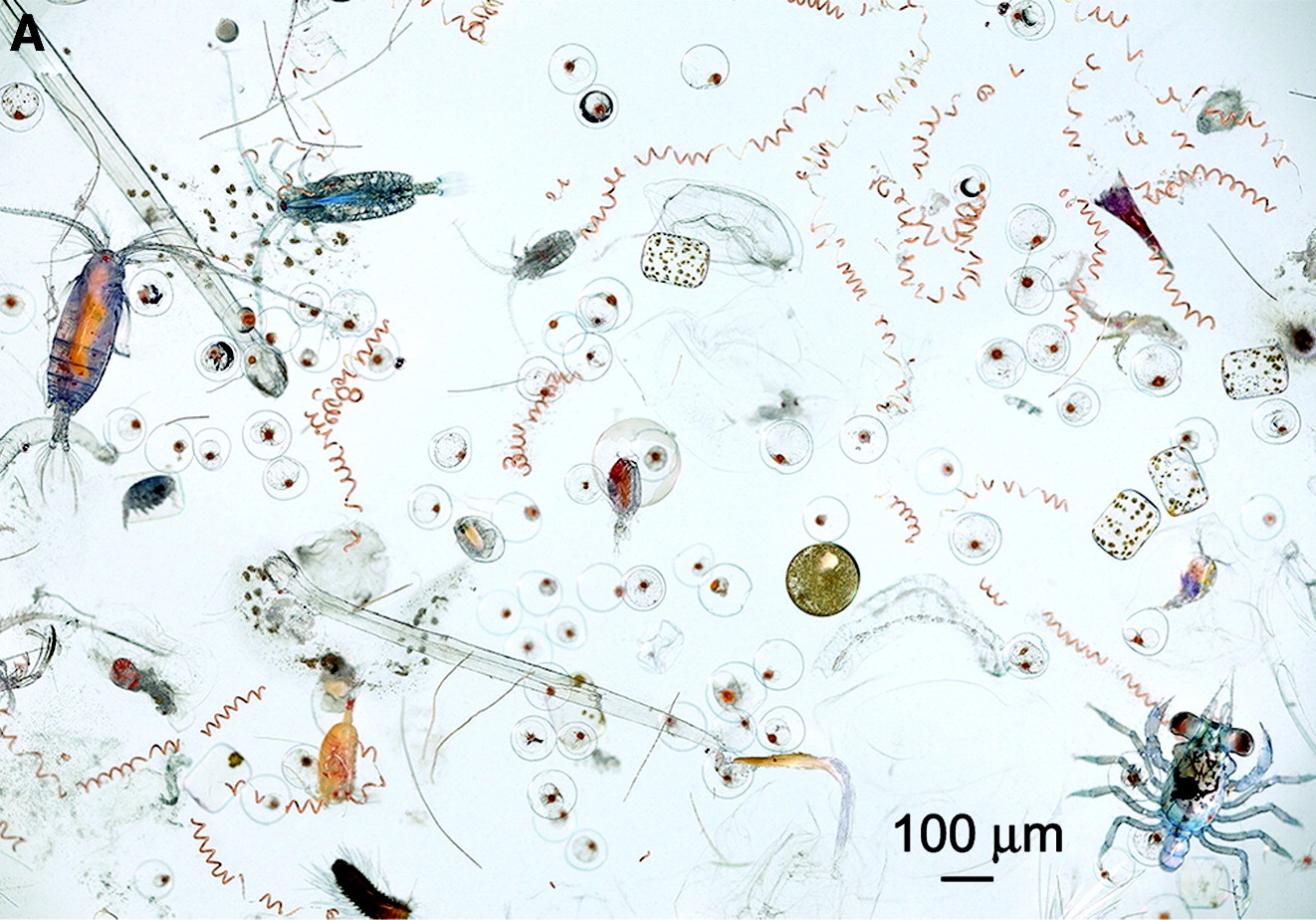
How do particles move in turbulent fluids? The answer to this question can be found in a new model presented in a thesis from the University of Gothenburg. The model could help speed up the development of new drugs.
When you stir a glass of water, it is easy to think that any particles in the water will end up in chaos and move completely randomly. But this is not always the case. For example, the so-called active micro-swimmers can move through flow on their own. Navid Mousavi, a PhD student at the University of Gothenburg, has created a model including various hydrodynamic factors to study how these particles handle and even utilise turbulence.
Micro-swimmers can be biological, such as plankton, or engineered particles such as nanomotors. Plankton contribute to global ecosystems by producing oxygen and they form the basis of the ocean food web.

Navid Mousavi has created new methods for modelling and studying the navigation of micro-swimmers by combining active matter physics with machine learning principles. The thesis finds optimal behaviours for plankton to survive in their turbulent habitat.
“In the model, plankton use local information for navigation, reflecting the real-world conditions that these small swimmers encounter. Unlike previous models where navigation was based on global information,” says Navid Mousavi.
The research also showed that micro-swimmers can utilise the flow to move faster than they can on their own, which is an important insight for both biological and artificial applications.
Another exciting result of the study is the discovery of optimal behavior to avoid high turbulent strain. Surprisingly, it is observed that micro-swimmers tend to swim against the current to keep their position in low-strain regions.
“This behaviour seems to be crucial for survival and allows plankton to avoid predators and stay in nutrient-rich zones,” says Navid Mousavi.

Important knowledge for medicine development
All the strategies found were shown to work effectively in several different scenarios, meaning they can be applied to real-life situations.
The results of the study provide important knowledge that has several applications. An example is in medicine, where it could help develop smart micro-swimmers that can deliver drugs directly to specific areas of the body, making treatments more effective. Environmentally, these tiny swimmers could help clean up microplastics from our oceans and contribute to a healthier planet.
“In the future, we will need to validate the model in experiments, both with natural plankton and artificial micro-swimmers,” says Navid Mousavi.
The researchers also plan to investigate more complex models that deals with energy efficiency and the collective behaviour of multiple swimmers.
IMAGE CREDIT: David Liittschwager.



Leave a Reply