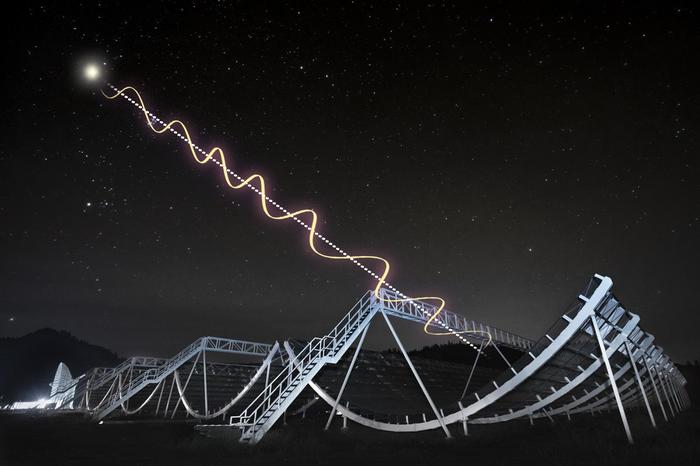
What scientists previously thought about where Fast Radio Bursts (FRBs) come from is just the tip of the iceberg, according to new research led by astronomers at the University of Toronto. The mysteries of the millisecond-long cosmic explosions are unfolding with a new way of analyzing data from the Canadian Hydrogen Intensity Mapping Experiment (CHIME).
Published today in The Astrophysical Journal, the study details the properties of polarized light from 128 non-repeating FRBs — those from sources that have only produced a single burst to date. It finds that they appear to come from galaxies like our own Milky Way with modest densities and modest magnetic fields.
Previous studies of FRBs have focused on much smaller samples of hyperactive repeating sources that, in contrast, appear to originate in dense, extremely magnetized environments. Only about 3 per cent of known FRBs repeat, coming from a source that has produced multiple bursts since being found.

Most radio telescopes can only see small points in the sky, making it easier to focus on repeating FRBs with known positions. CHIME can survey an extremely large area of the sky to detect both repeating and non-repeating FRBs.
“This was the first look at the other 97 per cent,” says lead author Ayush Pandhi, a PhD student at the Dunlap Institute for Astronomy & Astrophysics and the David A. Dunlap Department of Astronomy & Astrophysics at the University of Toronto. “It allows us to reconsider what we think FRBs are and see how repeating and non-repeating FRBs may be different.”
First detected in 2007, FRBs are extremely energetic flashes from distant sources across the universe. While over 1,000 FRBs have been catalogued since then, scientists do not yet know exactly where or how they are produced. They have also questioned whether repeating and non-repeating FRBs originate in similar environments.
Sign up for the Daily Dose Newsletter and get every morning’s best science news from around the web delivered straight to your inbox? It’s easy like Sunday morning.
“This is a new way to analyze the data we have on FRBs. Instead of just looking at how bright something is, we’re also looking at the angle of the light’s vibrating electromagnetic waves,” says Pandhi. “It gives you additional information about how and where that light is produced, and what it has passed through on its journey to us over many millions of light years.”
All light travels as waves that we interpret as different colours depending on the lengths between its peaks and valleys. Much of the light in the universe travels in wavelengths that the human eye cannot see, including light from FRBs, but radio telescopes like CHIME can.
Polarized light is made up of waves that vibrate in a single plane—vertically, horizontally, or another angle in between. The direction that light from FRBs is polarized was seen to change in two ways: with time and with the colour of the light. These changes can explain how an FRB might have been produced and what kind of material it passes through on its journey to Earth.
Studying how the direction of polarization changes for different colours of the light can tell us about the local density of where an FRB is produced and the strength of the magnetism that is present within it.
To determine what FRBs are and how they are produced, scientists need to understand their local environments. This study concludes that most FRBs, those that do not repeat, are not like the few repeating sources that have been previously studied. It suggests that this sample is either a separate population or more evolved versions of the same population that originate in a less extreme environment with a lower burst rate.
IMAGE CREDIT: CHIME. Illustration: Dunlap Institute.
If you enjoy the content we create and would like to support us, please consider becoming a patron on Patreon! By joining our community, you’ll gain access to exclusive perks such as early access to our latest content, behind-the-scenes updates, and the ability to submit questions and suggest topics for us to cover. Your support will enable us to continue creating high-quality content and reach a wider audience.
Join us on Patreon today and let’s work together to create more amazing content! https://www.patreon.com/ScientificInquirer



Leave a Reply