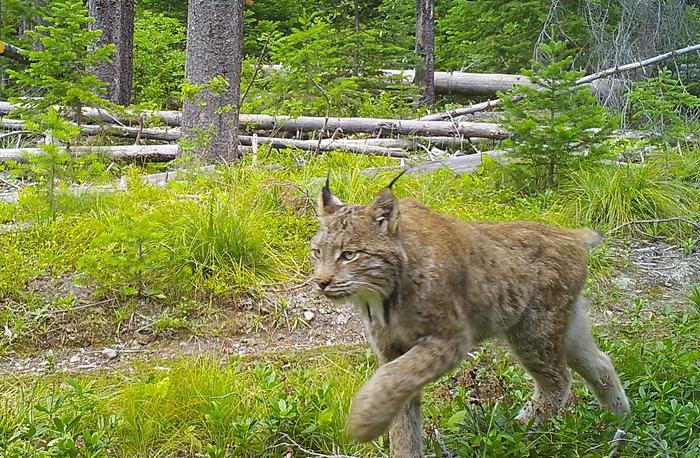
A broader past could mean a brighter future for Canada lynx in the U.S., according to recent research.
The study, published in the journal Biological Conservation, indicates that lynx might do well in the future in parts of Utah, central Idaho and the Yellowstone National Park region, even considering climate change and the lack of lynx in those areas now.

Using a model validated by historic records, researchers first found that in 1900, Canada lynx had more suitable habitat in the U.S. than the few northern corners of the country where they are found currently. The study showed the elusive big cat likely roamed over a larger area in the Pacific Northwest, Rocky Mountains, Great Lakes region and parts of New England.
“History matters even for wildlife,” said lead author Dan Thornton, a Washington State University wildlife ecologist. “As part of the criteria for species recovery, we have to understand their historic distribution. Otherwise, how can we help recover a species, if we don’t know what we’re recovering to?”
Sign up for the Daily Dose Newsletter and get every morning’s best science news from around the web delivered straight to your inbox? It’s easy like Sunday morning.
Having a more accurate picture of a species’ past can also help avoid an effect known as “shifting baseline syndrome,” Thornton added, which is a gradual change in what people accept as normal for the environment, or specifically in this case, a species’ habitat.
True to their name, Canada lynx are still abundant in Canada, but in the U.S. their numbers have dwindled. Currently, they are only found in limited, northern portions of Washington, Idaho, Montana, Minnesota and Maine. So far, recovery plans for lynx have been based on assumptions that they were never found much beyond these areas in the U.S., although a small population was successfully re-introduced to the Colorado Rockies in 1999.
This study, which has conservation implications for not only lynx but other threatened species, proposes one new way of estimating a species’ historic range, using modelling of suitable habitat validated by historical records.
Thornton and co-author Dennis Murray of Trent University in Canada created the model using factors to determine lynx’s suitable habitat like temperature, precipitation and land use in the last 40 years. They ran that model back in time to 1900 using historic climate and land use data to discover the possible past range, which they validated using records of lynx from museums as well as hunters and trappers who have prized the big cat for its fur.
The researchers then used the model to project suitable habitat into the future of 2050 and 2070. Even when accounting for climate change effects, they found areas that could be good for lynx that fall outside the species’ current range but likely within historically occupied areas: namely in central Idaho, northern Utah and the area in, and around, Yellowstone National Park. Whether or not these areas could support viable lynx populations now or in the future would require additional research, the authors noted.
Conserving lynx as a key predator is important for maintaining the integrity of forest ecosystems, the authors contend, and lynx are an iconic species in the mountains of the Pacific Northwest.
The researchers also hope that this approach to estimating historic range could help inform conservation efforts for other species.
“Thinking about historic range is really important. It’s also quite difficult because we often have limited data on where species were in the past,” Thornton said. “But there are potential ways to go about addressing that, and we wanted to provide one possible approach in this paper.”
IMAGE CREDIT: Washington State University
If you enjoy the content we create and would like to support us, please consider becoming a patron on Patreon! By joining our community, you’ll gain access to exclusive perks such as early access to our latest content, behind-the-scenes updates, and the ability to submit questions and suggest topics for us to cover. Your support will enable us to continue creating high-quality content and reach a wider audience.
Join us on Patreon today and let’s work together to create more amazing content! https://www.patreon.com/ScientificInquirer



Leave a Reply