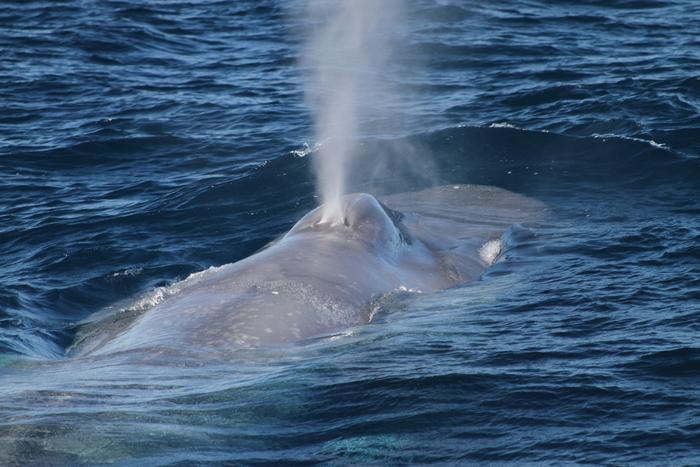
The largest living animal, the blue whale (Balaenoptera musculus) which averages about 27 metres in length, has slowly recovered from whaling only to face the rising challenges of global warming, pollution, disrupted food sources, shipping, and other human threats.
In a major new study, Flinders University has taken a stocktake of the number, distribution and genetic characteristics of blue whale populations around the world and found the greatest differences among the eastern Pacific, Antarctic subspecies and pygmy subspecies of the eastern Indian and western Pacific.
“Each of these groups need to be conserved to maintain biodiversity in the species, and there are indications that natural selection in different environments contributed to driving genetic differences between the high-level groups,” says study first author Dr Catherine Attard in a newly published article in Animal Conservation.
“Within these regions, there were differences between the eastern North and eastern South Pacific, and among the eastern Indian Ocean, the western South Pacific and the northern Indian Ocean but no differences in the Antarctic group,” she says.
The study found no evidence of inbreeding, which is good news for the potential recovery of subspecies and populations. However, challenges remain for this endangered species.
The recovery of baleen whales including endangered blue whales is now threatened by multiple human sources, including underwater noise, changing availability of food driven by human-induced effects on ocean productivity, environmental contaminants, ship collision and entanglement in fishing gear.

“Our findings build on decades of work to improve the management of endangered blue whales under the International Whaling Commission,” says Dr Attard.
The estimated migration rates were 1%-4% among each of the high-level groups, with both migrant individuals (i.e. movement without necessarily interbreeding) and hybrids (i.e. interbreeding) among the high-level groups.
Piecing together the whale population structures, the researchers found an unexpected similarity between the eastern South Pacific and eastern North Pacific blue whales, which suggests they are part of the same subspecies, rather than their current classification as separate subspecies.
“This finding was unexpected given that blue whale populations are thought to have opposite breeding seasons when their populations exist on either side of the equator,” adds senior author Associate Professor Luciana Möller, from the Molecular Ecology Lab and Cetacean Ecology, Behaviour and Evolution Lab at Flinders University.
“While eastern Indian and western Pacific blue whales have the lowest genetic diversity of the high-level hierarchical groups, which is likely due to climate-induced diversification rather than anthropogenic impacts, our study identified the eastern Indian Ocean, western South Pacific Ocean and potentially western Indian Ocean as different populations within the Indo-western Pacific,” says Associate Professor Möller.
As well as generating the largest global genomic dataset to date for blue whales, the study incorporated information from recent satellite tagging, acoustics and stable isotopes research to link the genetic results to blue whale population calls and typical migratory and breeding patterns.
Another coauthor, Matthew Flinders Professor Luciano Beheregaray, who founded the Molecular Ecology Lab at Flinders University in 2009, adds: “Genomics is a vital tool that has unparalleled power to determine population differentiation, connectivity, and other characteristics to inform the conservation management of biodiversity.
“Whole-genome population studies and comparisons with environmental conditions are needed to better understand adaptations in blue whales and other baleen whales. Localised depletion of blue whales could occur if these threats are concentrated in areas containing populations with limited connectivity to animals in surrounding regions.
“Thus, describing the spatio-temporal patterns of population differences within a species and their geographic boundaries can inform management decisions on the timing and location of human activities to minimise impacts on these wide-ranging whale species.”
While blue whales became protected from commercial whaling in 1966, the International Whaling Commission (IWC) implemented a global moratorium 20 years later.
The Flinders University-based research group calls on the IWC to use the findings to refine the stock delineations of blue whales for conservation and management purposes.
“We recommend that national management bodies minimise human activities that can impact these management groups when the blue whales are within their jurisdiction,” researchers conclude.
IMAGE CREDIT: Flinders University.
Sign up for the Daily Dose Newsletter and get the morning’s best science news from around the web delivered straight to your inbox? It’s easy like Sunday morning.

Leave a Reply