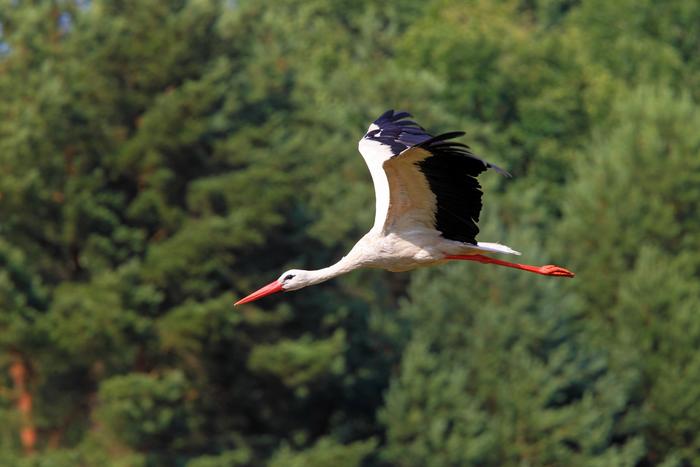
Research led by scientists from University of Wyoming and Max Planck Institute of Animal Behavior shows that migrating animals refine their behavior as they get older, suggesting that experiential learning is an important part of successful migration.
While genetics and social behavior are important factors shaping animal migrations, information gained through individual experience also appears to help shape migratory movements, says a research team led by Ellen Aikens. Aikens, who has a joint faculty appointment with UW’s Haub School of Environment and Natural Resources, was among the first cohort of assistant professors hired in 2023 by UW’s new School of Computing. Aikens’ research at the intersection of animal behavior and data science is driven by new possibilities from advanced computing and data science.

The migration findings appear March 4 in Proceedings of the National Academy of Sciences, one of the world’s most prestigious multidisciplinary scientific journals covering the biological, physical and social sciences.
The study, which also involved researchers from the University of Konstanz, involved technically sophisticated tracking of over 250 white storks spread across five breeding areas in southern Germany and Austria between 2013 and 2020.
Sign up for the Daily Dose Newsletter and get every morning’s best science news from around the web delivered straight to your inbox? It’s easy like Sunday morning.
The tracking data collected by the researchers not only pinpointed the migration pathways of the storks, but it also measured the timing and pace of individual storks as well as estimating the amount of energy storks used while flying. The team found that while young storks took their time exploring new places during migration, their migrations become faster as they age.
“As the birds age and gain more experience, older individuals stop exploring new places and instead move more quickly and directly, resulting in greater energy expenditure during migratory flight,” wrote lead author Aikens, whose research in recent years has provided insights into the movement of big-game animals in western Wyoming. “During spring migration, individuals innovated novel shortcuts during the transition from early life into adulthood, suggesting a reliance on spatial memory acquired through learning.”
Individual storks incrementally straightened their migration routes to find more direct ways to move between destinations during the spring migration to summer breeding and nesting grounds, the researchers say. The findings could have implications for a variety of other species of migrating animals.
“Although information has largely been overlooked as a currency shaping migratory behavior, gaining information and using it to incrementally refine migration behavior through learning could play an important role in saving both energy and time,” the researchers wrote. “The landscapes that animals move through are complex and dynamic, requiring that migrants learn where and when favorable conditions that facilitate movement occur and how to exploit them efficiently.”
The researchers don’t discount the importance of genetics and “culturally inherited information” in animal migrations, but they say the new findings point to individual experience as another key factor.
“Whether the first migration is guided by genetics or results from following informed individuals, learning within a lifetime represents an additional and complementary mechanism shaping animal migration,” the paper says.
IMAGE CREDIT: Christian Ziegler
If you enjoy the content we create and would like to support us, please consider becoming a patron on Patreon! By joining our community, you’ll gain access to exclusive perks such as early access to our latest content, behind-the-scenes updates, and the ability to submit questions and suggest topics for us to cover. Your support will enable us to continue creating high-quality content and reach a wider audience.
Join us on Patreon today and let’s work together to create more amazing content! https://www.patreon.com/ScientificInquirer




Leave a Reply