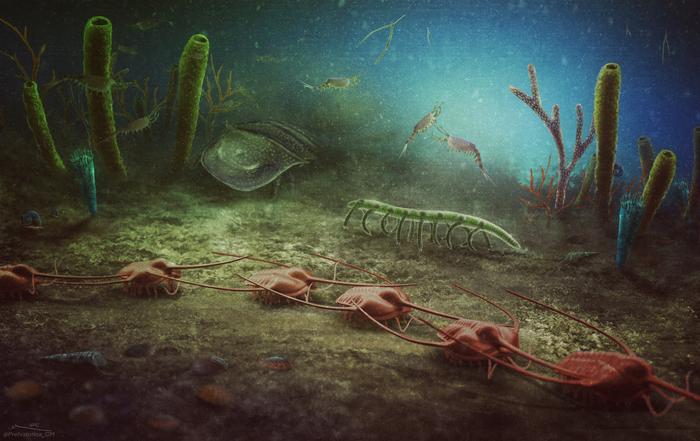
Nearly 400 exceptionally well-preserved fossils dating back 470 million years have been discovered in the south of France by two amateur paleontologists. This new fossil site of worldwide importance has been analyzed by scientists from the University of Lausanne, in collaboration with the CNRS and international teams. This discovery provides unprecedented information on the polar ecosystems of the Ordovician period.
Paleontology enthusiasts have unearthed one of the world’s richest and most diverse fossil sites from the Lower Ordovician period (around 470 million years ago). Located in Montagne Noire, in the Hérault department of France, this deposit of over 400 fossils is distinguished by an exceptionally well-preserved fauna. In addition to shelly components, it contains extremely rare soft elements such as digestive systems and cuticles, in a remarkable state of preservation. Moreover, this biota was once located very close to the South Pole, revealing the composition of Ordovician southernmost ecosystems.
At the Faculty of Geosciences and Environment at the University of Lausanne (UNIL), scientists have collaborated with the CNRS and international teams to carry out the first analyses of this deposit, known as the Cabrières Biota. The results are published in Nature Ecology & Evolution.

Analyses of the new biota reveal the presence of arthropods (a group that includes millipedes and shrimps) and cnidarians (a group that includes jellyfish and corals), as well as a large number of algae and sponges. The site’s high biodiversity suggests that this area served as a refuge for species that had escaped the high temperatures prevailing further north at the time.
“At this time of intense global warming, animals were indeed living in high latitude refugia, escaping extreme equatorial temperatures,” points out Farid Saleh, researcher at the University of Lausanne, and first author of the study. “The distant past gives us a glimpse of our possible near future,” adds Jonathan Antcliffe, researcher at the University of Lausanne and co-author of the study.
For their part, Eric Monceret and Sylvie Monceret-Goujon, the amateurs who discovered the site, amateurs who discovered the site, add with enthusiasm: “We’ve been prospecting and searching for fossils since the age of twenty,” says Eric Monceret. “When we came across this amazing biota, we understood the importance of the discovery and went from amazement to excitement,” adds Sylvie Monceret-Goujon.
This first publication marks the start of a long research program involving large-scale excavations and in-depth fossil analyses. Using innovative methods and techniques, the aim is to reveal the internal and external anatomy of the organisms, as well as to deduce their phylogenetic relationships and modes of life.
IMAGE CREDIT: Christian McCall.
Sign up for the Daily Dose Newsletter and get the morning’s best science news from around the web delivered straight to your inbox? It’s easy like Sunday morning.


Leave a Reply