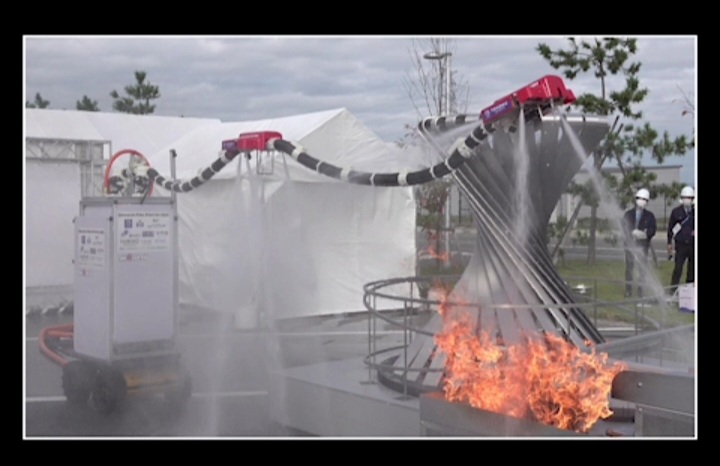
Imagine a flying dragon that doesn’t spout fire, but instead extinguishes it with blasts of water. Thanks to a team of Japanese researchers, this new kind of beast may soon be recruited to firefighter teams around the world, to help put out fires that are too dangerous for their human teammates to approach.

The blueprint of this novel firefighter robot, called the Dragon Firefighter, has now been published in Frontiers in Robotics and AI. And as it has been published as Open Science, roboticists around the world may freely use the plans to build their own Dragon Firefighters, for the benefit of all.

“We here present a prototype of a four-meter-long, remotely controllable flying firehose robot, engineered to safely and efficiently extinguish fires in buildings by directly approaching the fire sources,” said joint corresponding author Dr Yuichi Ambe, an assistant professor at Osaka University.

A research team from Prof Satoshi Tadokoro’s laboratory at Tohoku University began working on similar flying robots in 2016. Since then, 11 researchers and students have contributed to its further development. Prior and during development, they liaised with Japanese firefighters to better understand their needs.


Charles Darwin Signature T-shirt – “I think.” Two words that changed science and the world, scribbled tantalizingly in Darwin’s Transmutation Notebooks.

The Dragon Firefighter’s firehose is propelled upward (flying at two meters above the ground) by eight controllable jets of water spouting from its center and head. The firehose can change shape and be oriented towards flames, steered by a control unit in a wheeled cart behind. The cart is connected through a supply tube to a fire truck with a water reservoir of 14,000 liters.

The nozzles spout water at a rate of 6.6 liters per second with a pressure of up to one megapascal. The hose’s tip contains a conventional and thermal imaging camera, which help to find the location of the fire.

Goodness, gracious, great balls of fire

The Dragon Firefighter received its baptism of fire at the opening ceremony of the World Robot Summit 2020 (WRS2020), held in September 2021 in Fukushima. There, it successfully extinguished [49 min 00 s to 51 min 00 s] the ceremonial flame, consisting of fireballs lit by another robot, at a distance of four meters. Besides detailing its design, the present study also discusses lessons learned during this first demonstration of the Dragon’s abilities, as well as specifying further improvements made since.

Dr Yu Yamauchi, an assistant professor at Akita Prefectural University and another corresponding author, said: “Since the demonstration at WRS2020, we have continued to work on improving our Dragon and have learned many new things.”

“For example, we found that the original passive dampening mechanism which counters oscillations of the Dragon Firefighter’s body was impractical: it took too long to prepare for flight. We also found that heat from fires can cause detrimental plastic deformation in outdoor applications of the corrugated tube that holds the water hose and electric cables.”

Other improvements detailed in the study include better waterproofing, a nozzle unit capable of handling a wider range of net forces, and an improved mechanism for channeling water flow. But further developments are in the pipeline.

Ready to fly in ten years

“We estimate that it will take approximately 10 more years to deploy our robot in real-world firefighting scenarios,” said Ambe.

“The primary challenge will be to extend its reach to beyond 10 meters. Developing effective firefighting tactics tailored to this robot’s unique capabilities will likewise be a critical aspect of further development.”


Sign up for the Daily Dose Newsletter and get the morning’s best science news from around the web delivered straight to your inbox? It’s easy like Sunday morning.
Processing…
Success! You're on the list.

DAILY DOSE: Trump Replaces Casey Means With Fox News Doctor as Surgeon General Pick; Hidden Piece of Pangaea Revealed Beneath Appalachia.
Trump replaces surgeon general nominee amid vaccine concerns and criticism.
Climate change a global threat to brain health, stroke experts say
Climate change increases stroke risks through extreme weather, with efforts needed to …
Snow cover on Greek mountains has more than halved in four decades, study finds
A study reveals that snow cover in Greece's mountains has decreased by …
UN Women report finds online violence and deepfakes drive women from public life
A report reveals increasing online violence against women, worsening mental health and …

One response to “Scientists develop ‘flying dragon’ robot to fight fires from a distance”

  1. […] Imagínese un dragón volátil que no dispara fuego, sino que lo apaga con ráfagas de agua. Gracias a un equipo de investigadores japoneses, este nuevo tipo de bestia pronto podría ser reclutado para los equipos de bomberos de todo el mundo, para ayudar a apagar incendios demasiado peligrosos para que sus compañeros humanos se acerquen. El plano de este nuevo autómata de bomberos, llamado Dragon Firefighter, ahora se ha publicado en Frontiers in Robotics and AI. Y tal y como se ha publicado como Ciencia abierta, los robóticos de todo el mundo pueden utilizar autónomamente los planes para construir sus propios bomberos del dragón, en beneficio de todos. «Aquí presentamos un prototipo de una manga de fuego voladora de cuatro metros de derrochador y controlable remotamente. autómata, diseñado para extinguir incendios de forma segura y eficaz en los edificios acercándose directamente a las fuentes de incendio», dijo el autor conjunto, el dr. Yuichi Ambe, profesor ayudante de la Universidad de Osaka. Un equipo de investigación del laboratorio del profesor Satoshi Tadokoro en la Universidad de Tohoku empezó a trabajar en robots voladores similares en 2016. Desde entonces, 11 investigadores y estudiantes han contribuido a su avance posterior. Antaño y durante su avance, se relacionaron con los bomberos japoneses para entender mejor sus deyección. Camiseta de la firma de Charles Darwin – «Creo». Dos palabras que cambiaron la ciencia y el mundo, escritas de forma tentadora en los Cuadernos de transmutación de Darwin. La manguera de bomberos del Bombero del Dragón es impulsada cerca de en lo alto (volando a dos metros sobre el suelo) por ocho chorros de agua controlables que salen de su centro y capital. La manguera puede cambiar de forma y orientarse cerca de las llamas, dirigida por una dispositivo de control en un carro de ruedas detrás. El carro se conecta a través de un tubo de víveres a un camión de bomberos con un depósito de agua de 14.000 litros. Las boquillas brotan agua a una velocidad de 6,6 litros por segundo con una presión de hasta un megapascal . La punta de la manguera contiene una cámara de imagen convencional y térmica, que ayuda a encontrar la ubicación del fuego. Bondad, amable, grandes bolas de fuego El bombero del Dragón recibió su bautizo de fuego en la ceremonia de comprensión del World Autómata Summit 2020 (WRS2020), celebrado en septiembre de 2021 en Fukushima. Allí, se extinguió con éxito [49 min 00 s to 51 min 00 s] la fuego ceremonial, formada por bolas de fuego encendidas por otro autómata, a una distancia de cuatro metros. Por otra parte de detallar su diseño, el presente estudio analiza todavía las lecciones aprendidas durante esta primera demostración de las habilidades del Dragón, así como especifica las mejoras posteriores realizadas desde entonces. El doctor Yu Yamauchi, profesor asistente en la Universidad de la caudillaje de Akita y otro autor correspondiente, dijo: «Desde que la demostración del WRS2020, hemos continuado trabajando para mejorar nuestro Dragón y hemos aprendido muchas cosas nuevas.» «Por ejemplo, encontramos que el mecanismo de atenuación pasivo llamativo que contrarresta las oscilaciones del cuerpo del Bombero del Dragón era poco práctico: tardó demasiado en preparar el revoloteo. Incluso encontramos que el calor de los incendios puede causar una deformación plástica perjudicial en aplicaciones exteriores del tubo corrugado que sujeta la manguera de agua y los cables eléctricos.fuerzas y un mecanismo mejorado para canalizar el flujo de agua.Pero hay nuevos desarrollos en paciencia.Diligente para explotar interiormente de diez abriles «Calculamos que tardarán aproximadamente 10 abriles más en desplegar nuestro autómata en escenarios de lucha contra incendios del mundo actual», dijo Ambe. «El duelo principal será extender su trascendencia más allá de los 10 metros. El avance de tácticas efectivas de lucha contra incendios adaptadas a las capacidades únicas de este autómata todavía será un aspecto crítico para el avance posterior». Suscríbete al Boletín de informativo Daily Dose y recibirás las mejores informativo de ciencia de la mañana de todas partes de la web directamente a tu bandeja de entrada?Es realizable como el domingo por la mañana.Únete a la tira de correo electrónico de SCIENTIFIC INQUIRER u003cemu003eAl hacer clic en dirigir, aceptas compartir tu dirección de correo electrónico con el propietario del sitio y Mailchimp para acoger marketing, actualizaciones y otros correos electrónicos del propietario del sitio Utilice el enlace de revocación de la suscripción de estos correos electrónicos para desactivarse en cualquier momento.u003c/emu003e Procesamiento… ¡Éxito! la tira, vaya, se ha producido un error y no hemos podido procesar su suscripción, vuelva a cargar la página y vuelva a intentarlo. Source link […]

Leave a Reply

Trending

Discover more from Scientific Inquirer

Subscribe now to keep reading and get access to the full archive.

Continue reading