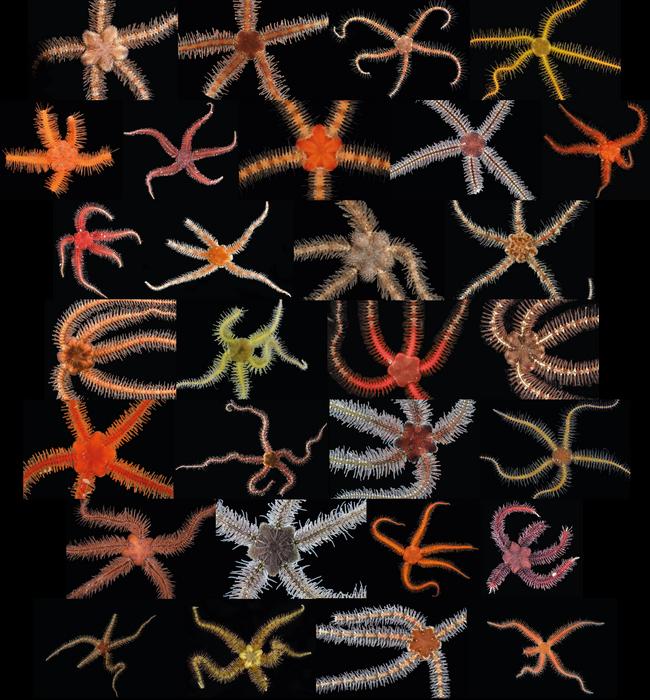
Ophiothrix angulata, a widely recognized and prevalent ophiuroid species in the Western Atlantic, has long been the subject of taxonomic debate due to its remarkable morphological diversity. A new study just published in PeerJ Life & Environment has shed light on the species’ taxonomy, revealing a significant scientific breakthrough.
Led by a team of researchers from Universidad Nacional Autónoma de México, Universidad Católica del Maule and Florida Natural History Museum, the comprehensive study aimed to assess species delimitation and geographic differentiation within O. angulata. Quetzalli Hernández, co-author of the study, emphasizes the need for an integrative approach: “We tried to unravel the genetic relationship between the various shapes and colorations of the arm in the ophiuroid species Ophiothrix angulata. This species is widely distributed across different latitudes and depths, and its classification has caused confusion since its description almost 200 years ago, due to the great variety of colorations and subtle differences observed, which have confused alpha taxonomists who have relied solely on morphological characteristics. So, to address this taxonomic challenge, we adopted an integrative approach, conducting separate analyses on multiple types of genetic and morphological data before combining them. By compiling extensive evidence and adhering to species definition criteria, we have determined that Ophiothrix angulata represents a species complex with cryptic diversity more or less delimited within large geographic regions. Undertaking this task was undeniably challenging, yet equally exhilarating.”
The study revealed significant discoveries regarding Ophiothrix angulata, which has traditionally been recognized as a single species. Hernández explained the findings, stating, “In the northwestern Atlantic distribution, we have identified two distinct genetic clades using the COI (mitochondrial) and ITS2 (nuclear) genetic markers. Notably, this genetic differentiation aligns with the variations observed in the shape of the ventral and dorsal arm plates. By combining genetic and morphometric data through integrative analyses, we have gathered substantial evidence to support the existence of more than one species within the cryptic complex of Ophiothrix angulata. One of these genetic clades reveals that a group previously classified as O. angulata belongs to a newly ophiuroid species. Additionally, an exhaustive analysis of the arm coloration patterns has provided scientific evidence indicating that coloration alone is not a reliable morphological characteristic for distinguishing the different genetic clades within our study. This finding holds great significance for the O. angulata species complex, as it challenges the validity of subspecies that were described solely based on coloration patterns in the 19th century, which remain relevant today.”
If you enjoy the content we create and would like to support us, please consider becoming a patron on Patreon! By joining our community, you’ll gain access to exclusive perks such as early access to our latest content, behind-the-scenes updates, and the ability to submit questions and suggest topics for us to cover. Your support will enable us to continue creating high-quality content and reach a wider audience.
Join us on Patreon today and let’s work together to create more amazing content! https://www.patreon.com/ScientificInquirer
The identification of multiple species within the Ophiothrix angulata complex demonstrates the importance of integrating various data types in taxonomic studies. This breakthrough not only enhances our understanding of the species’ evolutionary history but also has implications for conservation efforts and management strategies.
The study serves as a milestone in the field of ophiuroid research and highlights the value of interdisciplinary approaches. It paves the way for further exploration into the ecology, behavior, and distribution patterns of these newly identified species within Ophiothrix angulata.
IMAGE CREDIT: Florida Museum of Natural History & University of Florida


Leave a Reply