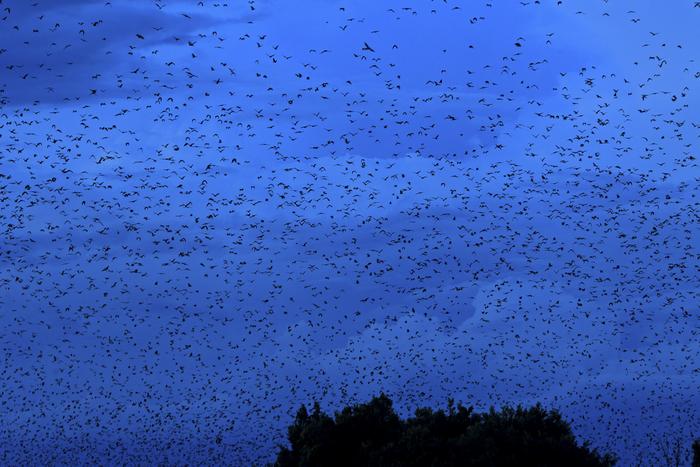
Once a year, a small forest in Zambia becomes the site of one of the world’s greatest natural spectacles. In November, straw-colored fruit bats migrate from across the African continent to a patch of trees in Kasanka National Park. For reasons not yet known, the bats converge for three months in a small area of the park, forming the largest colony of bats anywhere in Africa. The exact number of bats in this colony, however, has never been known. Estimates range anywhere from 1 to 10 million.
A new method developed by the Max Planck Institute of Animal Behavior (MPI-AB) has counted the colony with the greatest accuracy yet. The method uses GoPro cameras to record bats and then applies artificial intelligence (AI) to detect animals without the need for human observers. The method, published in the journal Ecosphere, produced an overall estimate of between 750,000 and 1,000,000 bats in Kasanka—making the colony the largest for bats by biomass anywhere in the world.
“We’ve shown that cheap cameras, combined with AI, can be used to monitor large animal populations in ways that would otherwise be impossible,” says Ben Koger who is first author on the paper. “This approach will change what we know about the natural world and how we work to maintain it in the face of rapid human development and climate change.”
If you enjoy the content we create and would like to support us, please consider becoming a patron on Patreon! By joining our community, you’ll gain access to exclusive perks such as early access to our latest content, behind-the-scenes updates, and the ability to submit questions and suggest topics for us to cover. Your support will enable us to continue creating high-quality content and reach a wider audience.
Join us on Patreon today and let’s work together to create more amazing content! https://www.patreon.com/ScientificInquirer
Africa’s secret gardeners
Even amongst the charismatic fauna of the African continent, the straw-colored fruit bat shines bright. By some estimates, it’s the most abundant mammal anywhere on the continent. And, by traveling up to two thousand kilometers every year, it’s also the most extreme long-distance migrant of any flying fox. From an environmental perspective, these merits matter a lot. By dispersing seeds as they fly over vast distances, the fruit bats are cardinal reforesters of degraded land—making them a “keystone” species on the African continent.
Scientists have long sought to estimate colony sizes of this important species, but the challenges of manually counting very large populations have led to widely fluctuating numbers. That’s always frustrated Dina Dechmann, a biologist from the MPI-AB, who has studied straw-colored fruit bats for over 10 years. Concerned that she has witnessed a decline in numbers of these fruit bats over her career, Dechmann wanted a tool that could accurately reveal if populations were changing. That is, she needed a way of counting bats that was reproducible and comparable across time.
“Straw-colored fruit bats are the secret gardeners of Africa,” says Dechmann. “They connect the continent in ways that no other seed disperser does. A loss of the species would be devastating for the ecosystem. So, if the population is decreasing at all, we urgently need to know.”
Dechmann began talking to longtime collaborators Roland Kays from NC State University and Teague O’Mara from Southeastern Louisiana University, as well as Kasanka Trust, the Zambian conservation organization responsible for managing Kasanka National Park and protecting its colony of bats. Together, they wondered if advances in computer vision and artificial intelligence could improve the accuracy and efficiency of counting large and complex bat populations. To find out, they approached Ben Koger, then a doctoral student at the MPI-AB, who was an expert in using automated approaches to create ecological datasets.
Accurate and comparable bat counts
Koger worked to devise a method that could be used by scientists and conservation managers to efficiently quantify the complex system. His method comprised two main steps. First, nine GoPro cameras were set up evenly around the colony to record the bats as they left the roost at dusk. Second, Koger trained deep learning models to automatically detect and count bats in the videos. To test the method’s accuracy, the team manually counted bats in a sample of clips and found the AI was 95% accurate—it even worked well in dark conditions.
“Using more sophisticated technology to monitor a colony as giant as Kasanka’s could be prohibitively expensive because you’d need so much equipment,” says Koger. “But we could show that cheap cameras paired with our custom software algorithms did very well at detecting and counting bats at our study site. This is hugely important for monitoring the site in the future.”
Recording bats over five nights, the new method counted an average of between around 750,000 and 1,000,000 animals per night. This result falls below previous counts at Kasanka, and the authors state that the study might not have caught the peak of bat migration, and some animals might have arrived after the count period. Even so, the study’s estimate makes Kasanka’s colony the heaviest congregation of bats anywhere in the world.
Says Dechmann: “This is a game-changer for counting and conserving large populations of animals. Now, we have an efficient and reproducible way of monitoring animals over time. If we use this same method to census animals every year, we can actually say if the population is going up or down.”
For the Kasanka colony, which is facing threats from agriculture and constriction, Dechmann says that the need for accurate monitoring has never been more urgent than now.
“It’s easy to assume that losing a few animals here and there from large populations won’t make a dent. But if we are to maintain the ecosystem services provided by these animals, we need to maintain their populations at meaningful levels. The Kasanka colony isn’t just one of many; it’s a sink colony of bats from across the subcontinent. Losing this colony would be devastating for Africa as a whole.”
IMAGE CREDIT: Christian Ziegler / Max Planck Institute of Animal Behavior


Leave a Reply