HAVE YOUR SAY.
Join us in The Bullpen, where the members of the Scientific Inquirer community get to shape the site’s editorial decision making. We’ll be discussing people and companies to profile on the site. On Wednesday, April 12 at 5:30pm EST, join us on Discord and let’s build the best Scientific Inquirer possible.
Many fluid-based wearable assistive technologies today require a large and noisy pump that is impractical – if not impossible – to integrate into clothing. This leads to a contradiction: wearable devices are routinely tethered to un-wearable pumps. Now, researchers at the Soft Transducers Laboratory (LMTS) in the School of Engineering have developed an elegantly simple solution to this dilemma.
“We present the world’s first pump in the form of a fiber; in essence, tubing that generates its own pressure and flow rate,” says LMTS head Herbert Shea. “Now, we can sew our fiber pumps directly into textiles and clothing, leaving conventional pumps behind.”
The research has been published in the journal Science.

Lightweight, powerful…and washable
Shea’s lab has a history of forward-thinking fluidics. In 2019, they produced the world’s first stretchable pump.
“This work builds on our previous generation of soft pump,” says Michael Smith, an LMTS post-doctoral researcher and lead author of the study. “The fiber format allows us to make lighter, more powerful pumps that are inherently more compatible with wearable technology.”
The LMTS fiber pumps use a principle called charge injection electrohydrodynamics (EHD) to generate a fluid flow without any moving parts. Two helical electrodes embedded in the pump wall ionize and accelerate molecules of a special non-conductive liquid. The ion movement and electrode shape generate a net forward fluid flow, resulting in silent, vibration-free operation, and requiring just a palm-sized power supply and battery.
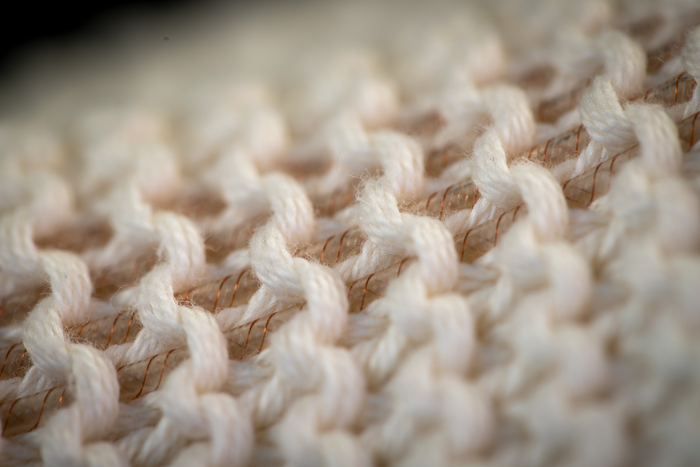
To achieve the pump’s unique structure, the researchers developed a novel fabrication technique that involves twisting copper wires and polyurethane threads together around a steel rod, and then fusing them with heat. After the rod is removed, the 2 mm fibers can be integrated into textiles using standard weaving and sewing techniques.
The pump’s simple design has a number of advantages. The materials required are cheap and readily available, and the manufacturing process can be easily scaled up. Because the amount of pressure generated by the pump is directly linked to its length, the tubes can be cut to match the application, optimizing performance while minimizing weight. The robust design can also be washed with conventional detergents.
From exoskeletons to virtual reality
The authors have already demonstrated how these fiber pumps can be used in new and exciting wearable technologies. For example, they can circulate hot and cold fluid through garments for those working in extreme temperature environments or in a therapeutic setting to help manage inflammation; and even for those looking to optimize athletic performance.
“These applications require long lengths of tubing anyway, and in our case, the tubing is the pump. This means we can make very simple and lightweight fluidic circuits that are convenient and comfortable to wear,” Smith says.
The study also describes artificial muscles made from fabric and embedded fiber pumps, which could be used to power soft exoskeletons to help patients move and walk.
The pump could even bring a new dimension to the world of virtual reality by simulating the sensation of temperature. In this case, users wear a glove with pumps filled with hot or cold liquid, allowing them to feel temperature changes in response to contact with a virtual object.
Pumped up for the future
The researchers are already looking to improve the performance of their device. “The pumps already perform well, and we’re confident that with more work, we can continue to make improvements in areas like efficiency and lifetime,” says Smith. Work has already started on scaling up the production of the fiber pumps, and the LMTS also has plans to embed them into more complex wearable devices.
“We believe that this innovation is a game-changer for wearable technology,” Shea says.
IMAGE CREDIT: LMTS EPFL




Leave a Reply