HAVE YOUR SAY.
Join us in The Bullpen, where the members of the Scientific Inquirer community get to shape the site’s editorial decision making. We’ll be discussing people and companies to profile on the site. On Wednesday, April 12 at 5:30pm EST, join us on Discord and let’s build the best Scientific Inquirer possible.
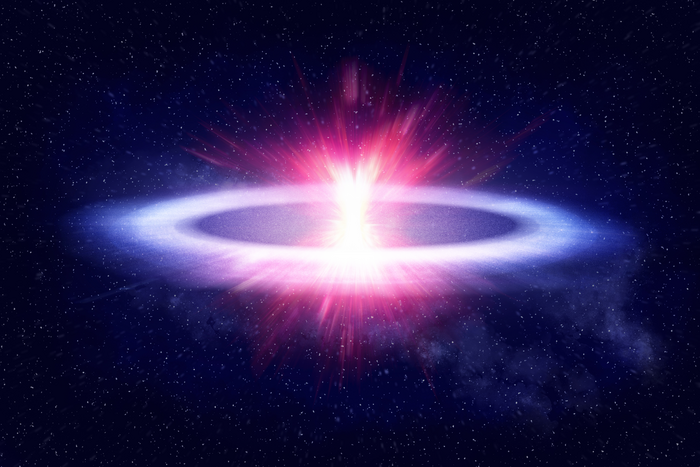
An explosion the size of our solar system has baffled scientists, as part of its shape – similar to that of an extremely flat disc – challenges everything we know about explosions in space.
The explosion observed was a bright Fast Blue Optical Transient (FBOT) – an extremely rare class of explosion which is much less common than other explosions, such as supernovas. The first bright FBOT was discovered in 2018 and given the nickname “the cow”.
Explosions of stars in the universe are almost always spherical in shape, as the stars themselves are spherical. However, this explosion, which occurred 180 million light years away, is the most aspherical ever seen in space, with a shape like a disc emerging a few days after it was discovered. This section of the explosion may have come from material shed by the star just before it exploded.

It’s still unclear how bright FBOT explosions occur, but it’s hoped that this observation, published in Monthly Notices of the Royal Astronomical Society, will bring us closer to understanding them.
Dr Justyn Maund, Lead Author of the study from the University of Sheffield’s Department of Physics and Astronomy, said: “Very little is known about FBOT explosions – they just don’t behave like exploding stars should, they are too bright and they evolve too quickly. Put simply, they are weird, and this new observation makes them even weirder.
“Hopefully this new finding will help us shed a bit more light on them – we never thought that explosions could be this aspherical. There are a few potential explanations for it: the stars involved may have created a disc just before they died or these could be failed supernovas, where the core of the star collapses to a blackhole or neutron star which then eats the rest of the star.
“What we now know for sure is that the levels of asymmetry recorded are a key part of understanding these mysterious explosions, and it challenges our preconceptions of how stars might explode in the Universe.”
Scientists made the discovery after spotting a flash of polarised light completely by chance. They were able to measure the polarisation of the blast – using the astronomical equivalent of polaroid sunglasses – with the Liverpool Telescope (owned by Liverpool John Moores University) located on La Palma.
By measuring the polarisation, it allowed them to measure the shape of the explosion, effectively seeing something the size of our Solar System but in a galaxy 180 million light years away. They were then able to use the data to reconstruct the 3D shape of the explosion, and were able to map the edges of the blast – allowing them to see just how flat it was.
The mirror of the Liverpool Telescope is only 2.0m in diameter, but by studying the polarisation the astronomers were able to reconstruct the shape of the explosion as if the telescope had a diameter of about 750km.
Researchers will now undertake a new survey with the international Vera Rubin Observatory in Chile, which is expected to help discover more FBOTs and further understand them.
IMAGE CREDIT: Phil Drury, University of Sheffield




Leave a Reply