HAVE YOUR SAY.
Join us in The Bullpen, where the members of the Scientific Inquirer community get to shape the site’s editorial decision making. We’ll be discussing people and companies to profile on the site. On Wednesday, April 12 at 5:30pm EST, join us on Discord and let’s build the best Scientific Inquirer possible.
Scientists have calculated that the fastest changing Antarctic region - the Amundsen Sea Embayment - has lost more than 3,000 billion tonnes of ice over a 25-year period.
If all the lost ice was piled on London, it would stand over 2 km tall - or 7.4 times the height of the Shard. If it were to cover Manhattan, it would stand at 61 km – or 137 Empire State Buildings placed on top of one another.
Twenty major glaciers form the Amundsen Sea Embayment in West Antarctica, which is more than four times the size of the UK, and they play a key role in contributing to the level of the world’s oceans.

So much water is held in the snow and ice, that if it were to all to drain into the sea, global sea levels could increase by more than one metre.
The research, led by Dr Benjamin Davison at the University of Leeds, calculated the “mass balance” of the Amundsen Sea Embayment. This describes the balance between mass of snow and ice gain due to snowfall and mass lost through calving, where icebergs form at the end of a glacier and drift out to sea.
When calving happens faster than the ice is replaced by snowfall, then the Embayment loses mass overall and contributes to global sea level rise. Similarly, when snowfall supply drops, the Embayment can lose mass overall and contribute to sea level rise.
The results show that West Antarctica saw a net decline of 3,331 billion tonnes of ice between 1996 and 2021, contributing over nine millimetres to global sea levels. Changes in ocean temperature and currents are thought to have been the most important factors driving the loss of ice.
Dr Davison, a Research Fellow at the Institute for Climate and Atmospheric Science at Leeds, said: “The 20 glaciers in West Antarctica have lost an awful lot of ice over the last quarter of a century and there is no sign that the process is going to reverse anytime soon although there were periods where the rate of mass loss did ease slightly.
“Scientists are monitoring what is happening in the Amundsen Sea Embayment because of the crucial role it plays in sea-level rise. If ocean levels were to rise significantly in future years, there are communities around the world who would experience extreme flooding.”
The research has been published in the scientific journal Nature Communications.
Importance of extreme snowfall events
Using climate models that show how air currents move around the world, the scientists identified that the Amundsen Sea Embayment had experienced several extreme snowfall events over the 25-year study period.
These would have resulted in periods of heavy snowfall and periods of very little snowfall or a “snow drought”.
The researchers factored these extreme events into their calculations. Surprisingly, they found that these events contributed up to half of the ice change at certain times, and therefore played a key role in the contribution the Amundsen Sea Embayment was making to sea level rise during certain time periods.
For example, between 2009 and 2013, the models revealed a period of persistently low snowfall, or “snow drought”. The lack of nourishing snowfall starved the ice sheet and caused it to lose ice, therefore contributing about 25% more to sea level rise than in years of average snowfall.
In contrast, during the winters of 2019 and 2020 there was very heavy snowfall. The scientists estimated that this heavy snowfall mitigated the sea level contribution from the Amundsen Sea Embayment, reducing it to about half of what it would have been in an average year.
Dr Davison said: “Changes in ocean temperature and circulation appear to be driving the long-term, large-scale changes in West Antarctica ice sheet mass. We absolutely need to research those more because they are likely to control the overall sea level contribution from West Antarctica.
“However, we were really surprised to see just how much periods of extremely low or high snowfall could affect the ice sheet over two to five-year periods – so much so that we think they could play an important, albeit secondary role, in controlling rates of West Antarctic ice loss.”
Dr Pierre Dutrieux, a scientist at the British Antarctic Survey and co-author of the study, added: “Ocean temperature changes and glacial dynamics appear strongly connected in this part of the world, but this work highlights the large variability and unexpected processes by which snowfall also plays a direct role in modulating glacier mass. “
New glacier named
The ice loss from the region over the past 25 years has seen the retreat of the Pine Island Glacier, also known as PIG.
As it retreated, one of its tributary glaciers became detached from the main glacier and rapidly accelerated. As a result, the tributary glacier has now been named by the UK Antarctic Place-names Committee, Piglet Glacier, so that it can be unambiguously located and identified by future studies.
Dr Anna Hogg, one of the authors of the paper and Associate Professor at the Institute of Climate and Atmospheric Science at Leeds, said: “As well as shedding new light on the role of extreme snowfall variability on ice sheet mass changes, this research also provides new estimates of how quickly this important region of Antarctica is contributing to sea level rise.
“Satellite observations have showed that the newly named Piglet Glacier accelerated its ice speed by 40%, as the larger PIG retreated to its smallest extent since records began.”
Satellites such as the European Space Agency’s Copernicus Sentinel-1 satellite, which uses sensors that ‘see’ through cloud even during the long Polar night, have transformed the ability of scientists to monitor remote regions and to monitor the incredibly rapid change taking place in Antarctica.
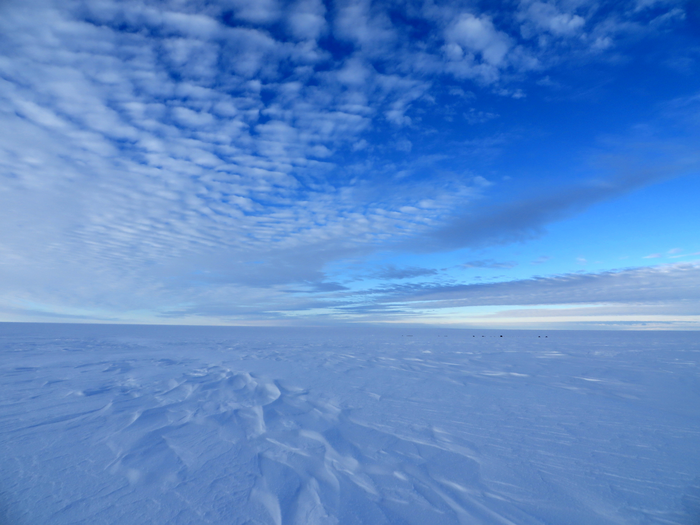
IMAGE CREDIT: University of Leeds



Leave a Reply