HAVE YOUR SAY.
Join us in The Bullpen, where the members of the Scientific Inquirer community get to shape the site’s editorial decision making. We’ll be discussing people and companies to profile on the site. On Wednesday, March 8 at 5:30pm EST, join us on Discord and let’s build the best Scientific Inquirer possible.
PCR technology is a molecular diagnostics technology that detects target nucleic acids by amplifying the DNA amount. It has brought marked progress in the life sciences field since its development in 1984. This technology has recently become familiar to the public due to the COVID-19 pandemic, since PCR can detect nucleic acids that identify the COVID-19 virus. However, due to the technical nature of the PCR test, results cannot be immediately delivered. It takes at least 1 to 2 hours for the test as it requires repeated temperature cycles (60~95℃).
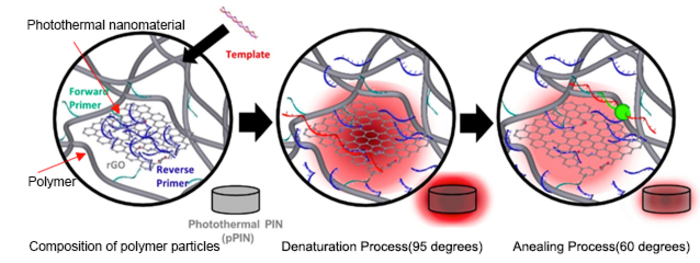
Dr. Sang Kyung Kim (Director) and Dr. Seungwon Jung’s research team at the Center for Augmented Safety System with Intelligence, Sensing of the Korea Institute of Science and Technology (KIST, President: Seok Jin Yoon) announced that they had developed an ultrafast PCR technology. By using photothermal nanomaterials, the ultrafast PCR shortens the test time by 10-fold, compared with the time taken for the existing test. The new method is completed in 5 minutes, with diagnostic performance equal to that of the existing test method.
Photothermal nanomaterials generate heat immediately upon light irradiation. As such, photothermal nanomaterials rapidly increase in temperature, but it is difficult to maintain performance due to their low stability. The KIST research team has developed a polymer composite that physically holds photothermal nanomaterials and can overcome their instability. By applying it to a PCR system, they have successfully developed a compact PCR system without a heat plate. In addition, they implemented a multiplex diagnostic technology that detects several genes at once, enabling it to distinguish several types of COVID-19 variants in a single reaction.

Director Sang Kyung Kim states, “through additional research, we plan to miniaturize the developed ultrafast PCR technology this year, to develop a device that can be utilized anywhere. While maintaining the strength of PCR as an accurate diagnostic method, we will increase its convenience, field applicability, and promptness, by which we expect that it will become a precision diagnostic device that can be used at primary local clinics, pharmacies, and even at home. In addition, PCR technology is a universal molecular diagnostic technology that can be applied to various diseases other than infectious diseases, so it will become more applicable.”
IMAGE CREDIT: Korea Institute of Science and Technology




Leave a Reply