MILLSTADT, Ill. — It was a late Friday afternoon when a team of men approached a tiny pink casket. One wiped his brow. Another stepped away to smoke a cigarette. Then, with calloused hands, they gently lowered the child’s body into the ground.
Earlier that day, the groundskeepers at Sunset Gardens of Memory had dug the small grave up on a hill in a special section of this cemetery in a southern Illinois community across the river from St. Louis. It was for a 3-year-old girl killed by a stray bullet.
“It can be stressful sometimes,” Jasper Belt, 26, said. “We have to use little shovels.”
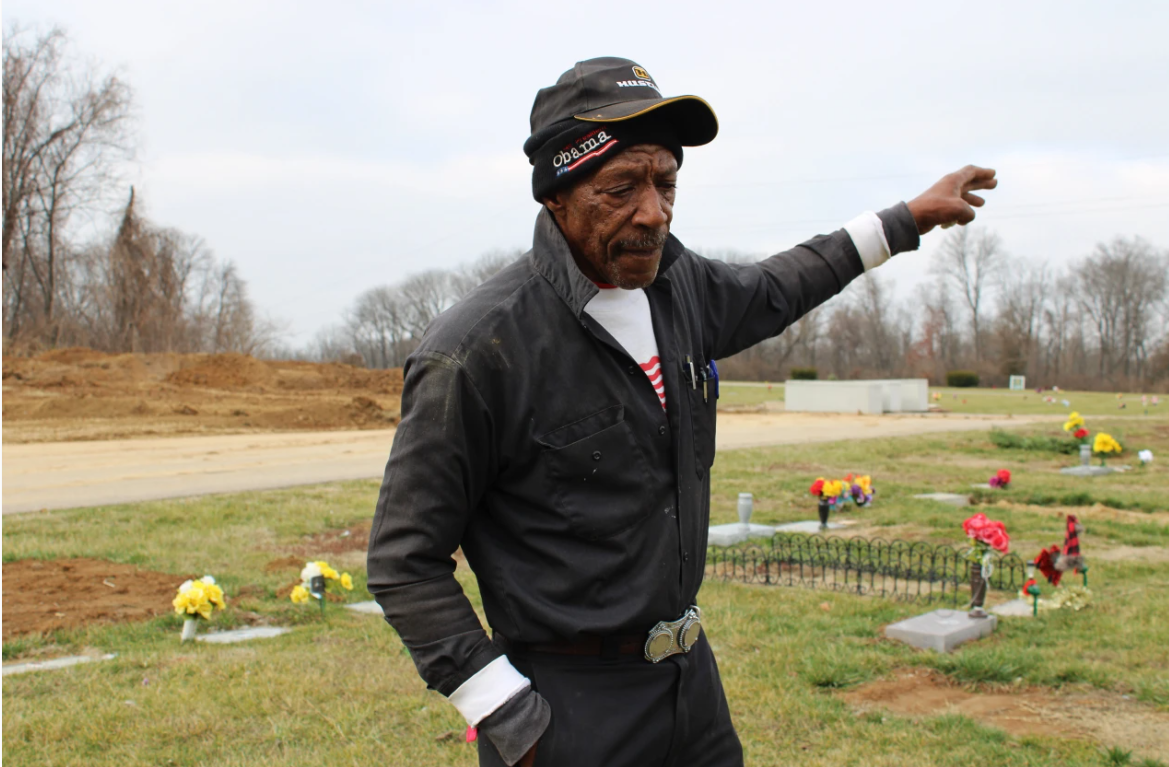
More than 30 years ago, Johnnie Haire and the other groundskeepers built a garden site just for children, separate from unlabeled sections of the 30-acre cemetery where they used to bury infants. They added a birdbath and bought angel figurines, carefully painting each one a hue of brown. Haire wanted the angels to be Black, like many of the children laid to rest here.
“This is ‘Baby Land,’” said Haire, 67, Sunset Gardens’ grounds supervisor, as he gestured across the area. “This is where a lot of babies are buried.”
Cemeteries like this one have long honored those who die too young. Such special burial sites exist in Gainesville, Florida; Quincy, Illinois; Owensboro, Kentucky; and beyond. They are for stillborn children and those who died of disease or accidents.
Today, a modern epidemic fills more graves than anything else: In the U.S., firearm-related injuries were the leading cause of death for children in 2020, ahead of motor vehicle crashes, according to researchers from the University of Michigan.
The men at Sunset Gardens are collecting data in their own way, too.
In 2019, Haire broke ground on a new section of the cemetery where teenagers and young adults are buried, including those killed by covid-19 and many who were victims of gun violence. It’s called the “Garden of Grace.” It’s already been used more than anyone would like.
“One time, it was just every weekend. Just a steady flow,” Haire said. “This one getting killed over here. This one getting killed over there. They fighting against each other, some rival gangs or whatever they were. So we had a lot. A lot of that.”
And 2021 was especially deadly nationwide: More than 47,000 people of all ages died from gunshot injuries, the highest U.S. toll since the early 1990s, according to the Centers for Disease Control and Prevention. This past year wasn’t as deadly nationally, though the tally is still being finalized.
The groundskeepers at Sunset Gardens have learned to watch their step in Baby Land because grieving parents drop off toys, candy, and balloons for their deceased children. “They just do things so differently in grief,” said Jocelyn Belt, 35, whose dad, William Belt Sr., 66, has worked at the cemetery since before she was born. Her brother and cousin work there, too.
The groundskeepers work quietly as families grieve. William Belt Jr., 44, said he doesn’t pry, even if he knows the family and would like to know how they’re doing.
“That’s what you learn not to do,” he said. “We let them come to us.”
But often, the men said, they are anonymous amid the rituals of grief. William Belt Jr. said he sometimes runs into those who attended the burials around town. “They don’t know my name. They’ll be like, ‘Gravedigger, you buried my mom. Man, thanks.’”
These men understand the complicated pain of losing loved ones. In the past year alone, the Belt family has experienced three deaths, including a relative who was shot and killed.
And on New Year’s Eve, William Belt Jr. himself was shot while in his truck outside a gas station convenience store.
“Nobody’s exempt,” he said, while recovering at home. “It could have been an old lady going to get some cornmeal or something like that from that store and could have got caught right in the crossfire.”
His family is thankful he’s OK. He is still grappling with his own close call, though.
“I would have probably been overtime for some of my co-workers. That’s something to think about,” Belt said. “And then they wouldn’t been able to go to my funeral ’cause they got to bury me.”
William Belt Sr. said his body froze when his son was shot. And he said he couldn’t hold back his emotions when he buried his brother and niece less than a month apart. Many of their relatives are buried at Sunset Gardens — literally by them.
“I weep,” he said. “Big difference between crying and weeping. Weeping, I’m closer to God.”
Their job is physical, emotional work done in all seasons, all weather. Injuries occur. Heartbreak is everywhere.
To hold their own hearts together, the groundskeepers often decompress as they eat lunch in a shed near the cemetery’s front office, trading stories in front of a wood-burning stove to keep warm during winter. They find joy where they can. The Belts like to fish. And the senior Belt occasionally sings the blues to soothe his soul. Parker, a long-haired cat, provides them company, too — and enjoys investigating the men’s lunches.
And they laugh when they can. William Belt Sr. still remembers his first year on the job. He wanted to be respectful, he said with a smile, even though his clients were deceased.
“‘Excuse me, coming through,’” Belt recalled saying as he walked through the cemetery. “Then I got myself together.”
Digging graves for a living wasn’t on the career list for Belt or his friend Haire. But that’s exactly what the two men have done for some 43 years — whether it’s for those who lived long, full lives or those whose young lives were cut short. They’re caretakers.
“That’s the proper name for it,” Haire said.
As he stood amid the graves on a recent day, he noted that the wooden Baby Land sign that welcomes mourners is worn. The paint on the angels is peeling, too.
“It needs touching up over there,” Haire said. “But I’ve been busy.”
This article originally appeared in Kaiser Health News.
WORDS: Cara Anthony: canthony@kff.org, @CaraRAnthony
IMAGE CREDIT: Cara Anthony/KHN.

Leave a Reply