HAVE YOUR SAY.
Join us in The Bullpen, where the members of the Scientific Inquirer community get to shape the site’s editorial decision making. We’ll be discussing people and companies to profile on the site. On Wednesday, January 25 at 5:30pm EST, join us on Discord and let’s build the best Scientific Inquirer possible.
“Suppose you knew everything there was to know about a water molecule — the chemical formula, the bond angle, etc.,” says Joseph Thywissen, a professor in the Department of Physics and a member of the Centre for Quantum Information & Quantum Control at the University of Toronto.
“You might know everything about the molecule, but still not know there are waves on the ocean, much less how to surf them,” he says. “That’s because when you put a bunch of molecules together, they behave in a way you probably cannot anticipate.”
Thywissen is describing the concept in physics known as emergence: the relationship between the behaviour and characteristics of individual particles and large numbers of those particles. He and his collaborators have taken a first step in understanding this transition from “one-to-many” particles by studying not one, not many, but two isolated, interacting particles, in this case potassium atoms.

The result, described in a paper published today in the journal Nature, is a first, small step toward understanding natural quantum systems, and how they can lead to more powerful and effective quantum simulations.
The collaborative team of experimental physicists from the University of Toronto and theoretical physicists from the University of Colorado has measured the strength of a type of interaction — known as “p-wave interactions” — between two potassium atoms and found the result confirms a longstanding prediction.
P-wave interactions are weak in naturally occurring systems, but researchers had predicted that they have a much higher maximum theoretical limit. The team is the first to confirm that the p-wave force between particles reached this maximum.
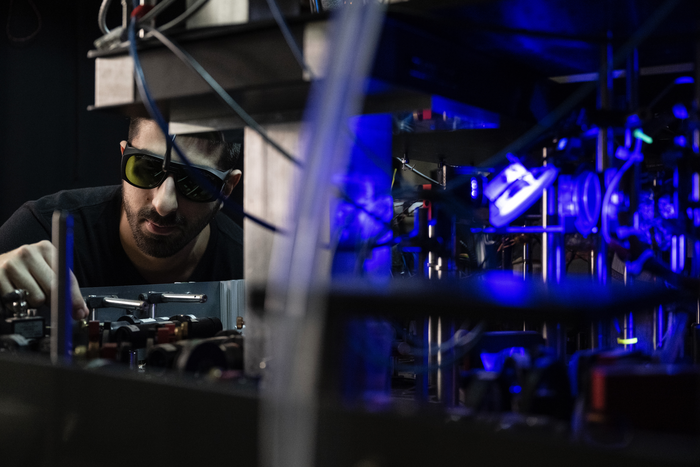
“In our lab, we were able to isolate two atoms at a time,” says Vijin Venu, a physics PhD graduate of the University of Toronto. “This approach avoids the complexity of many-atom systems and allows full control and study of interactions between atoms in a pair.”
The team isolated pairs of atoms within a 3D optical lattice — a “crystal of light” as University of Toronto physics postdoctoral researcher Cora Fujiwara describes it — created at the intersection of three laser beams at 90 degrees to each other. The intersecting beams generated stationary nodes of high intensity which trapped pairs of particles. With pairs isolated in this way, the researchers were able to measure the strength of their mutual interaction.
“What we saw in our experiment was remarkable,” says Fujiwara. “It’s a perfect little system. And now that we have this understanding of this two-particle system, we can start to create these sorts of exotic systems which involve many, many more particles.”
The result has ramifications in many different technologies including the study of superfluids, superconductivity and quantum simulations.
Quantum simulations are models designed to understand quantum systems like atoms, molecules or chemical reactions — systems ruled by quantum mechanics. These simulations can help understand how properties of materials emerge from particle-particle interactions.
“In fact, the interactions between spin-polarized fermions that we have observed are predicted to give rise to new forms of unconventional robust superfluids, which are believed to be a potential resource for quantum calculations,” explains Ana Maria Rey, an adjoint professor of physics at the University of Colorado Boulder and a fellow of JILA and the National Institute of Standards and Technology.
The challenge of solving quantum models with existing computers is daunting; the task has been described as teaching quantum mechanics to a computer. A promising alternative is to use existing quantum systems — in other words, actual atoms and molecules.
“What’s hard for us, is easy for nature,” says Thywissen. “And so, we can harness the computational power of nature just ‘doing its thing’ to solve problems that are otherwise intractable to us.”
IMAGE CREDIT: Jo-Anne McArthur


Leave a Reply