HAVE YOUR SAY.
Join us in The Bullpen, where the members of the Scientific Inquirer community get to shape the site’s editorial decision making. We’ll be discussing people and companies to profile on the site. On Wednesday, December 14 at 5:30pm EST, join us on Discord and let’s build the best Scientific Inquirer possible.
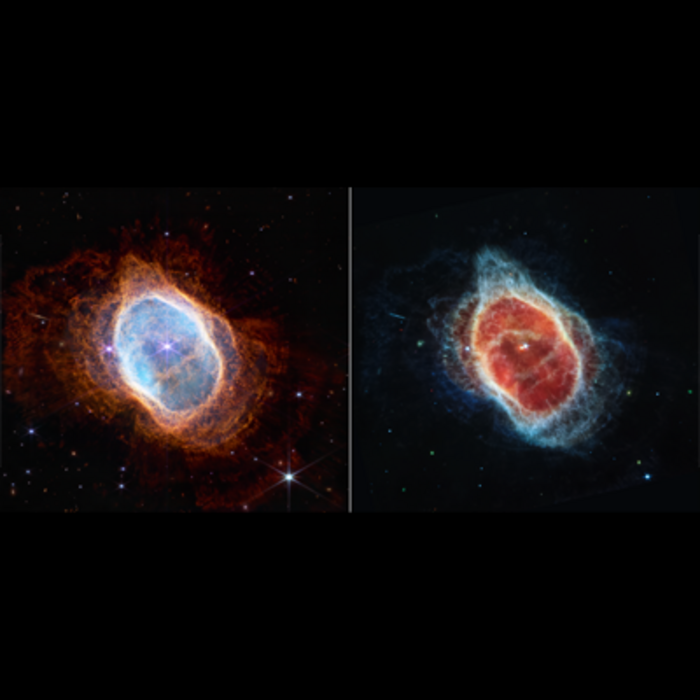
Around 2500 years ago, a star ejected most of its gas, forming the beautiful Southern Ring Nebula, NGC 3132, chosen as one of the first five image packages from the James Webb Space Telescope (JWST).
A team of nearly 70 astronomers from 66 organisations across Europe, North, South and Central America, and Asia have used the JWST images to piece together the messy death of this star.
“It was nearly three times the size of our Sun, but much younger, about 500 million years old. It created shrouds of gas that have expanded out from the ejection site, and left a remnant dense white dwarf star, with about half the mass of the Sun, but approximately the size of the Earth,” says Professor Orsola De Marco, lead author on the paper, from Macquarie University’s Research Centre for Astronomy, Astrophysics and Astrophotonics.
“We were surprised to find evidence of two or three companion stars that probably hastened its death as well as one more ‘innocent bystander’ star that got caught up in the interaction,” she says.
The study was based on the JWST images supplemented by data from the ESO Very Large Telescope in Chile, the San Pedro de Mártir Telescope in Mexico, the Gaia Space Telescope, and the Hubble Space Telescope.
It paves the way for future JWST observations of nebulae, providing insight into fundamental astrophysical processes including colliding winds, and binary star interactions, with implications for supernovae and gravitational wave systems.
The paper is published today in Nature Astronomy https://www.nature.com/articles/s41550-022-01845-2
“When we first saw the images, we knew we had to do something, we must investigate! The community came together and from this one image of a randomly chosen nebula we were able to discern much more precise structures than ever before. The promise of the James Webb Space Telescope is incredible,” says De Marco, who is also president of the International Astronomical Union Commission on Planetary Nebulae.
Astronomers gathered online and developed theories and models around the mid-infrared image to reconstruct just how the star had died.
Shining at the centre of the nebula is an ultra-hot central star, a white dwarf that has burned up its hydrogen. “This star is now small and hot, but is surrounded by cool dust,” said Joel Kastner, another team member, from the Rochester Institute of Technology USA. “We think all that gas and dust we see thrown all over the place must have come from that one star, but it was tossed in very specific directions by the companion stars.”
There are also a series of spiral structures moving out from the centre. These concentric arches would be created when a companion orbits the central star while it is losing mass. Another companion is further out and is also visible in the picture.
Looking at a three-dimensional reconstruction of the data, the team also saw pairs of protuberances that may occur when astronomical objects eject matter in jet form. These are irregular and shoot out in different directions, possibly implying a triple star interaction at the centre.
De Marco says: “We first inferred the presence of a close companion because of the dusty disk around the central star, the further partner that created the arches and the super far companion that you can see in the image. Once we saw the jets, we knew there had to be another star or even two involved at the centre, so we believe there are one or two very close companions, an additional one at middle distance and one very far away. If this is the case, there are four or even five objects involved in this messy death.”
IMAGE CREDIT: NASA.



Leave a Reply