HAVE YOUR SAY.
Join us in The Bullpen, where the members of the Scientific Inquirer community get to shape the site’s editorial decision making. We’ll be discussing people and companies to profile on the site. On Wednesday, November 23 at 5:30pm EST, join us on Discord and let’s build the best Scientific Inquirer possible.
An international research team led by the University of Minnesota Twin Cities has measured the size of a star dating back 2 billion years after the Big Bang, or more than 11 billion years ago. Detailed images show the exploding star cooling and could help scientists learn more about the stars and galaxies present in the early Universe.
The paper is published in Nature, the world’s leading peer-reviewed, multidisciplinary science journal.
“This is the first detailed look at a supernova at a much earlier epoch of the Universe’s evolution,” said Patrick Kelly, a lead author of the paper and an associate professor in the University of Minnesota School of Physics and Astronomy. “It’s very exciting because we can learn in detail about an individual star when the Universe was less than a fifth of its current age, and begin to understand if the stars that existed many billions of years ago are different from the ones nearby.”

The red supergiant in question was about 500 times larger than the sun, and it’s located at redshift three, which is about 60 times farther away than any other supernova observed in this detail.
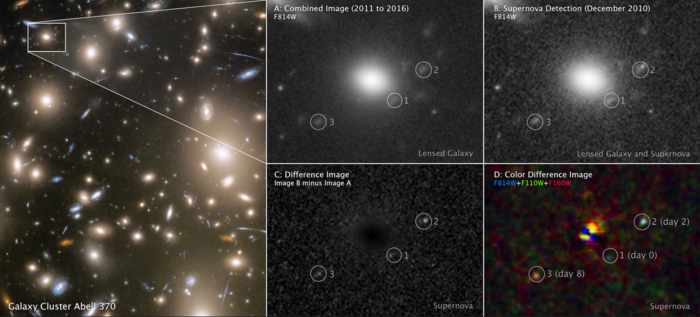
Using data from the Hubble Space Telescope with follow-up spectroscopy using the University of Minnesota’s access to the Large Binocular Telescope, the researchers were able to identify multiple detailed images of the red supergiant because of a phenomenon called gravitational lensing, where mass, such as that in a galaxy, bends light. This magnifies the light emitted from the star.
“The gravitational lens acts as a natural magnifying glass and multiplies Hubble’s power by a factor of eight,” Kelly said. “Here, we see three images. Even though they can be seen at the same time, they show the supernova as it was at different ages separated by several days. We see the supernova rapidly cooling, which allows us to basically reconstruct what happened and study how the supernova cooled in its first few days with just one set of images. It enables us to see a rerun of a supernova.”
The researchers combined this discovery with another one of Kelly’s supernova discoveries from 2014 to estimate how many stars were exploding when the Universe was a small fraction of its current age. They found that there were likely many more supernovae than previously thought.
“Core-collapse supernovae mark the deaths of massive, short-lived stars. The number of core-collapse supernovae we detect can be used to understand how many massive stars were formed in galaxies when the Universe was much younger,” said Wenlei Chen, first author of the paper and a postdoctoral researcher in the University of Minnesota School of Physics and Astronomy.
IMAGE CREDIT: Wenlei Chen, NASA


Leave a Reply