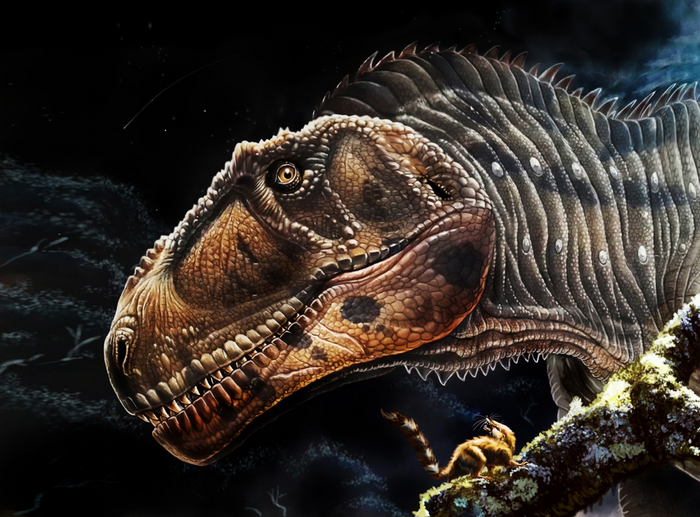
A team co-led by University of Minnesota Twin Cities researcher Peter Makovicky and Argentinean colleagues Juan Canale and Sebastian Apesteguía has discovered a new huge, meat-eating dinosaur, dubbed Meraxes gigas. The new dinosaur provides clues about the evolution and biology of dinosaurs such as the Carcharodontosaurus and Tyrannosaurus rex—specifically, why these animals had such big skulls and tiny arms.
The study is published in Current Biology, a peer-reviewed scientific biology journal.
The researchers initially discovered Meraxes in Patagonia in 2012 and have spent the last several years extracting, preparing, and analyzing the specimen. The dinosaur is part of the Carcharodontosauridae family, a group of giant carnivorous theropods that also includes Giganotosaurus, one of the largest known meat-eating dinosaurs and one of the reptilian stars of the recently released “Jurassic World: Dominion” movie.
HAVE YOUR SAY.
Join us in The Bullpen, where the members of the Scientific Inquirer community get to shape the site’s editorial decision making. We’ll be discussing people and companies to profile on the site. On Wednesday, July 20 at 5:30pm EST, join us on Discord and let’s build the best Scientific Inquirer possible.
Though not the largest among carcharodontosaurids, Meraxes was still an imposing animal measuring around 36 feet from snout to tail tip and weighing approximately 9,000 pounds. The researchers recovered the Meraxes from rocks that are around 90-95 million years old, alongside other dinosaurs including several long-necked sauropod specimens.
Meraxes is among the most complete carcharodontosaurid skeleton paleontologists have found yet in the southern hemisphere and includes nearly the entirety of the animal’s skull, hips, and both left and right arms and legs.
“The neat thing is that we found the body plan is surprisingly similar to tyrannosaurs like T. rex,” said Peter Makovicky, one of the principal authors of the study and a professor in the University of Minnesota N.H. Winchell School of Earth and Environmental Sciences. “But, they’re not particularly closely related to T. rex. They’re from very different branches of the meat-eating dinosaur family tree. So, having this new discovery allowed us to probe the question of, ‘Why do these meat-eating dinosaurs get so big and have these dinky little arms?’”
“The discovery of this new carcharodontosaurid, the most complete up to now, gives us an outstanding opportunity to learn about their systematics, paleobiology, and true size like never before,” said Sebastian Apesteguía, a co-author of the study and a researcher at Maimónides University in Argentina.
With the statistical data that Meraxes provided, the researchers found that large, mega-predatory dinosaurs in all three families of therapods grew in similar ways. As they evolved, their skulls grew larger and their arms progressively shortened.
The possible uses of the tiny forelimbs in T. rex and other large carnivorous dinosaurs have been the topic of much speculation and debate.
“What we’re suggesting is that there’s a different take on this,” Makovicky said. “We shouldn’t worry so much about what the arms are being used for, because the arms are actually being reduced as a consequence of the skulls becoming massive. Whatever the arms may or may not have been used for, they’re taking on a secondary function since the skull is being optimized to handle larger prey.”
The researchers also found that carcharodontosaurids including species from Patagonia evolved very quickly, but then disappeared suddenly from the fossil record very soon after.
“Usually when animals are on the verge of extinction, it’s because they’re evolutionary rates are quite slow, meaning they aren’t adapting very quickly to their environment,” explained Juan Canale, the study’s lead author and a researcher at the National University of Río Negro. “Here, we have evidence that Meraxes and its relatives were evolving quite fast and yet within a few million years of being around, they disappeared, and we don’t know why. It’s one of these finds where you answer some questions, but it generates more questions for the future.”
IMAGE CREDIT: Jorge Gonzalez



Leave a Reply