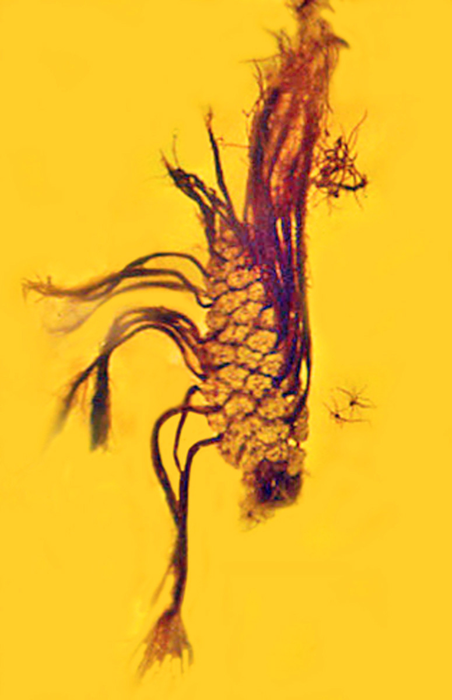
CORVALLIS, Ore. – Oregon State University research has uncovered the first fossil evidence of a rare botanical condition known as precocious germination in which seeds sprout before leaving the fruit.

In a paper published in Historical Biology, George Poinar Jr. of the Oregon State College of Science describes a pine cone, approximately 40 million years old, encased in Baltic amber from which several embryonic stems are emerging.
“Crucial to the development of all plants, seed germination typically occurs in the ground after a seed has fallen,” said Poinar, an international expert in using plant and animal life forms preserved in amber to learn about the biology and ecology of the distant past. “We tend to associate viviparity – embryonic development while still inside the parent – with animals and forget that it does sometimes occur in plants.”
Most typically, by far, those occurrences involve angiosperms, Poinar said. Angiosperms, which directly or indirectly provide most of the food people eat, have flowers and produce seeds enclosed in fruit.
“Seed germination in fruits is fairly common in plants that lack seed dormancy, like tomatoes, peppers and grapefruit, and it happens for a variety of reasons,” he said. “But it’s rare in gymnosperms.”
Gymnosperms such as conifers produce “naked,” or non-enclosed, seeds. Precocious germination in pine cones is so rare that only one naturally occurring example of this condition, from 1965, has been described in the scientific literature, Poinar said.
“That’s part of what makes this discovery so intriguing, even beyond that it’s the first fossil record of plant viviparity involving seed germination,” he said. “I find it fascinating that the seeds in this small pine cone could start to germinate inside the cone and the sprouts could grow out so far before they perished in the resin.”
At the sprouts’ tips are needle clusters, some in bundles of five, associating the fossil with the extinct pine species Pinus cembrifolia, which was previously described from Baltic amber, Poinar said.
Pine cones in Baltic amber are not commonly found, he added. The ones that do appear are prized by collectors and because the cones’ scales are hard, they’re usually very well preserved and appear lifelike.
Viviparity in plants typically shows up in one of two ways, Poinar said. Precocious germination is the more common of the two, the other being vegetative viviparity, such as when a bulbil emerges directly from the flower head of a parent plant.
“In the case of seed viviparity in this fossil, the seeds produced embryonic stems that are quite evident in the amber,” he said. “Whether those stems, known as hypocotyls, appeared before the cone became encased in amber is unclear. However, based on their position, it appears that some growth, if not most, occurred after the pine cone fell into the resin.
“Often some activity occurs after creatures are entombed in resin, such as entrapped insects depositing eggs,” Poinar said. “Also, insect parasites sometimes flee their hosts into the resin after the latter become trapped. In the case of the pine cone, the cuticle covering the exposed portions of the shoots could have protected them from rapid entrance of the resin’s natural fixatives.”
Research on viviparity in extant gymnosperms suggests the condition could be linked to winter frosts. Light frosts would have been possible if the Baltic amber forest had a humid, warm-temperate environment as has been posited, Poinar said.
“This is the first fossil record of seed viviparity in plants but this condition probably occurred quite a bit earlier than this Eocene record,” he said. “There’s no reason why vegetative viviparity couldn’t have occurred hundreds of millions of years ago in ancient spore-bearing plants like ferns and lycopods.”
IMAGE CREDIT: George Poinar Jr., OSU


Leave a Reply