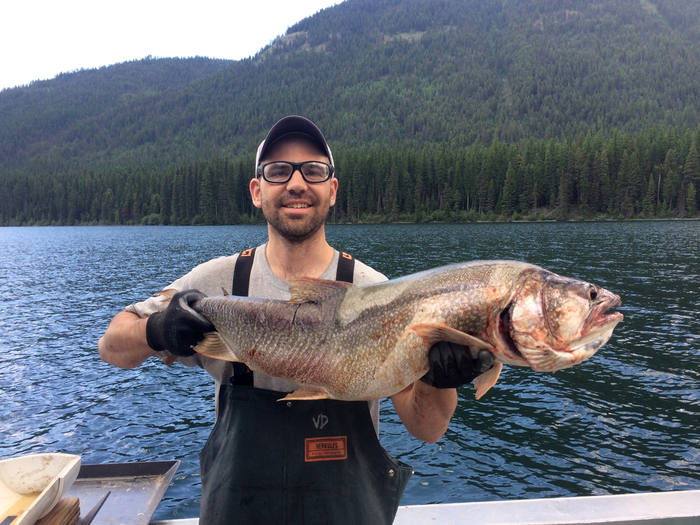
FLATHEAD LAKE, Montana – Invasive species cause biodiversity loss and about $120 billion in annual damages in the U.S. alone. Despite plentiful evidence that invasive species can change food webs, how invaders disrupt food webs and native species over time has remained unclear.
Now, thanks to a new collaborative study, there is greater insight into how invasive species progressively affect native food webs. The research was conducted by the University of Montana’s Flathead Lake Biological Station, the U.S. Geological Survey and Montana Fish, Wildlife & Parks.
“This study provides new details about how invasive lake trout affect entire lake food webs,” said U.S. Fish and Wildlife fish biologist Charles Wainright, who recently completed his graduate student work at UM’s biological station. “The findings will be important for conserving native species and ecosystems in Montana and elsewhere.”
The study, recently published in the prestigious journal Proceedings of the National Academy of Sciences, used long-term fisheries monitoring records to determine the timing of invasion by a nonnative fish predator, lake trout, in 10 northwestern Montana lakes. It also analyzed food webs from those lakes to determine how they changed and impacted native communities as the invasions progressed.
The research team showed that lake trout disrupted food webs by forcing native fishes to feed on suboptimal food sources in different habitats, eventually causing the loss of the native predator, bull trout, a threatened species protected under the U.S. Endangered Species Act.
“Native bull trout populations have drastically declined in many lakes across western Montana due to competitive interactions with invasive lake trout,” said Clint Muhlfeld, a USGS aquatic ecologist and FLBS associate research professor. “For the first time, we show what happens not only to bull trout but entire food webs supporting them as lake trout invade and upset lake ecosystems over time.”

The study also showed the food-web effects of lake trout invasion were especially pronounced as lake trout abundance increased rapidly 25 to 50 years after colonization. After 50 years, lake trout were the dominant apex predator in these food webs. The study shows that, given enough time, invasive lake trout can disrupt and replace a native fish species – like bull trout – and create divergent biological communities that are vastly different than uninvaded ecosystems.
This study adds to a body of evidence showing that invasive species have affected western Montana. For example, until the late 1800s, about 10 native species of fish patrolled the waters of Flathead Lake, including abundant westslope cutthroat trout and bull trout. Beginning in 1905, fisheries managers began introducing nonnative species to the food web as a means to improve Flathead Lake tourism and generate more recreational fishing appeal. Today, there are more than 20 species of fish in Flathead Lake, and introduced species like lake trout, lake whitefish, and Mysis shrimp dominate the food web in Flathead Lake, so much so that native species – including bull trout and westslope cutthroat, Montana’s state fish – have declined dramatically.
“This has been a truly collaborative effort,” said FLBS lake ecologist Shawn Devlin. “The work leverages the rather bleak history of introduction and invasion of nonnative species in northwest Montana lakes into an ecological experiment built on the power of long-term data and a deeper understanding of lake ecology.”
The study’s results stress the importance of protecting entire landscapes from biological invasions. The use of innovative biosurveillance monitoring techniques, like environmental DNA, also are critical to increasing the likelihood of detecting invaders before they become established. For ecosystems that already have been invaded, this study’s findings can inform proactive control efforts during the early stages of invasion to avoid food web disruptions that may be difficult to reverse.
The study, led by Wainright, was co-authored by Muhlfeld, Devlin, FLBS Director Jim Elser and Samuel Bourret of Montana Fish, Wildlife & Parks. The research was supported by the USGS Biological Threats Program, FLBS and philanthropic gifts.
IMAGE CREDIT: Joe Giersch, USGS


Leave a Reply