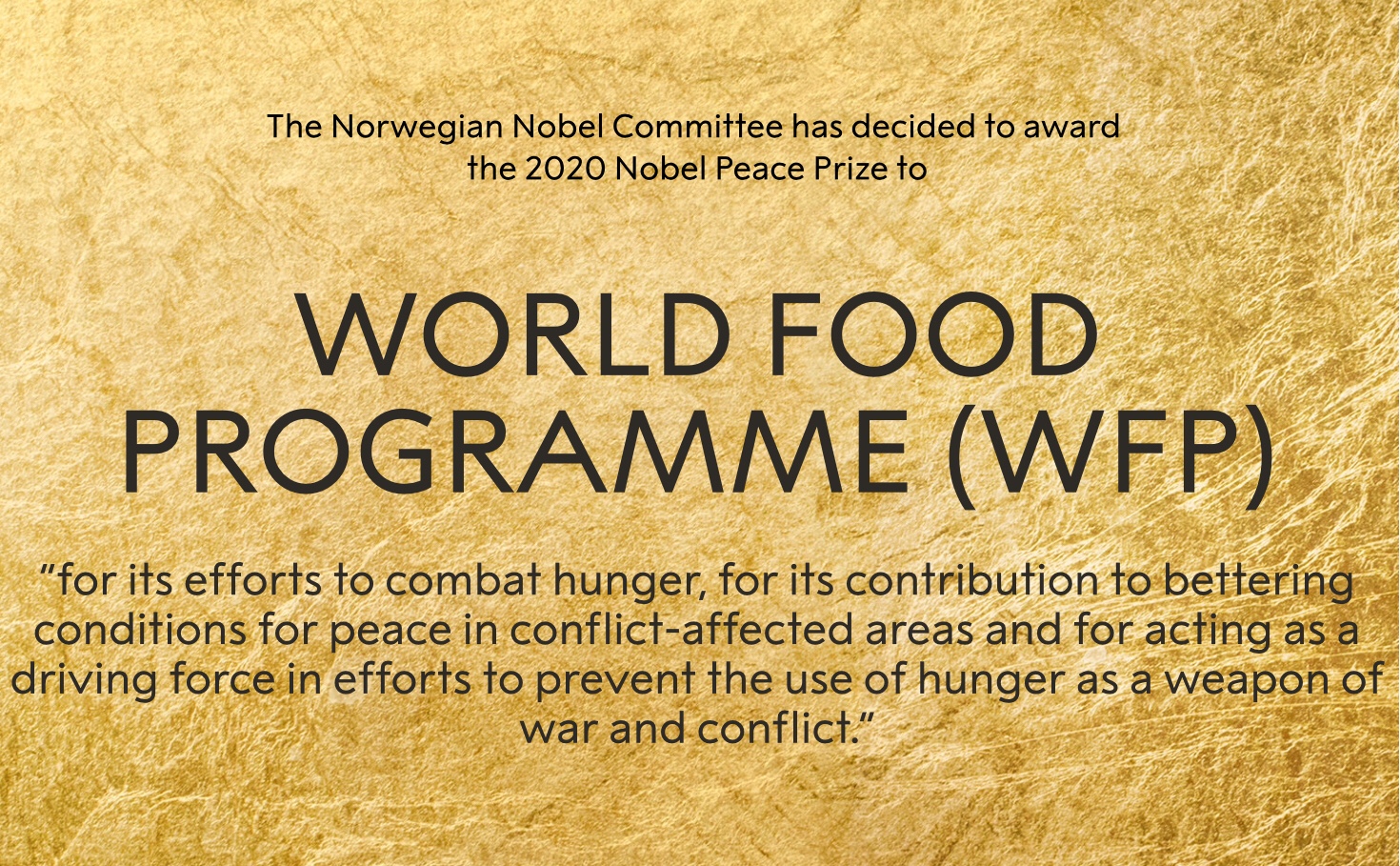
For years on end, the Nobel Peace Prize was, arguably, the most controversial member of the Nobel Prize family. We’ll gladly skip the obvious politics of past decisions for this year’s award which shouldn’t be too controversial (though you never know these days). Per Reuters, “The United Nations’ World Food Programme (WFP) won the Nobel Peace Prize on Friday for its efforts to combat hunger around the world and improve conditions for peace in areas affected by conflict.” The organization cited the current global pandemic as a factor in its decision, making the WFP all the more obvious. https://reut.rs/34EQslx
COVAX is the World Health Organization-led COVID-19 vaccine initiative designed to ensure access to lower-income countries. A noble cause. To their credit, Japan was quick to join, leading the way among major economies. Now, Reuters reports that another major world power has decided to join COVAX. According to Reuters, “China has joined a global scheme for the distribution of COVID-19 vaccine backed by the World Health Organization (WHO), it said on Friday, giving a major boost to an initiative shunned by U.S. President Donald Trump. Beijing’s latest bid to join the global fight against the coronavirus follows criticism over its handling of the pandemic, which has contributed to a growing unfavourable view of China in advanced nations, a recent survey showed.” Whether this gesture changes people’s views of the Asian nation or not, remains to be seen. The WHO-China tandem hasn’t exactly been bathed in glory of late. The only person who could manage to come across worse than them is the aforementioned U.S. president. https://reut.rs/2GxmMid
Some members of the scientific community in America are on a PR offensive, asking the public to have faith in the Food and Drug Administration and its vetting of potential COVID-19 vaccines. Science quotes some of the leaders of America’s scientific establishment: “‘Despite a lot of the political noise, the science is going well,’ said Francis Collins, director of the National Institutes of Health (NIH). ‘I know there’s a great deal of anxiety about mischief here. It would be pretty darn hard for mischief to derail this process. And I hope everybody can start to get calmed down about that.’” Considering what’s been done to undercut institutions like the NIH, it’s a big ask but, we agree, a necessary one. Sad that it’s come to this though. https://bit.ly/3iEzHf6
Researchers in the United States used data from hospitals in New York and Massachusetts and performed a multicenter retrospective cohort study with a separate multicenter cohort for external validation. Their goal was to create a model that would predict the severity of short term COVID-19 cases. Per PLOS, “We developed a risk model consisting of patient age, hypoxia severity, mean arterial pressure and presence of kidney dysfunction at hospital presentation. Multivariable regression model was based on risk factors selected from univariable and Chi-squared automatic interaction detection analyses.” https://bit.ly/3de5VNl
Everyone who’s had a loved one in the hospital is familiar with the experience of medical staff leaving much to be desire, especially when it comes to basic things like compassion or even basic levels of interpersonal skills. An op-ed in STAT by a medical student whose father is in the hospital being treated for cancer eloquently argues that the system could use more of a human touch. According to the piece, “It shouldn’t take a medical degree to ensure great care. I wish that doctors had infinite time to bridge the gap between their knowledge and that of their patients and patients’ families, but they don’t. Our hospital systems don’t allow for the highest-quality physician-patient interactions, and they sadly don’t prioritize patients’ sleep, dignity, or even understanding of their own health. Instead, hospitals put a premium on efficiency, often at the cost of confusing patients and reinforcing power dynamics that stifle shared decision making.” We wholly second everything she says in this well-written piece. https://bit.ly/3lsPUFT
Lastly, we’d like to leave you for the weekend with a generous dose of positivity. For that we turn to one of our favorite podcasts at the moment, “How to Save a Planet.” In this week’s episode, hosts Dr. Ayana Elizabeth Johnson and Alex Blumberg explain how “Green New Deal” advocates pushed Biden to adopt the most ambitious climate platform in U.S. history. This week’s episode features guests Varshini Prakash, the Co-Founder of the Sunrise Movement; Rhiana Gunn-Wright, an original author of the Green New Deal alongside Alexandria Ocasio-Cortez; and Maggie Thomas, the political director of Evergreen Action. Building on last week’s deep dive into how the Part of Lincoln became the Party of Denial, this episode traces the evolution of climate change discourse in the politics. “How to Save a Planet” is a Spotify Original Podcast, from Gimlet, a Spotify Studio. https://spoti.fi/2IeuVIP



Leave a Reply