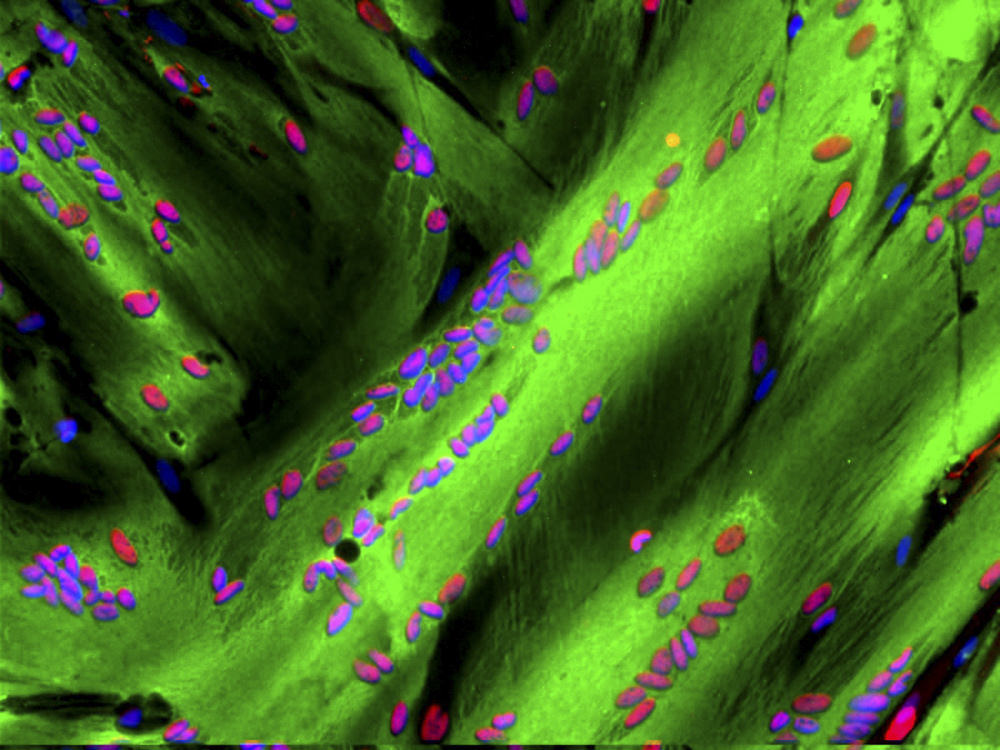
Aging muscle presents a puzzle that has long resisted explanation. Muscles lose strength as mitochondria, the cellular structures that generate energy, become less efficient with age. Yet instead of shrinking away from the fibers that depend most on those failing mitochondria, aging muscle actually shifts toward more of them: slow-twitch fibers, which rely heavily on mitochondrial function. A similar shift shows up in many muscle-wasting diseases. A new study from the University of Copenhagen, published in Nature Aging, identifies a specific molecular trigger behind that shift.
The researchers focused on cardiolipin, a fat found almost exclusively in the inner membrane of mitochondria, where it helps maintain the membrane’s folded structure and supports energy production. Levels of cardiolipin decline with both age and disease in mouse and human muscle. When the team artificially lowered cardiolipin in young mice, it reproduced the same fast-to-slow fiber shift seen in older animals and in humans. Restoring cardiolipin to roughly two-thirds of normal levels reversed muscle wasting in the mice and prevented early deaths.
The team’s working explanation is that the fiber shift isn’t simple decline, but a defense mechanism. Stressed mitochondria generate more reactive oxygen species, molecules that can damage cells, and the switch toward slow-twitch fibers appears to blunt that damage. An antioxidant treatment reduced the fiber shift in the mice, but counterintuitively, antioxidants given to the animals made their muscles worse rather than better. A protein called ERRγ turned out to drive the whole process: blocking it in cultured muscle cells stopped the fiber switch completely. Cardiolipin-deficient mice also pulled much more glucose from their blood, but used it mainly to build the cell’s own antioxidants rather than to generate energy.
The work was conducted in mice, with human muscle samples confirming only that cardiolipin falls with age. Still, the researchers see a path toward treatment. The FDA recently granted accelerated approval to elamipretide, a drug designed to stabilize cardiolipin, for the rare genetic disorder Barth syndrome, and ERRγ belongs to a class of nuclear receptor already targeted by an estimated 10 to 15 percent of FDA-approved small-molecule drugs. As first author Fabian Finger, an assistant professor at the University of Copenhagen, put it, the fiber switch isn’t the muscle failing — it’s the muscle trading power for protection. Senior author Zachary Gerhart-Hines said he was most encouraged that even a partial recovery of cardiolipin was enough to bring muscle function back toward normal. The study involved more than 20 institutions and was funded in part by the Novo Nordisk Foundation, the European Research Council, and the U.S. National Institutes of Health.
Journal: Nature Aging
Article Title: Mitochondrial membrane lipid cardiolipin controls fiber-type adaptations in aging muscle via estrogen-related receptor γ
DOI: 10.1038/s43587-026-01227-7
Publication Date: September 29, 2026
Source: EurekAlert


Leave a Reply