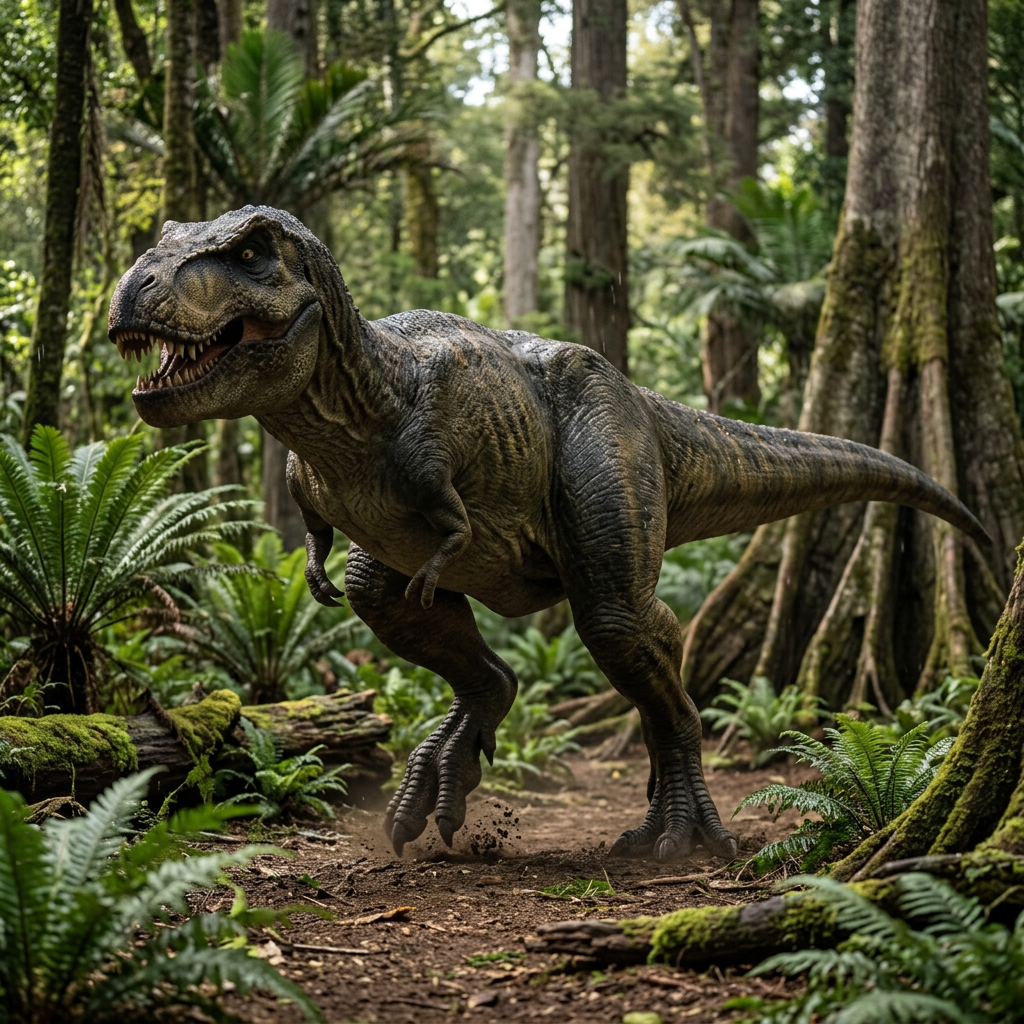
T. Rex Ran Nearly as Hot as Humans: Scientists have directly estimated the body temperature of Tyrannosaurus rex from fossilized teeth, strengthening evidence that the enormous predator was warm-blooded. Researchers analyzed carbon and oxygen isotopes bonded together inside enamel from three T. rex teeth recovered from Montana’s Hell Creek Formation. The chemical “clumped isotope” thermometer produced an average temperature of 36.3°C (97.3°F), comparable to humans and modern elephants. Crocodilians from the same environment averaged only about 30.9°C, supporting the interpretation that T. rex actively maintained elevated body heat rather than simply tracking environmental temperatures. The method required only milligrams of enamel, making similar studies of museum fossils increasingly feasible. Published in Science Advances, the findings help explain how tyrannosaurs sustained active lifestyles and inhabited climates ranging from temperate regions to comparatively cold high latitudes. (Reuters)
Skull Immune Hubs Fight Brain Tumors: Researchers have discovered previously unknown lymph-node-like structures inside skull bone marrow that appear to function as a localized immune-defense system for the brain. Scientists at Washington University School of Medicine in St. Louis tracked proteins moving from the brain through microscopic skull channels and found organized collections of B cells and T follicular helper cells capable of mounting immune responses. In mice with glioblastoma, disrupting these structures accelerated tumor growth and shortened survival. Conversely, applying an immune-stimulating gel beneath the scalp activated the skull hubs, improved tumor rejection and extended survival. Similar immune-cell populations were detected in human skull marrow. Published in Nature, the findings raise the intriguing possibility that future treatments for brain tumors—and potentially neurological diseases involving immunity—could target immune activity locally through the skull rather than systemically. (ScienceDaily)
Ancient DNA Tracks Plague Across Four Centuries: Ancient DNA is providing an unusually detailed reconstruction of how plague repeatedly swept through Europe after the Black Death. Researchers recovered 26 genomes of Yersinia pestis from human remains at 11 archaeological sites spanning Estonia, Russia, England, the Netherlands and Switzerland. The samples date between 1349 and 1710. By combining bacterial phylogenies with radiocarbon dating, researchers developed a method that narrowed the likely dates of ancient infections enough to associate many genomes with historically recorded outbreaks. The analysis reveals previously unknown plague lineages and suggests major diversification around 1450–1500, while later outbreaks followed human movements associated with events including the Thirty Years’ War and Great Northern War. Published in PNAS, the work demonstrates how genetics, archaeology and documentary history can reconstruct the movement and evolution of historical pandemics with remarkable precision. (PubMed)
Emperor Penguins Relocate as Antarctic Ice Changes: Satellite observations reveal that emperor penguin colonies can relocate substantial distances when changing ice conditions threaten established breeding sites. Researchers analyzing medium- and very-high-resolution imagery identified five colonies in West Antarctica that moved significantly during the past decade. Two relocations appear connected to recent ice-shelf calving events. Another colony had existed unnoticed for decades but repeatedly changed location, while two additional colonies formed comparatively recently. Because emperor penguins depend on stable fast ice to breed and raise chicks, their ability to move could provide an important mechanism for responding to environmental disruption. The findings nevertheless do not imply that penguins can simply escape climate change: suitable alternative breeding sites remain dependent on regional sea-ice conditions. Published in Communications Biology, the study shows that emperor penguin populations are considerably more geographically dynamic than previously recognized. (Nature)
RNA Switch Lets Pancreatic Cells Change Identity: Researchers have uncovered an RNA-regulation mechanism that helps pancreatic alpha cells maintain their identity—and potentially prevents them from becoming insulin-producing beta-like cells. The study focuses on m6A, a chemical modification added to messenger RNA. Metabolic signals that normally stimulate glucagon secretion increased m6A-related machinery in alpha cells. When researchers deleted the m6A-writing enzyme METTL14 specifically from mouse alpha cells, glucagon responses weakened, alpha-cell numbers declined and beta-cell mass increased. Some alpha cells began transitioning toward immature insulin-producing beta-like states. Molecular analysis identified the transcription factor YY1 as one pathway connecting lost m6A regulation with this cellular reprogramming. Published in Nature Metabolism, the findings expose an epitranscriptomic mechanism governing pancreatic-cell identity and suggest a potentially important avenue for diabetes research: learning how to deliberately unlock alpha-cell plasticity to replenish insulin-producing beta cells. (Nature)
Mars Records Three Distinct Episodes of Water: Perseverance has uncovered evidence that rocks along the inner rim of Jezero Crater interacted with water on at least three separate occasions, revealing a more complicated hydrological history than scientists expected. Instead of sedimentary rocks from the crater’s ancient lake, Perseverance found slowly cooled igneous rocks rich in olivine. Lower-elevation rocks record successive alteration: carbon-dioxide-rich groundwater produced carbonate-filled fractures; a later episode, possibly involving the lake, left silica; and heated groundwater subsequently created veins containing calcium sulfate and fluorite. Researchers reconstructed the sequence using SuperCam measurements of more than 185 bedrock targets. Because carbonate and silica can preserve evidence of past microbial activity, the findings, published in Communications Earth & Environment, strengthen the Margin Unit’s importance for reconstructing early Mars’ changing climate and habitability. (NASA)
Dissolving Battery Powers Devices Inside the Body: Engineers at Massachusetts Institute of Technology have developed tiny batteries capable of powering ingestible medical devices before safely breaking down inside the gastrointestinal tract. Built from bioresorbable materials including magnesium, molybdenum trioxide and cellulose, the batteries generate about 1.84 volts. In pigs, they powered electrical stimulation for as long as three days; 20 minutes of stomach stimulation increased levels of the appetite-regulating hormone ghrelin by roughly 50%. A second version powered an RFID transmitter capable of sending signals from inside the gastrointestinal tract over distances up to 1.5 meters. Published in Nature Chemical Engineering, the technology could eventually support temporary devices for drug delivery, sensing and gastrointestinal stimulation without leaving conventional batteries behind. Researchers anticipate initial clinical testing of the RFID system in approximately two years. (MIT News)
First Adult T. Rex Trackway Discovered: Four enormous footprints discovered in North Dakota represent the first described continuous trackway likely made by an adult Tyrannosaurus rex. High-school science teacher Kent Hups discovered the roughly seven-meter trail in the Hell Creek Formation in 2025. Researchers from the Denver Museum of Nature & Science and Liverpool John Moores University used high-resolution 3D scanning to document the approximately 66.5-million-year-old tracks. Footprint shape, size and the abundance of T. rex fossils locally identify the dinosaur as the most likely trackmaker. The two left and two right footprints indicate a stride of approximately four meters and suggest the animal was traveling around 5.6–7.2 kilometers per hour—roughly a brisk human walking pace. Unlike bones, the researchers note, trackways preserve fleeting evidence of dinosaur behavior and locomotion. (Discover Wildlife)
Genetic Variant Reveals New Developmental Disorder: Researchers at Baylor College of Medicine and Texas Children’s Hospital have identified the same extremely rare BMPR2 variant in six unrelated children with overlapping neurodevelopmental conditions. Five experienced global developmental delays involving movement and speech or language, while four had autism diagnoses; some also experienced seizures, anxiety or hyperactivity. Unlike previously known BMPR2 mutations that reduce the gene’s activity, the newly identified variant is a gain-of-function mutation that makes the receptor excessively active even without its normal molecular signal. Recreating the mutation in fruit flies produced excessive BMP signaling and abnormal nervous-system development, including too many neuronal connections. Experimental compounds reduced the abnormal signaling in fly tissue, although researchers emphasize they are far from clinical treatments. The study appears in The American Journal of Human Genetics. (Medical Xpress)
Portable Test Distinguishes Ebola From Lassa: Cornell researchers have developed a portable diagnostic platform that can simultaneously detect and distinguish Ebola virus disease and Lassa fever from a single pinprick of blood. Both infections can initially produce similar symptoms—including fever, headache, vomiting and weakness—but require different clinical and public-health responses. The test uses a strip containing antibodies that recognize viral proteins, combined with a Portable Rapid Onsite Versatile Image-based Detection System, or PROVIDS. A camera photographs the test strip and software analyzes the lines in under five seconds, providing an objective quantitative result rather than relying on visual interpretation. Designed for regions with unreliable electricity, limited refrigeration and minimal laboratory infrastructure, the system could help health workers make faster decisions during outbreaks. The research was published in Analytical Chemistry. (Medical Xpress)



Leave a Reply