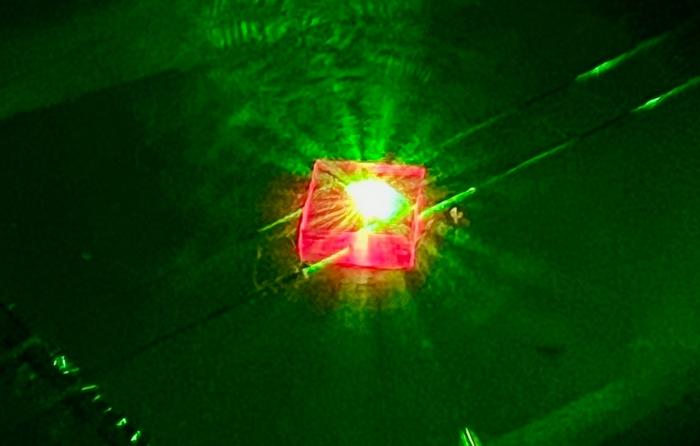
Researchers at King Abdullah University of Science and Technology (KAUST) have developed a new technology that allows digital devices to verify their identity using their own physical characteristics, potentially offering a faster and more secure alternative to conventional passwords and security keys. The work, published in Nature Electronics, addresses a growing challenge facing the digital systems that power cloud computing, artificial intelligence, and connected devices: as these networks grow, so does the need to confirm that every device communicating within them is genuine and hasn’t been copied or compromised.
A Fingerprint Made of Light
The KAUST team built a system that uses tiny laser devices to generate unique digital fingerprints. Just as no two human fingerprints are exactly alike, each laser produces its own distinctive light pattern that can be used to verify identity. The researchers then combined the technology with artificial intelligence, enabling the system to recognize and authenticate those fingerprints almost instantly.
“Every connected device needs a way to prove that it is genuine. Today this often relies on stored passwords or security keys. Our approach explores whether devices can instead identify themselves using characteristics that are inherently part of the hardware,” said Assistant Professor Yating Wan, who led the research at KAUST.
The technology could have future applications in large digital networks where millions of devices, servers, and sensors need to communicate securely, including cloud computing platforms, AI infrastructure, and connected devices used across industry and everyday life. In laboratory testing, the system generated authentication responses at extremely high speeds while consuming very little energy, suggesting it could support future computing systems where both performance and efficiency matter.
“As artificial intelligence and cloud services continue to expand, there is growing interest in new approaches to digital security that can operate at large scale. This work demonstrates how photonics and artificial intelligence can be combined to address that challenge,” Wan said. The researchers are now continuing to explore how the technology could be integrated into future computing and communications systems.
The research was published in Nature Electronics.

Leave a Reply