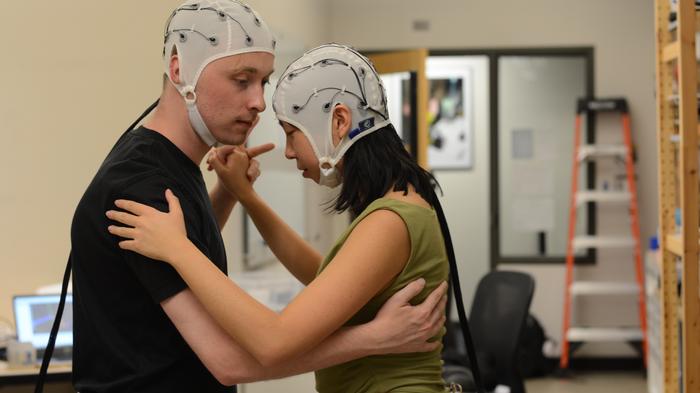
Scientists at the University of Colorado Boulder have discovered something that experienced ballroom dancers have long known: When dancers are in tune with each other, their brains may sync up, helping them move as one.
“When we dance, our brains are actually coupling,” said Thiago Roque, a graduate student in the Atlas Institute who led the study. “We are synchronizing our brains through our behavior.”
For the unique experiment, the researchers placed electroencephalogram (EEG) caps, or devices that measure electrical activity in the brain, on pairs doing the Argentine Tango—a sensuous dance where a leader and follower hold each other tight while moving together to music.

The team found that when those dancers were moving together in time, the activity in their brains also began to look startling similar. Scientists call that phenomenon “interbrain coupling” or “neural synchronization.” Researchers have seen similar patterns in other social activities, such as playing duets on the guitar, but never before in dancing.
Roque presented the group’s results in March at the 20th International Conference on Tangible, Embedded and Embodied Interaction in Chicago.
The researchers also took their findings one step further, designing a wearable device that monitors dancers’ brains and vibrates when they sync up.
The tool, which dancers wear on their wrists, is still in its early stages. But Roque envisions that similar technologies could one day help people learn a wide range of tasks that require humans to coordinate without speaking—such as playing music or team sports.
“When we are performing, we aren’t conscious of this sort of synchronization,” Roque said. “My goal was to bring unconscious things to the conscious level.”
Shall we dance?
Ruojia Sun knows all about that kind of unconscious communication. She took part in the new study both as a researcher and co-author and as one of the dancers.
Sun started tangoing when she moved to Boulder five years ago. Unlike many other types of dances, the tango is rarely choreographed — dancers usually improvise their steps in the moment. Pairs signal their next moves through subtle signs like a light compression of the hands or a shift in the upper body.
“I wound up loving so many aspects of it,” said Sun, who earned a master’s degree in creative technology and design at CU Boulder in 2024. “It’s a really interesting way to connect with another human being.”
To explore that connection, Roque brought five pairs of experienced tango dancers, including Sun and her long-time dance partner, into the lab. In addition to the EEG caps, the pairs wore movement sensors on their ankles so that the research team could track their steps.
Then, the dancers began to tango.
Riding the wave
When neurons fire in the brain, they create pulses of electrical activity, or “brainwaves.” EEG sensors measure those waves at different frequencies. Humans, for example, tend to produce fast pulses known as beta waves when they are concentrating or thinking hard. In contrast, they often generate slower, theta waves, when they’re relaxing.
Roque noted that how those waves behaved in the experiment depended on how in-step the dancers were with each other.
When a leader, for example, took a step forward and the follower took an immediate (within 200 milliseconds or less) step back, their brain waves tended to match up—rising and falling at about the same time. When their steps weren’t in sync, neither were their brains. Those trends were true for a range of brain waves, including beta and theta waves.
“When I started seeing the results—they were perfect,” Roque said. “The coupling was even better than I expected.”
Other co-authors of the new study included Grace Leslie, associate professor at ATLAS and the College of Music, and Ellen Do, professor at ATLAS and the Department of Computer Science.
From dancing to cycling
He and his colleagues wondered if a wearable device could enhance that experience of synchrony.
Sun tried out the team’s biofeedback device with her tango partner. The tool buzzed at all times but vibrated vigorously when the pair’s brain waves lined up. Sun noted that the buzzing was distracting when she and her partner weren’t in sync. But when they were, it just felt right.
“It almost enhanced that feeling of connection,” Sun said.
Roque still has a lot of work to do before dancers, or anyone else, can wear that kind of device in the real world. For a start, he’d like to flip the settings—making the wrist device buzz when dancers aren’t in tune with each other and go silent when they’re synchronizing.
He believes that technologies that make unconscious signals conscious could help humans learn and understand each other’s behavior—including during collective sports like soccer, cycling and more.
“In sports, you need to know what your teammates are going to do,” he said. “By using a system like this, they may be able to better learn how to understand each other during training.”
IMAGE CREDIT: The ATLAS Institute/CU Boulder


Leave a Reply