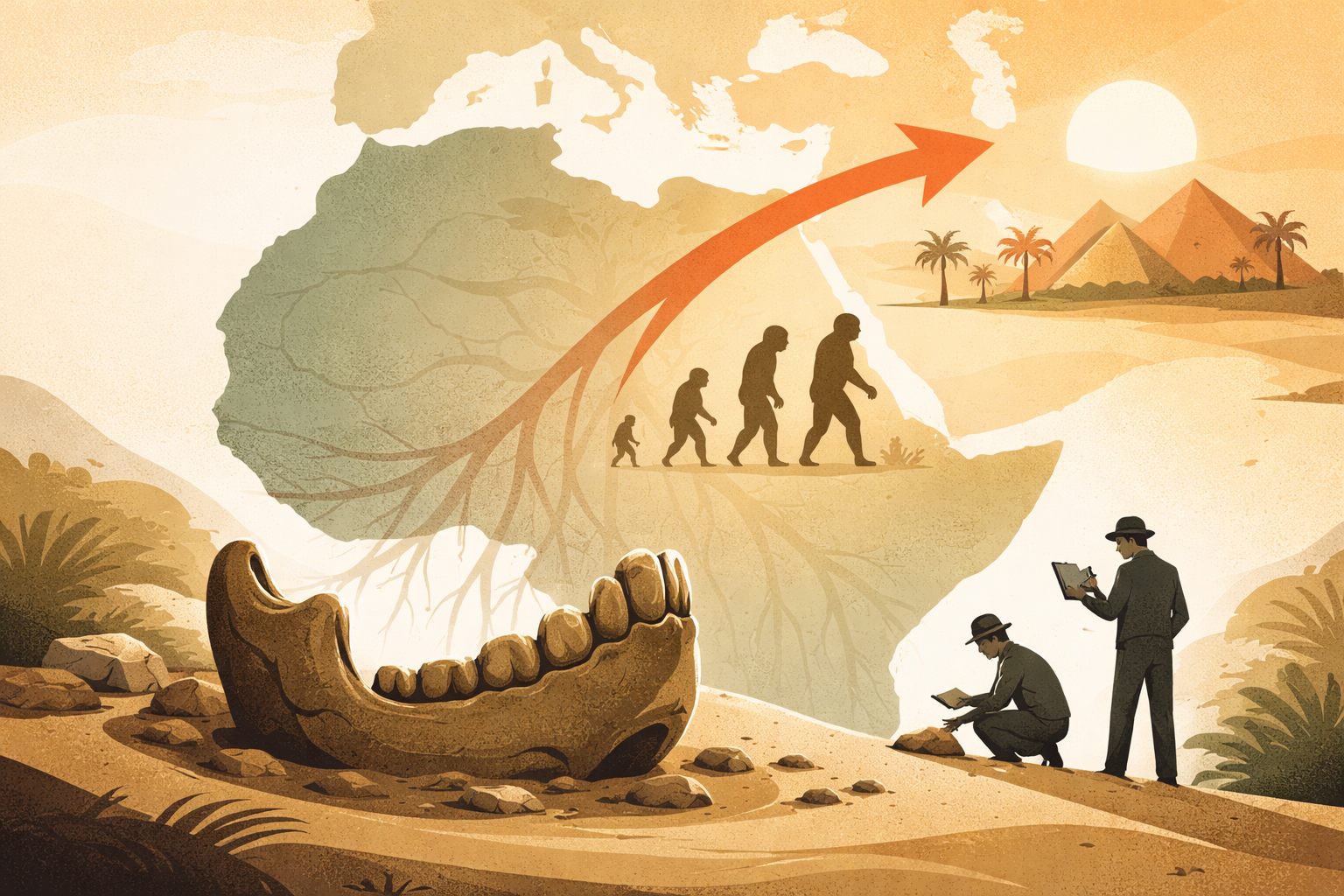
Spain’s Stegosaurs Get a Major Recount: A new Palaeontologia Electronica paper revisits eastern Spain’s stegosaur record and finds it richer and messier than the old picture suggested. The study examines material from nine fossil sites in the Villar del Arzobispo Formation and assigns specimens to broader groups such as Stegosauria indet., Neostegosauria indet., and Dacentrurinae indet., while also reassessing older historical material scattered across collections. That may sound taxonomically cautious, but it matters: the work expands the known Late Jurassic stegosaur record in Iberia without forcing fragmentary fossils into overly specific names. In practical terms, it strengthens the case that eastern Spain was a more important stegosaur-bearing region than the literature once reflected, and it shows how much paleontology still depends on museum detective work as well as field discovery. (Palaeo Electronica)
The Oldest Known Crinoid Larva: One of the week’s quieter but genuinely important paleontology stories comes from Ontario, where researchers describe the geologically oldest known crinoid pentacrinoid larva. The fossil, from the Ordovician Verulam Formation, is tiny, just over 4 millimeters tall, with an aboral cup only about 1.3 millimeters high. Its importance lies not in size but in developmental biology. Larval and juvenile stages are rarely preserved, which means paleontologists usually reconstruct extinct life histories from adults alone. This specimen provides a rare window into early crinoid ontogeny and suggests major morphological change occurred between the larval and adult forms, since it does not match known local adult crinoids in all details. It is a reminder that evolutionary history is partly hidden in life stages we almost never fossilize. (Cambridge University Press & Assessment)

Why Some Ichthyosaurs Stayed So Stunningly 3D: Exceptional preservation always tempts romantic language, but this week’s ichthyosaur paper delivers something better: mechanism. In Communications Earth & Environment, researchers studying a 183-million-year-old marine reptile from Germany’s Posidonia Shale argue that its three-dimensional preservation depended on a chemical and microbial balancing act. The surrounding setting was strongly oxygen-poor, but the fossil itself recorded distinct redox microenvironments. Sulfate-reducing bacteria helped generate carbonate concretions, while sulfur-oxidizing bacteria may have contributed to mineral infilling within the bones. In other words, the fossil was preserved not simply because decay stopped, but because decay chemistry and early mineralization interacted in just the right way. That is significant beyond one specimen: it refines how paleontologists think about Konservat-Lagerstätten and the conditions needed for spectacular fossils to survive deep time. (Nature)
Korea’s Tiny Fossil Eggs Fill a Big Gap: South Korea has yielded abundant dinosaur footprints, nests, and eggs, but direct body evidence for bird-line dinosaurs has been comparatively scarce. A new report highlighted by Phys.org says tiny fossil eggs from Aphae Island now help close that gap. The eggs, assigned to Onggwanoolithus aphaedoensis, are presented as the first known bird-type dinosaur eggs from Cretaceous South Korea. The site also includes four other kinds of theropod eggs, suggesting a diverse nesting ground rather than a one-off curiosity. The broader importance is contextual: these delicate eggshells offer physical confirmation that bird-like dinosaurs were part of the same ecosystem responsible for the region’s rich track record. Paleontology often advances by connecting traces to bodies, and here eggs may be doing some of that long-delayed bridging work. (Phys.org)
An Ice Age Cave Beneath Central Texas: A University of Texas-led study of Bender’s Cave in Comal County reports fossils that may open a new window onto Central Texas during the last interglacial, roughly 100,000 years ago. Paleontologist John Moretti found remains from a giant tortoise and a pampathere, along with many other fossils, while snorkeling through an underground stream in what appears to be the first paleontological study of a Texas water cave. That alone is vivid. More important, the fauna may represent an interval and ecosystem not previously documented in the region despite decades of work. Statistical comparison links the assemblage more closely with other interglacial Texas sites than with the better-known younger Central Texas record. If that interpretation holds, the cave is not just a fossil cache; it is evidence that this region once hosted a significantly different animal community and landscape. (Jackson School of Geosciences)
Oldest Dog DNA Rewrites Early Domestication Timing: Two new ancient-DNA studies are pushing dog history deeper into the Ice Age. The oldest genetically identified dog now comes from Pınarbaşı in present-day Turkey and dates to about 15,800 years ago, while the broader genomic picture suggests dogs were already widespread across western Eurasia by at least 14,000 years ago. That matters because dog domestication has long been argued over in terms of place, timing, and whether it happened once or more than once. These new results do not end that debate, but they decisively strengthen the case that early dogs were already established companions of hunter-gatherers well before agriculture. The studies also imply that dog-wolf divergence likely began substantially earlier, perhaps before 24,000 years ago. The headline is simple: the human-dog partnership looks older, broader, and more culturally embedded than previously confirmed. (Science News)
Astronomers Catch a Solar System in the Act: Planet formation is usually reconstructed after the fact, from mature systems or single protoplanets caught mid-growth. This week, astronomers reported something rarer: a young system called WISPIT 2, about 437 light-years away, where two gas giants appear to be forming inside a protoplanetary disk. That makes it only the second confirmed example of a baby solar system caught in this stage, after PDS 70. The newly recognized world, WISPIT 2c, joins the previously reported WISPIT 2b, and the structure of the disk hints that more protoplanets may still be lurking there. The scientific appeal is obvious. Our own solar system’s earliest stages are inaccessible except through models, so systems like WISPIT 2 act as live laboratories for understanding how giant planets carve gaps, shape disks, and emerge from stellar debris. (Scientific American)
AI Just Cleared a Peer-Review Threshold: The most unsettling technology story of the week may be the simplest to state: an AI system wrote a paper that passed peer review. As Scientific American reports, Jeff Clune and colleagues described an “AI Scientist” pipeline that can survey literature, generate hypotheses, run experiments, analyze results, and draft a manuscript. One of three AI-generated papers submitted to an ICLR 2025 workshop was accepted, though even the researchers say the output was mediocre and the workshop bar was lower than that of a flagship conference. Still, the significance is hard to miss. The issue is not that AI has already become a great scientist. It has not. The issue is scale: the system reportedly produced a formally passable paper in about 15 hours for roughly $140, raising obvious concerns about review overload, detection, and research-quality dilution. (Scientific American)
Webb and Hubble Deliver a New Saturn Benchmark: NASA’s combined Webb-Hubble release on Saturn is more than pretty astronomy. By pairing infrared data from Webb with visible-light imaging from Hubble, researchers get a layered view of Saturn’s atmosphere, rings, and moons that neither telescope could provide alone. The new release highlights bright icy rings, multiple moons, the long-lived ribbon wave, remnants of the Great Springtime Storm, and faint views of the planet’s famous hexagon. Particularly interesting are the grey-green polar emissions in Webb’s data, which may reflect high-altitude aerosols or auroral activity. NASA notes these may be among the last high-resolution looks at the north-polar hexagon until the 2040s as that region heads into prolonged winter darkness. It is a classic example of observational complementarity: one planet, two wavelengths, and a much deeper sense of atmospheric structure and seasonal change. (NASA Science)


Leave a Reply