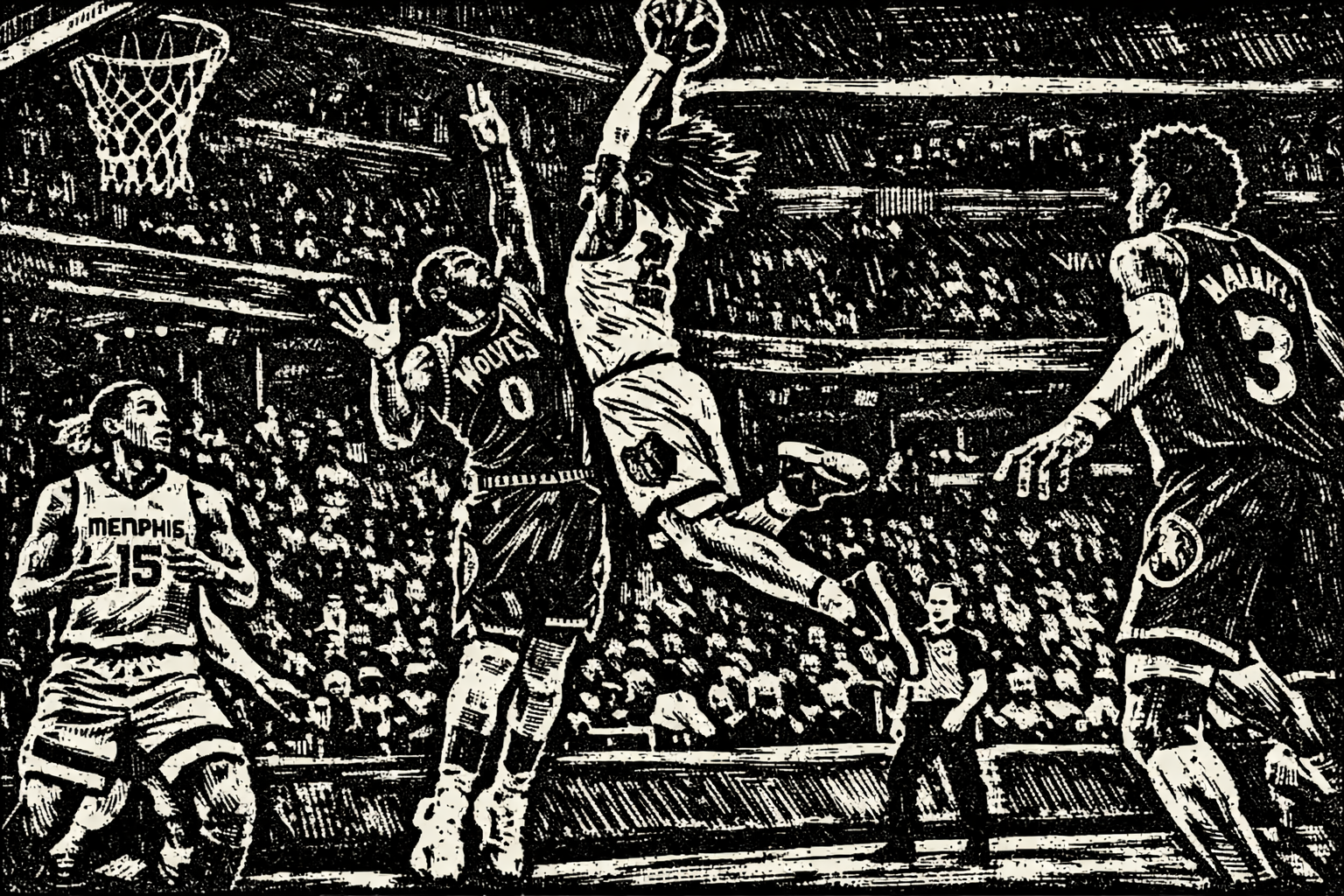
Let’s face it. If an NBA game was an adult film, the thundering, in-your-face, sky-walking-over-three-defenders would be the undisputed money shot. Even in the age of the three-point revolution (YAWN…), the dunk is the real home run, despite early American Basketball Association announcers calling the three a “home run”.
Chicks may dig the long ball but everybody adores the dunk. It’s that simple.
When we talk about dunks, our instincts take over and we tend to know a good one the moment it happens. Two things stand out – style and power. While the wonderful minds in the scientific community haven’t quite figured out how to quantify style, they’ve figured out the elements of the power dunk a long time ago (even before the dunk existed). In its simplest distillation, the power dunk entails the storing energy as Potential Energy (PE) when loading up for the dunk — so that’s right before the jump and pulling the ball back before driving it through the hoop — and then releasing the stored up PE into pure Kinetic Energy during the final, scintillating moments of the jam.
But here’s what’s interesting. If we put together a Kinetic Dunk Power Rankings for the top NBA slams, it would be a far cry from the kind of Power Rankings you’re used to. In fact, we doubt you’ve ever seen anything like it. It would also differ from the NBA’s own Slam Dunk ratings. We actually measure the actual “Power” in Power Rankings.
In order to calculate the Kinetic Power in a dunk, we basically did two things. Calculated the player’s KE as he hurtled through the air and the KE of the ball being stuffed at the end. Thankfully, physics and the NBA supplied all the necessary variables to make this possible. From the NBA statistics standpoint, the factors that matter most were vertical jump distance, takeoff distance, hang time, and ball speed at dunk.
So just to be clear, that is Player KE + Ball KE = Total Dunk KE.
We have listed the Top 10 slam dunks in the order the NBA Dunk Score Leaderboard, not according to our KE calculations. At the very end, we’ll revamp the Top 10.
JUSTIN CHAMPAGNIE: 2,060J + 55J = 2,115J
SHAEDON SHARPE: 1,467J + 152J = 1,619J
JALEN SMITH: 1,212J + 169J = 1,382J
ONYEKA OKONGWU: 1,778J + 259J = 2,037J
ZION WILLIAMSON: 1,718J + 245J = 1,963J
MATAS BUZELIS: 1,651J + 201J = 1,852J
WALTER CLAYTON JR.: 1,676J + 40J = 1,716J
JADEN McDANIELS: 1,551J + 286J = 1,838J
BRANDON INGRAM: 1,734J + 234J = 1,968J
BRANDON MILLER: 1,814J + 234J = 2,049J
Adjusting the NBA Dunk Score Top 10 according to Kinetic Energy Dunks gives us this adjusted leaderboard:
1. Justin Champagnie — 2,115
2. Brandon Miller — 2,049
3. Onyeka Okongwu — 2,037
4. Brandon Ingram — 1,968
5. Zion Williamson — 1,963
6. Matas Buzelis — 1,852
7. Jaden McDaniels — 1,838
8. Walter Clayton Jr. — 1,716
9. Shaedon Sharpe — 1,619
10. Jalen Smith — 1,382
As interesting as this is, it’s not the final ultimate adjustment because ball speed plays an interesting role in determining a dunk’s KE and the hands down champion when it comes to dunk speed isn’t even on our list.
But that’s an analysis for next time.
WORDS: Marc Landas




Leave a Reply