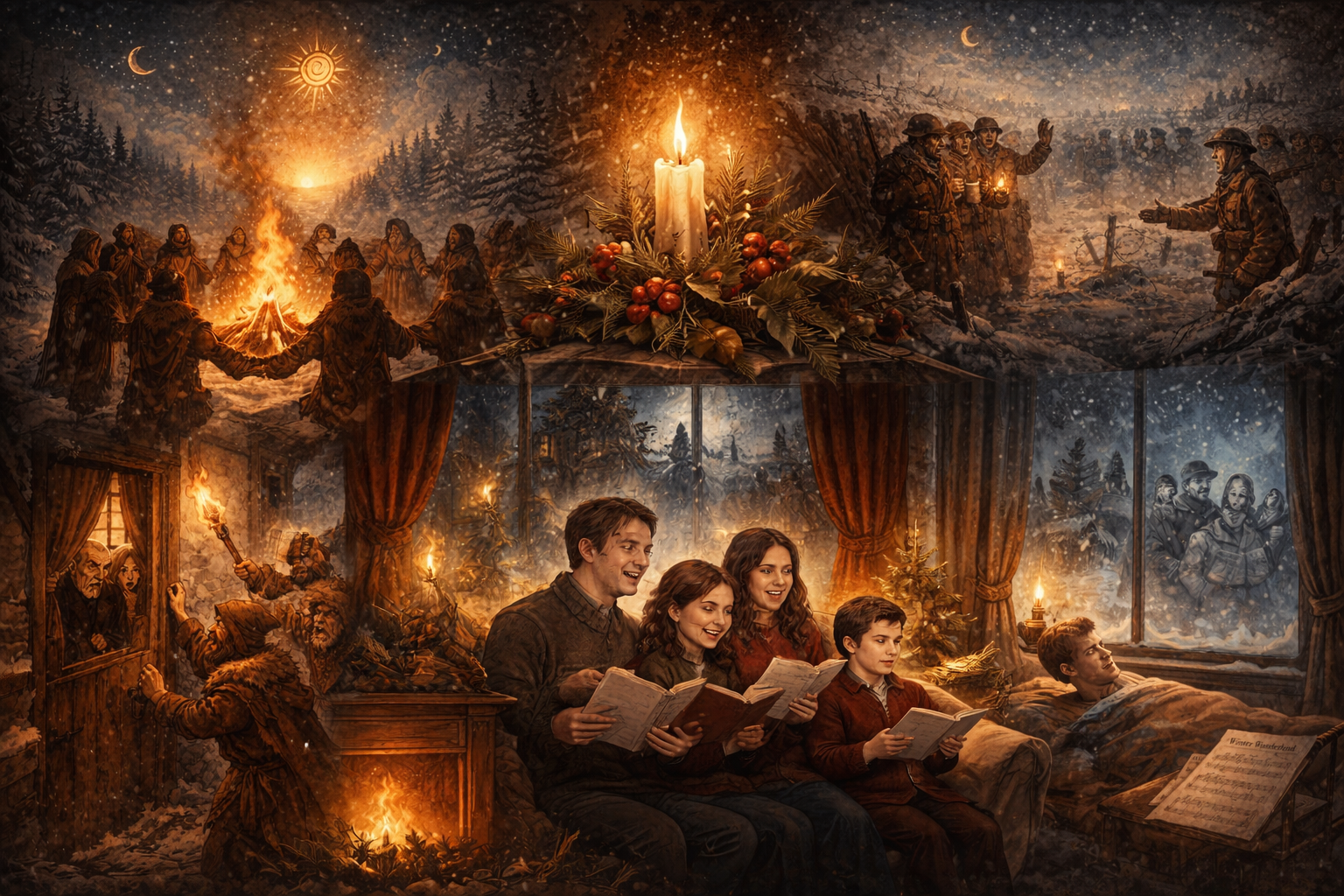
As the holiday season wraps us in its cozy embrace, with twinkling lights adorning homes and the scent of pine filling the air, families gather to sing timeless Christmas carols. These melodies evoke joy and nostalgia, yet beneath their cheerful notes lies a shadowy past. From ancient pagan rituals celebrating the sun’s return to compositions born amid devastating plagues and brutal wars, the history of Christmas carols reveals a tapestry of human resilience, cultural adaptation, and dark undertones. This evolution reflects how societies have repurposed music to cope with hardship, blending spiritual solace with communal bonding.
The roots of Christmas carols stretch back to pre-Christian Europe, where pagan communities marked the winter solstice with chants and circle dances. The solstice, occurring around December 21, is the shortest day of the year in the Northern Hemisphere, a phenomenon caused by Earth’s axial tilt of about 23.5 degrees, which results in minimal sunlight exposure. Pagans viewed this as a pivotal moment symbolizing the rebirth of light and life, crucial for agricultural cycles as it heralded longer days for planting.

Songs were sung around fires to invoke fertility and ward off winter’s harshness, fostering social cohesion through rhythmic group activities. As Christianity spread, early leaders co-opted these traditions to ease conversion. In 129 A.D., a Roman bishop decreed that a hymn called “Angels Hymn” be sung at Christmas services, replacing pagan tunes with Christian lyrics. This syncretism, a process anthropologists describe as cultural diffusion—where beliefs merge to reduce resistance—allowed carols to evolve from solstice chants into Nativity celebrations.
“The idea of carolling originally had little to do with religion or Christmas. It was a communal activity, uniting people in song and movement to keep warm and raise spirits through the cold and bleak winter months,” notes music historian Andrew Green in his exploration of holiday music.

By the Middle Ages, carols had become lively folk songs, but their practice turned debaucherous. Groups of wassailers roamed door-to-door, demanding food and ale in exchange for songs, sometimes escalating to threats of violence or property damage if refused. Lyrics from the era, such as “We’ve come here to claim our right/And if you don’t open up your door/We’ll lay it flat upon the floor,” highlight this rowdy side. Puritans in 17th-century England, viewing such revelry as pagan excess tied to Saturnalia—a Roman festival of role reversal and hedonism—banned Christmas altogether in 1647.
A contemporary tract decried the holiday as “the old Heathen’s Feasting Day, in honour to Saturn their Idol-God, the Papist’s Massing Day, the Profane Man’s Ranting Day.” Professor Ronald Hutton, a historian of British folklore, explains that these dances eventually faded as “people just got bored with it,” paving the way for more structured hymns. This shift underscores evolutionary psychology’s role in rituals: music strengthens group bonds during uncertain times, but societal norms curb excesses for stability.

Even darker chapters emerged during periods of disease and strife. In the 1930s, amid tuberculosis outbreaks—often called the “white plague” for its pale victims—Richard Smith penned “Winter Wonderland” while confined to a Pennsylvania sanitarium. Tuberculosis, caused by the bacterium Mycobacterium tuberculosis, spreads via airborne droplets and ravaged populations before antibiotics, killing up to 25% of infected individuals through lung destruction and systemic failure.
Smith’s lyrics, evoking snowy escapism, were a poignant escape from his illness; he died at 34 the following year. Earlier, the 16th-century “Coventry Carol” lamented the biblical Massacre of the Innocents, its haunting melody reflecting plague-era grief in England, where bubonic outbreaks like the 1665 Great Plague claimed 100,000 lives. As ethnomusicologist Virginia Wyatt observes, “Caroling dates to the earliest days of Christianity,” but in hard times, it served as catharsis, with songs channeling collective mourning into shared expression.

World wars infused carols with wartime melancholy. During World War I’s 1914 Christmas Truce, soldiers from opposing trenches sang “Silent Night,” composed in 1818 amid post-Napoleonic austerity. The carol’s plea for peace resonated as troops ceased fire, exchanging gifts across no-man’s-land—a brief reprieve in a conflict that killed millions through trench warfare and disease.
In World War II, “White Christmas” by Irving Berlin captured homesick soldiers’ longing; Berlin, who lost his infant son on Christmas 1928, imbued it with sorrow. Bing Crosby performed it for troops, though he hesitated, noting, “I didn’t come that far to make them sad.”

Similarly, “Have Yourself a Merry Little Christmas,” written in 1944, originally featured bleak lines like “Have yourself a merry little Christmas / It may be your last,” mirroring wartime uncertainty.
Composer Hugh Martin recalled producers requesting an upbeat revision: “It’s a sad scene, but we want a sort of upbeat song, which will make it even sadder if she’s smiling through her tears.” Psychologically, such music aids trauma processing, releasing endorphins to foster hope amid despair.
Today, these carols endure, their dark origins softened by time yet reminding us of humanity’s capacity to find light in shadows. As we sing this holiday season, we honor a legacy forged in ritual, plague, and war—a testament to music’s enduring power.
Endnotes:
- Andrew Green, “A history of Christmas carols,” The History Press, 2016.
- Percy Dearmer, quoted in “The Surprising History of Christmas Carols,” The Walrus, December 20, 2022.
- Ronald Hutton, quoted in “A brief history of Christmas carols,” English Heritage.
- Virginia Wyatt, quoted in “Music expert shares the appealing history of Christmas carols,” Virginia Tech News, December 5, 2025.
- “The backstories of our most loved Christmas songs,” Hudson Valley One, December 10, 2022.
- Hugh Martin, quoted in “The Surprising History Behind Your Favorite Christmas Carols,” Reader’s Digest, September 23, 2024.
- Bing Crosby, quoted in “The Surprising History Behind Your Favorite Christmas Carols,” Reader’s Digest, September 23, 2024.
- “History of Christmas,” History.com.
- “A Brief History Of Christmas Carols: From Pagan Chants To Festive Hymns,” Superlocrian, December 8, 2024.
- 1656 political tract, quoted in “The Surprising History of Christmas Carols,” The Walrus, December 20, 2022.


Leave a Reply