Our galaxy’s most abundant type of planet could be rich in liquid water due to formative interactions between magma oceans and primitive atmospheres during their early years, according to new research published in Nature by Carnegie’s Francesca Miozzi and Anat Shahar.
Of the more than 6,000 known exoplanets in the Milky Way, so-called Sub-Neptunes are the most common. They are smaller than Neptune and more massive than Earth and believed to have rocky interiors with thick hydrogen-dominated atmospheres.
This makes them good candidates for testing ideas about how rocky planets, like our own, acquired an abundance of water—which was critical for the rise of life on Earth and is considered a fundamental component of planetary habitability.
“Our rapidly increasing knowledge about the vast diversity of exoplanets has enabled us to envision new details about the earliest stages of rocky planet formation and evolution,” Miozzi explained. “This opened the door to considering a new source for planetary water supplies—a long-debated mystery among Earth and planetary scientists—but experiments designed with this purpose in mind were absent.”
This work is part of the interdisciplinary, multi-institution AEThER (Atmospheric Empirical, Theoretical, and Experimental Research) project, which was founded and is led by Shahar. Funded by the Alfred P. Sloan Foundation, the initiative combines expertise across a diversity of fields—including astronomy, cosmochemistry, planetary dynamics, petrology, mineral physics, and more—to answer fundamental questions about the characteristics that enable rocky planets to develop favorable conditions for hosting life. Their work has a particular focus on attempting to link observations of planetary atmospheres to the evolution and dynamics of their rocky bodies.
Previous mathematical modeling research has demonstrated that interactions between atmospheric hydrogen and iron-bearing magma oceans during planet formation can produce significant quantities of water. However, comprehensive experimental tests of this proposed source of planetary water had not been performed until now.

Miozzi and Shahar led an international team of researchers from the Institut de Physique du Globe de Paris (IPGP) and UCLA to create the conditions under which such interactions between hydrogen—representing the early planetary atmosphere—and iron-rich silica melt—representing the formative magma ocean—would occur in a young planet. They accomplished this by compressing samples up to nearly 600,000 times atmospheric pressure (60 gigapascals) and heating them to over 4,000 degrees Celsius (7,200 degrees Fahrenheit).
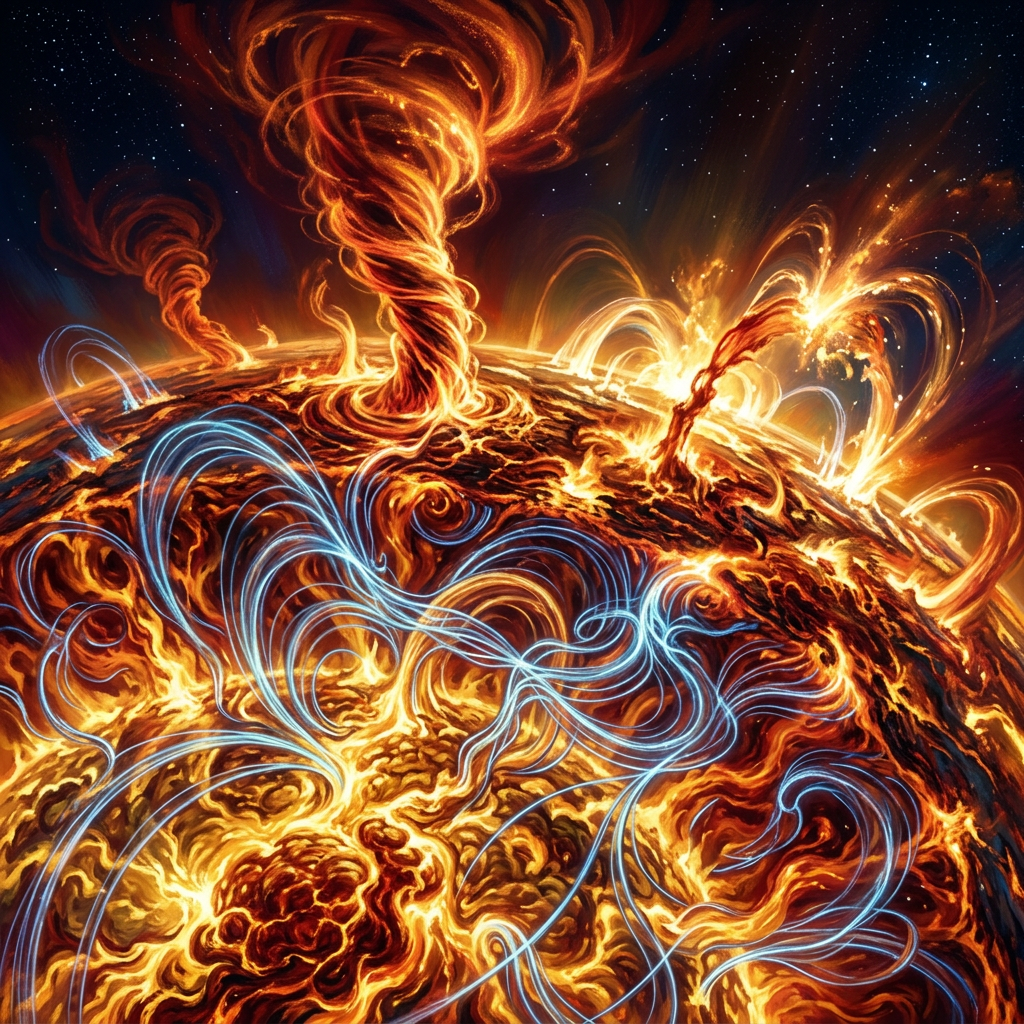
Their experimental environment mimics a critical phase of the rocky planet evolutionary process. Such bodies are formed from the disk of dust and gas that surrounds a young star in the period after its birth. This material accretes into bodies which crash into each other and grow larger and hotter, eventually melting into a vast magma ocean. These young planets are often surrounded by a thick envelope of molecular hydrogen, H2, which can act like a “thermal blanket,” maintaining the magma ocean for billions of years before it cools.
“Our work provided the first experimental evidence of two critical processes from early planetary evolution,” Miozzi indicated. “We showed that a copious amount of hydrogen is dissolved into the melt and significant quantities of water are created by iron-oxide reduction by molecular hydrogen.”
Taken together, these findings demonstrate that large amounts of hydrogen can be stored in the magma ocean while water formation is occurring. This has major implications for the physical and chemical properties of the planet’s interior, with potential effects also on core development and atmospheric composition.
“The presence of liquid water is considered critical for planetary habitability,” Shahar concluded. “This work demonstrates that large quantities of water are created as a natural consequence of planet formation. It represents a major step forward in how we think about the search for distant worlds capable of hosting life.”
IMAGE CREDIT: Navid Marvi/Carnegie Science.



Leave a Reply