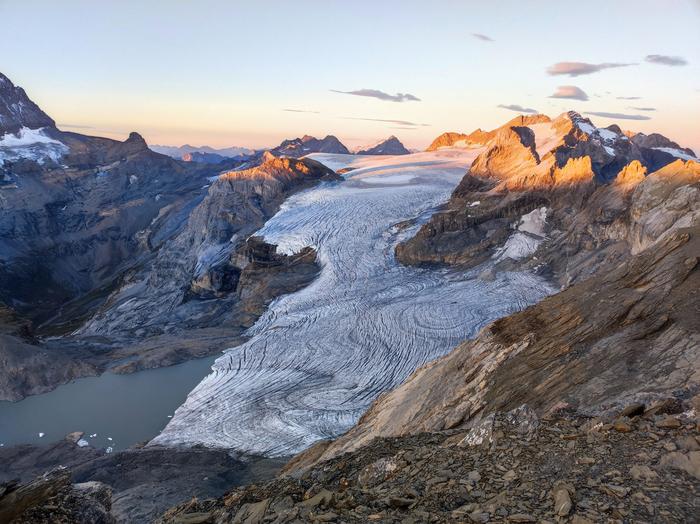
Even the United Nations International Year of Glaciers’ Preservation has seen further massive melting of glaciers in Switzerland. A winter with little snow was followed by heat waves in June 2025 that saw glaciers nearing the record levels of losses of 2022. Snow reserves from the winter were already depleted in the first half of July, and the ice masses began to melt earlier than had rarely ever been recorded. The cool weather in July provided some relief and prevented an even worse outcome. Nevertheless, almost a further three per cent of the ice volume was lost across Switzerland this year, and this is the fourth greatest shrinkage after the years 2022, 2023 and 2003. 2025 therefore importantly contributed to the decade with the most rapid ice loss. Glaciers all over Switzerland have lost a quarter of their volume since 2015. Over 1,000 small glaciers have already disappeared.
In particular, glaciers from the winter disappeared there up to the summit level. As a consequence, the ice thickness on, for example, the Claridenfirn (Canton of Glarus), the Plaine Morte Glacier (Canton of Bern) and the Silvretta Glacier (Canton of the Grisons) reduced by over two metres. For glaciers in the southern Canton of Valais, such as the Allalin Glacier or Findel Glacier, the loss was less at around one metre.
In the winter of 2024/2025, the combination of less precipitation and the third warmest six months of winter (October to March) since measurements began led to very low snow depths. For example, less fresh snow fell in parts of the northern and central Grisons than ever before. For this reason, around 13 per cent less snow was evident on the glaciers at the end of April when compared to the period from 2010 to 2020. The second warmest June since records began led to rapid melting of
snow right up to the highest altitudes. Following a somewhat cool and damp July, August brought a heatwave with a high zero-degree line recorded in part at over 5,000 metres. In combination, this weather led to above-average temperatures in the summer. Between July and September, a few cold fronts resulted to individual days with fresh snow over 2,500 m above sea level, but this only remained for longer periods in high mountains.
“The continuous diminishing of glaciers also contributes to the destabilising of mountains,” says Matthias Huss, Director of GLAMOS. “This can lead to events such as in the Lötschental valley where an avalanche of rock and ice buried the village of Blatten.”
Sign up for the Daily Dose Newsletter and get every morning’s best science news from around the web delivered straight to your inbox? It’s easy like Sunday morning.
COPY III
IMAGE CREDIT: Matthias Huss / VAW / ETH Zurich.




Leave a Reply