While the early Mars climate remains an open question, a new study suggests its atmosphere may have been hospitable to life due to volcanic activity which emitted sulfur gases that contributed to a greenhouse warming effect.
This finding comes from a study published in Science Advances, led by researchers at The University of Texas at Austin.
Using data from the composition of Martian meteorites, the researchers ran more than 40 computer simulations with varied temperatures, concentrations, and chemistry to estimate how much carbon, nitrogen, and sulfide gases may have been emitted on early Mars.
Instead of the high concentrations of sulfur dioxide (SO₂) that previous Mars climate models predicted, their research shows volcanic activity on Mars around 3-4 billion years ago may have led to high concentrations of a range of chemically “reduced” forms of sulfur – which are highly reactive. This includes sodium sulfide (H₂S), disulfur (S₂) and possibly sulfur hexafluoride (SF6) – an extremely potent greenhouse gas.
According to lead author Lucia Bellino, a doctoral student at the UT Jackson School of Geosciences, this may have made for a unique Martian environment – one that may have been hospitable to certain forms of life.
“The presence of reduced sulfur may have induced a hazy environment which led to the formation of greenhouse gases, such as SF6, that trap heat and liquid water,” said Bellino. “The degassed sulfur species and redox conditions are also found in hydrothermal systems on Earth that sustain diverse microbial life.”
Sign up for the Daily Dose Newsletter and get every morning’s best science news from around the web delivered straight to your inbox? It’s easy like Sunday morning.
Previous Mars studies have researched how the release of gases at the surface, often through volcanic eruptions, may have impacted the planet’s atmosphere. In contrast, this study simulated how sulfur changed as it moved throughout geologic processes, including how it separated from other minerals as it was incorporated into magma layers below the planet’s crust. This is important because it gives a more realistic sense of the chemical state of the gas before it’s released at the surface where it can shape the early climate conditions of Mars.
The study also revealed that sulfur may have been frequently changing forms. While Martian meteorites have high concentrations of reduced sulfur, the Martian surface contains sulfur that’s chemically bonded to oxygen.
“This indicates that sulfur cycling – the transition of sulfur to different forms – may have been a dominant process occurring on early Mars,” said Bellino.
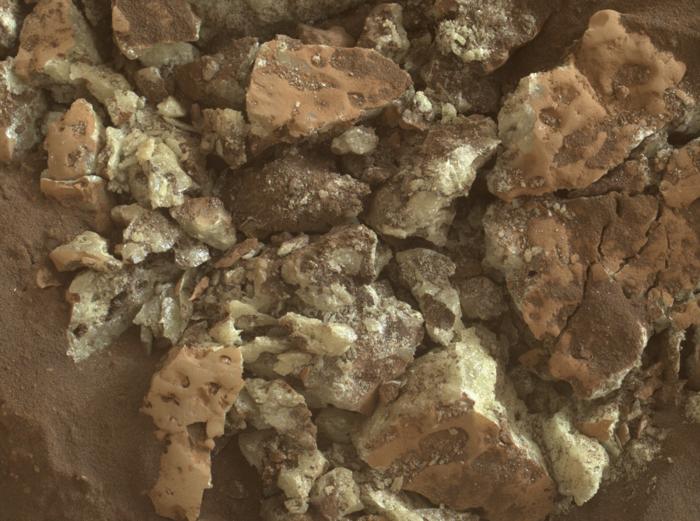
Last year, while the team was in the midst of its research, NASA made a discovery that seemed to back their findings. NASA’s Curiosity Mars rover rolled over and cracked open a rock, revealing elemental sulfur. While Mars is known for being rich in sulfurous minerals, it was the first time the mineral had been found in pure form, unbound to oxygen.
“We were very excited to see the news from NASA and a large outcrop of elemental sulfur,” said Chenguang Sun, Bellino’s advisor and an assistant professor at the Jackson School’s Department of Earth and Planetary Sciences. “One of the key takeaways from our research is that as S₂ was emitted, it would precipitate as elemental sulfur. When we started working on this project, there were no such known observations.”
As the team moves forward, they will use their computer simulations to investigate other processes that would have been essential to sustain life on Mars, including the source of water on early Mars, and whether volcanic activity could have provided a large reservoir of water on the planet’s surface. They also seek to understand whether the reduced forms of sulfur may have served as a food source for microbes in an early climate that resembled Earth’s hydrothermal systems.
Mars is far from the Sun, and today, it’s typically cold with an average temperature of -80 degrees Fahrenheit. Bellino hopes that climate modeling experts can use her team’s research to predict how warm the early Mars climate might have been, and, if microbes were present, how long they could have existed in a warmer atmosphere.
IMAGE CREDIT: NASA.
Leave a Reply