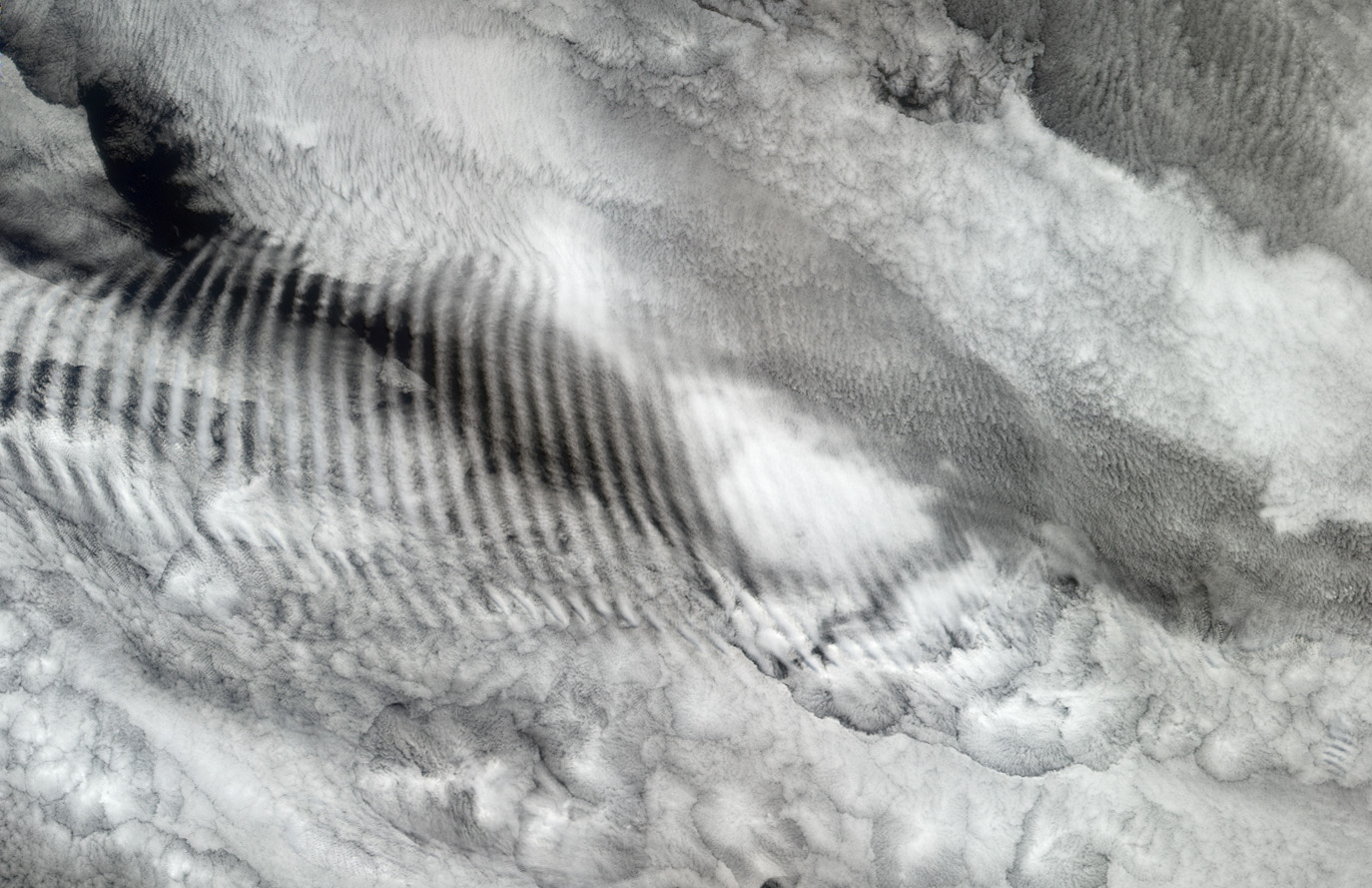

Above Earth’s oceans, the sky can ripple like a pond. This image reveals atmospheric gravity waves—large-scale undulations triggered when stratified air is disturbed by an underlying force, such as an island, thunderstorm updraft, or frontal boundary. As the air mass resists displacement, it oscillates vertically, creating waves that perturb the cloud deck in elegant, fingerprint-like patterns visible from space.
The image combines data from the MISR (Multi-angle Imaging SpectroRadiometer) aboard NASA’s Terra satellite. MISR captures sunlight reflected at multiple angles, enabling visualization of subtle cloud structures and shadows. Here, the marine stratocumulus layer—a common oceanic cloud type—provides a textured backdrop in which gravity waves are strikingly highlighted. These clouds typically indicate sinking air and cooler conditions, making them perfect canvases for observing atmospheric ripples.
Why do gravity waves matter? They act as conduits for energy and momentum between atmospheric layers, affecting everything from lower tropospheric turbulence to circulation in the upper atmosphere. Waves like these modulate weather, influence cloud formation, and even guide the propagation of long-range radio waves and satellite trajectories. For climate scientists, gravity waves are essential for models of Earth’s atmospheric dynamics, as they bridge processes from the ocean surface to high-altitude winds.
From a planetary perspective, these waves also remind us of Earth’s fluid nature. Like stones dropped into water, the atmosphere—though invisible—is equally responsive to disturbances, and its patterns translate the interplay of wind, water, heat, and topography into beautiful, scientific order.


Leave a Reply